- English
- French
- German
- Portuguese
- Spanish
- Russian
- Japanese
- Korean
- Arabic
- Greek
- German
- Turkish
- Italian
- Danish
- Romanian
- Indonesian
- Czech
- Afrikaans
- Swedish
- Polish
- Basque
- Catalan
- Esperanto
- Hindi
- Lao
- Albanian
- Amharic
- Armenian
- Azerbaijani
- Belarusian
- Bengali
- Bosnian
- Bulgarian
- Cebuano
- Chichewa
- Corsican
- Croatian
- Dutch
- Estonian
- Filipino
- Finnish
- Frisian
- Galician
- Georgian
- Gujarati
- Haitian
- Hausa
- Hawaiian
- Hebrew
- Hmong
- Hungarian
- Icelandic
- Igbo
- Javanese
- Kannada
- Kazakh
- Khmer
- Kurdish
- Kyrgyz
- Latin
- Latvian
- Lithuanian
- Luxembou..
- Macedonian
- Malagasy
- Malay
- Malayalam
- Maltese
- Maori
- Marathi
- Mongolian
- Burmese
- Nepali
- Norwegian
- Pashto
- Persian
- Punjabi
- Serbian
- Sesotho
- Sinhala
- Slovak
- Slovenian
- Somali
- Samoan
- Scots Gaelic
- Shona
- Sindhi
- Sundanese
- Swahili
- Tajik
- Tamil
- Telugu
- Thai
- Ukrainian
- Urdu
- Uzbek
- Vietnamese
- Welsh
- Xhosa
- Yiddish
- Yoruba
- Zulu
MicroPython display manufacturer
Scalable MicroPython Display Solutions from a Certified Hardware Factory
Your project’s transition from a prototype to a market-ready product requires more than just a source; it demands a manufacturing partner who owns the assembly line and understands the hardware-firmware interface. When your business scales, you need the assurance of direct factory transparency to ensure consistent component quality and long-term supply stability.
Finding a reliable MicroPython display manufacturer often involves navigating a sea of resellers who lack deep technical insight into the underlying hardware. For B2B procurement managers, the risk isn't just a faulty screen; it is the uncertainty of whether a vendor can provide the engineering support needed to resolve complex SPI bus timing or memory allocation failures during mass deployment. Prototyping an HMI (Human-Machine Interface) with Python scripts is inherently fast, but moving to industrial production requires a partner who can guarantee signal integrity and heat dissipation at the silicon level.

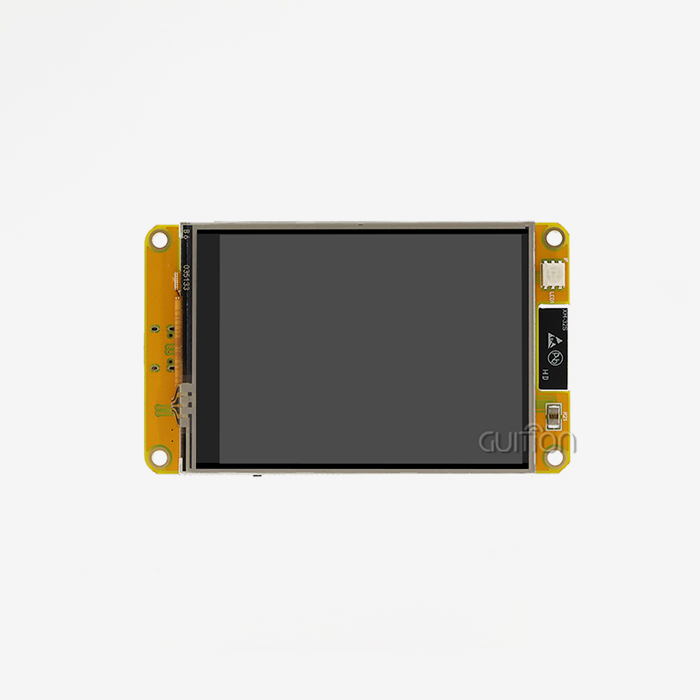
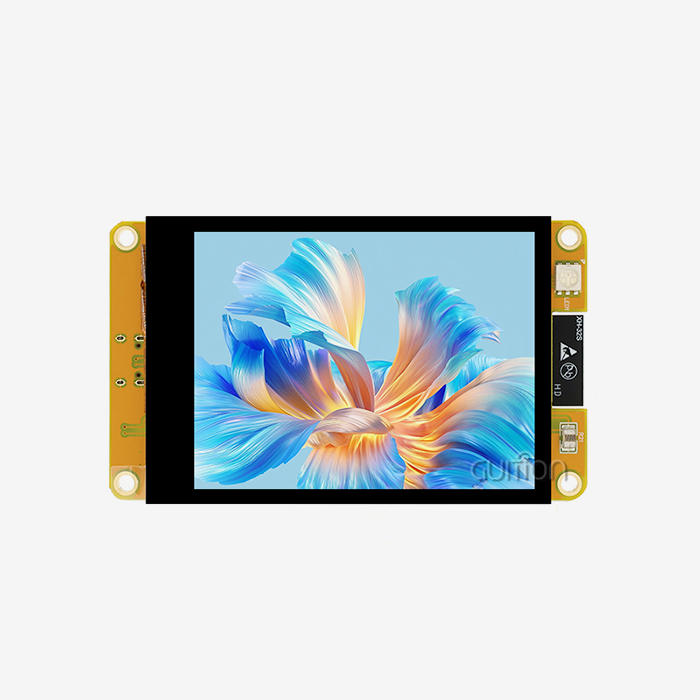
Shenzhen Jingcai Intelligent Co., Ltd. addresses these manufacturing gaps with our GUITION brand, specifically the JC4827W543N_I model. This 4.3-inch MicroPython display is engineered around the powerful ESP32-S3R8 dual-core MCU, running at 240MHz with 8MB of integrated PSRAM to prevent common heap fragmentation issues found in lower-end modules. By integrating Wi-Fi, Bluetooth, and a dedicated backlight control circuit directly into the module’s PCB, we provide a streamlined hardware architecture that supports a 480*272 resolution while maintaining full compatibility with the MicroPython ecosystem.
As a dedicated production facility, we back our manufacturing with CE, RED, and FCC certifications, ensuring every unit meets international electromagnetic compatibility and safety standards. Our quality control protocols include rigorous bus timing verification and power state logic testing to ensure the MicroPython display remains stable under continuous industrial workloads. The inclusion of a TF card interface and 10 available IO ports reflects our engineering commitment to providing an extensible embedded platform designed for professional integration.
Our production facility maintains consistent quality control protocols across all ESP32-based hardware modules to support high-volume industrial deployments.
A Certified Professional Manufacturer of High-Performance MicroPython Displays
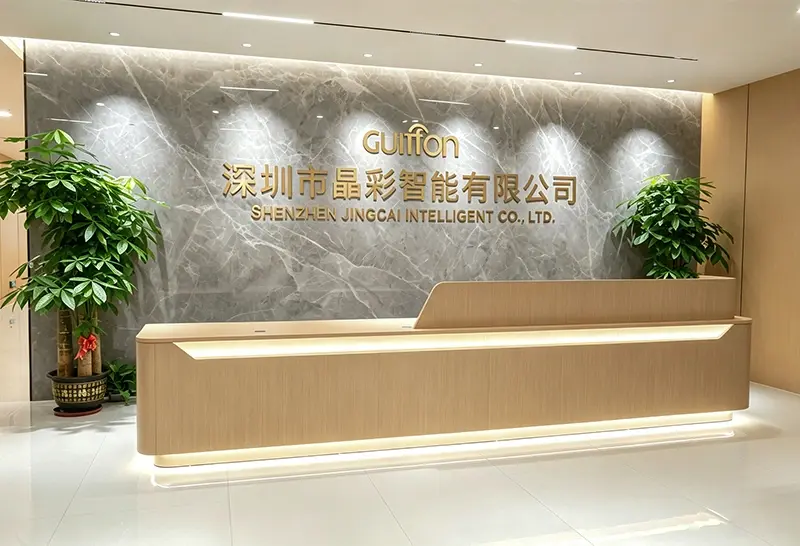
Shenzhen Jingcai Intelligent Co., Ltd. stands as a premier R&D-driven manufacturer specializing in high-integration MicroPython display modules that bridge the gap between rapid prototyping and industrial-grade reliability. We started in 2021 and have been working hard to perfect GUITION. We have focused all of our engineering resources to this brand, making sure every LCD module is produced to the strict technical requirements of our worldwide B2B procurement partners and hardware engineers.
Our core strength lies in our deep hardware-software integration capabilities. Unlike assembly-only providers, our technical team optimizes the ESP32-S3R8 dual-core architecture, delivering modules clocked at 240MHz with 8M PSRAM to specifically resolve the RAM exhaustion issues common in complex MicroPython environments. As a MicroPython display manufacturer, our flagship 4.3-inch 480 * 272 resolution displays are engineered to support versatile development ecosystems, including MicroPython, Arduino, and ESP IDE, providing the stability required for modern IoT and HMI applications.
We operate out of our own dedicated facility in Shenzhen, where we execute rigorous quality control for every manufacturing run, including checks on bus timing and signal integrity, to guaranty smooth refresh rates and 30+ FPS performance. We are CE, RED and FCC certified which means we stand behind our dedication to international compliance and that our products are manufactured to fulfill the demanding safety and interoperability criteria of the European and North American markets. With a proven track record of delivering high-performance display solutions to customers in over 30 countries, we offer the production scale and technical transparency necessary for secure supply chains. Contact our engineering team today to obtain a factory audit or full technical documentation for your next MicroPython project.
✅ Verified Manufacturer Since 2021
✅ CE, RED, FCC Certified
✅ 8M PSRAM Technical Integration
✅ Global Export Experience
✅ Direct Factory R&D Support
Professional Manufacturing for High-Performance MicroPython Display Systems

Finding a reliable hardware partner for ESP32-S3 based MicroPython projects often involves navigating inconsistent quality and fragmented technical support. Industrial developers require more than just a screen; they need verified manufacturing stability and hardware-firmware optimization. GUITION bridges this gap by integrating advanced SMT production lines with rigorous Python-specific stability testing to ensure seamless GUI deployment. As a MicroPython display manufacturer, this integrated approach minimizes hardware-software friction in mission-critical HMI applications.
- Integrated ESP32-S3 Hardware Research and Development
- Leveraging the dual-core 240MHz ESP32-S3R8 architecture, engineering teams optimize 8MB PSRAM and 4MB Flash configurations specifically for memory-intensive MicroPython environments. This proactive hardware design eliminates common heap fragmentation issues during 480*272 resolution rendering. By reserving 10 IO ports and TF card interfaces, the hardware serves as a versatile backbone for complex industrial IoT telemetry.
- View Technical Specs
- Scalable Manufacturing for Industrial-Grade LCD Modules
- Automated SMT assembly lines ensure precision placement of the 4.3-inch LCD and backlight control circuits, maintaining consistent quality across high-volume production runs. Every JC4827W543N_I unit undergoes automated optical inspection to guarantee display uniformity and electrical integrity. High-precision assembly provides the stability necessary for large-scale enterprise deployments.
- Explore Production Capacity
- Rigorous Stability Validation for Python Firmware Environments
- Quality control protocols extend beyond physical hardware to include 48-hour continuous refresh testing under MicroPython and LVGL workloads. Technicians use logic analyzers to verify SPI bus timing and signal integrity, ensuring that interpreted code executes without latency or pixel corruption. Comprehensive testing procedures confirm that modules meet demanding industrial uptime requirements.
- Check Quality Standards
10,000+ | Monthly Production Capacity
15+ | Years of HMI Hardware Expertise
100% | Factory-Level MicroPython Stability Testing
24-Hour | Rapid Prototyping and Technical Response
FAQs
1. What is your factory’s production capacity and lead time for the MicroPython display series?
GUITION operates a specialized manufacturing facility with a monthly production capacity of over 50,000 units for the JC4827W543N_I module series. For standard bulk orders, our typical lead time ranges from 15 to 25 business days, depending on the specific volume and customization requirements. As a direct manufacturer, we maintain a stable supply chain for core components, including the ESP32-S3R8 MCU and 4.3-inch LCD panels. Every batch undergoes rigorous automated optical inspection (AOI) to ensure consistent quality before shipping. Contact our sales team today to receive a formal quotation and a detailed production schedule tailored to your project.2. What certifications do you hold to verify the quality and global compliance of your MicroPython display modules?
Our MicroPython display products are fully certified with CE, RED, and FCC standards, ensuring they meet the strict regulatory requirements for the European and North American markets. These certifications validate the electromagnetic compatibility and safety of our hardware, which is essential for projects utilizing the integrated Wi-Fi and Bluetooth functions of the ESP32-S3. Beyond international labels, our factory implements an ISO9001-aligned quality management system. This process ensures full traceability for all critical components, from the 8M PSRAM to the backlight control circuits, providing B2B clients with the reliability needed for professional-grade deployments.3. How do you guarantee the hardware reliability and firmware stability of your ESP32-S3 modules?
We guarantee hardware reliability through a multi-stage verification process that includes 48-hour continuous aging tests and signal integrity checks using high-precision logic analyzers. To prevent the common "MemoryError" issues often encountered in complex MicroPython environments, our JC4827W543N_I module is engineered with 8MB of PSRAM, offering significant headroom for high-resolution 480*272 GUI assets. We specifically test the SPI bus timing to ensure it sustains peak performance without pixel corruption or lag. This rigorous testing protocol ensures that our modules remain stable in 24/7 industrial HMI applications and environmental monitoring nodes.4. Can you support technical hardware customization or OEM branding for large-scale industrial projects?
Yes, we provide comprehensive OEM and hardware customization services, ranging from logo silk-screening to modifying the 10 available IO ports to suit specific peripheral needs. Our R&D team can assist in optimizing the MicroPython display drivers to ensure your custom UI runs efficiently on the dual-core 240MHz processor. Whether you require a specialized TF card interface configuration or unique backlight control logic, our engineering department can deliver prototype revisions within 3 to 4 weeks. This flexibility allows B2B partners to accelerate their time-to-market while maintaining a unique product identity. Inquire today to discuss your specific customization requirements with our engineers.5. What are the key factors to consider when evaluating a MicroPython display manufacturer for B2B applications?
The primary factors for evaluating a professional manufacturer include their certification portfolio (such as FCC and CE), the scalability of their hardware resources, and their technical support depth. A reliable supplier must offer modules that feature sufficient PSRAM (at least 8MB for color displays) to handle Python's heap demands and support high-speed hardware SPI for smooth refresh rates. Furthermore, verifying that the manufacturer uses authentic ESP32-S3R8 chips is crucial for long-term Wi-Fi and Bluetooth stability. A manufacturer’s ability to provide comprehensive documentation for multiple development environments, including MicroPython and Arduino IDE, is a strong indicator of their engineering maturity and commitment to client success.
Best Selling Products
Related Blogs
Related Search
Address:Room 701, Building A, Chengtou Technology Building, Guansheng 1st Road, Luhu Community, Guanhu Street, Longhua District, Shenzhen City
Telephone:+8618665846730
Email:david@guition.com
WhatsApp:8618665846730
