- English
- French
- German
- Portuguese
- Spanish
- Russian
- Japanese
- Korean
- Arabic
- Greek
- German
- Turkish
- Italian
- Danish
- Romanian
- Indonesian
- Czech
- Afrikaans
- Swedish
- Polish
- Basque
- Catalan
- Esperanto
- Hindi
- Lao
- Albanian
- Amharic
- Armenian
- Azerbaijani
- Belarusian
- Bengali
- Bosnian
- Bulgarian
- Cebuano
- Chichewa
- Corsican
- Croatian
- Dutch
- Estonian
- Filipino
- Finnish
- Frisian
- Galician
- Georgian
- Gujarati
- Haitian
- Hausa
- Hawaiian
- Hebrew
- Hmong
- Hungarian
- Icelandic
- Igbo
- Javanese
- Kannada
- Kazakh
- Khmer
- Kurdish
- Kyrgyz
- Latin
- Latvian
- Lithuanian
- Luxembou..
- Macedonian
- Malagasy
- Malay
- Malayalam
- Maltese
- Maori
- Marathi
- Mongolian
- Burmese
- Nepali
- Norwegian
- Pashto
- Persian
- Punjabi
- Serbian
- Sesotho
- Sinhala
- Slovak
- Slovenian
- Somali
- Samoan
- Scots Gaelic
- Shona
- Sindhi
- Sundanese
- Swahili
- Tajik
- Tamil
- Telugu
- Thai
- Ukrainian
- Urdu
- Uzbek
- Vietnamese
- Welsh
- Xhosa
- Yiddish
- Yoruba
- Zulu
RGB LCD Screen vs OLED: Which Is Best for OEM Devices?
When engineers and product managers ask us what display technology is best for their OEM gadget, the answer isn’t just about brightness or color depth. The RGB LCD screen provides proven industrial dependability, broad working temperature ranges, and easy interaction with host controllers like as STM32 or NXP i.MX. OLED delivers self-emissive contrast and small profiles. For most industrial, medical, and automation applications where cost control, environmental resistance, and lengthy supply lifecycles are important, an RGB LCD panel is still the realistic standard. This article takes you through each technology so you can confidently make a buying choice.

Understanding RGB LCD Screen and OLED Display Technologies
How an RGB LCD Screen Works
How does an RGB LCD panel work? Light from an LED backlight passes through a liquid crystal layer and color filters. The host CPU continually refreshes the panel by sending picture data across a parallel RGB interface with timing signals: VSYNC, HSYNC, DOTCLK, and DE. This architecture provides 16-bit (RGB565), 18-bit (RGB666), and 24-bit (RGB888) color depth and up to 16.7 million colors in true color combinations. There is no internal frame buffer; thus, all refresh cycles are managed by the host controller, needing a powerful MCU yet allowing fast, low-latency rendering, which suits industrial HMI displays.
How OLED Display Technology Works
OLED screens use organic materials to produce light at each pixel, removing the need for a backlight. This self-emissive architecture delivers deep blacks and great contrast ratios. OLED panels are usually thinner and lighter than LCD screens. But organic materials deteriorate over time, especially with long periods of static content – a serious problem in always-on industrial terminals or medical monitors. The use of OLED in luxury consumer gadgets and wearables is expanding, but large-size industrial applications are still hampered by cost and lifespan considerations.
OEM Application Context for Each Technology
When choosing display modules, procurement teams should first consider application context. RGB LCD modules dominate industrial control panels, 3D printer interfaces, charging stations, agricultural automation equipment, etc. because they can be counted on to survive broad temperature fluctuations and continuous operation. OLEDs will be increasingly common in small consumer electronics and high-end medical wearables where the increased expense is justified by ultra-thin form factors and great contrast. This divide means developers may choose the correct tech for the right device from the get-go.
Detailed Comparison Between RGB LCD and OLED for OEM Use
Visual Performance: Resolution, Color Depth, and Refresh Rate
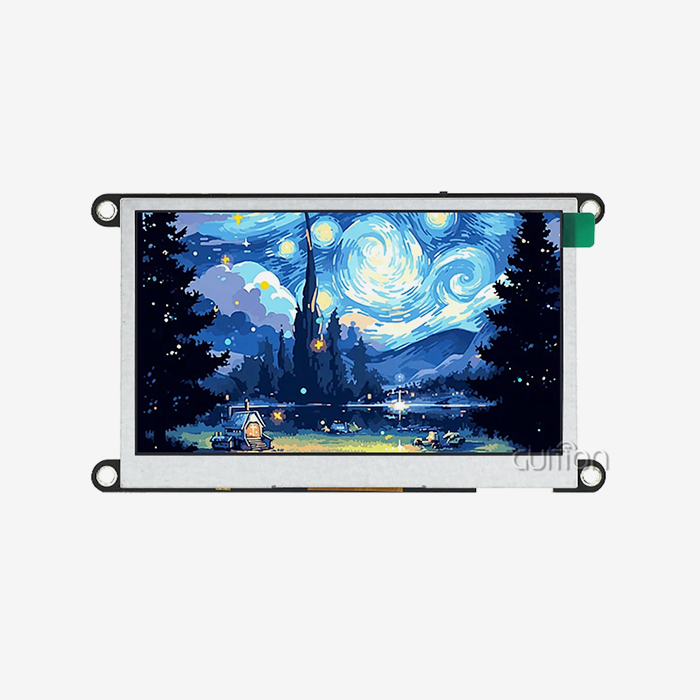
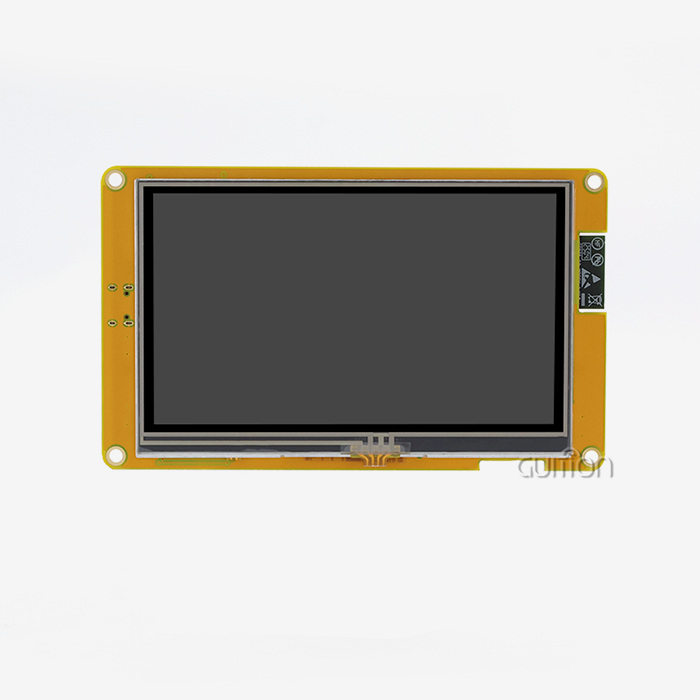
RGB LCD screen panels are available with resolutions from 480×272 to 1280×800 and 16.7M colors on 24-bit connections, and are suitable for detailed HMI graphics. OLED screens, however, have always had better pixel density when they are tiny. But for the 5-inch to 10-inch industrial display, the resolution difference has been greatly minimized. In typical installations, both technologies are capable of 60Hz refresh rates. The GUITION JC8048B070N, for example, provides 800×480 resolution with full 16.7M color reproduction via its EK9716 driver IC, crisp enough for professional control interfaces.
Power Consumption and Battery Life
OLED uses less electricity to show dark material since unlit pixels drain no current. This is a huge benefit for battery-powered hand-held devices. An RGB LCD panel consumes the same amount of backlight power no matter what is on the screen. That difference affects less in fixed-installation industrial equipment — charging stations, HMI panels, medical monitoring — when AC power is accessible. When selecting between the two technologies, engineers creating portable IoT devices should consider display content patterns in their power budget.
Viewing Angles, Durability, and Environmental Resistance
IPS-based RGB LCD panels provide a 170° view angle (horizontal & vertical), which is enough to fulfill most industrial requirements. In terms of viewing angle performance, this may be matched or exceeded by OLED screens. Where LCD has an obvious operational advantage is longevity. RGB LCD panels are resistant to burn-in, can operate in a broad range of temperatures (usually -20°C to +70°C in industrial grades), and retain color fidelity after years of continuous use. OLED panels are prone to picture retention and organic layer deterioration, especially in high-brightness, static-content situations that are frequent in industrial applications.
Procurement Insights: Which Display Is Optimal for Your OEM Device?
Matching Display Technology to Device Requirements
Picking the proper panel begins with three questions: What are the ambient lighting conditions? Is the gadget battery-powered or AC-powered? Is the program showing static or dynamic content? Factory floors and outdoor kiosks often use RGB LCD panels with 500-1000 nit backlights. OLED efficiency may be of use to battery-powered gadgets presenting diversified information. Static dashboard displays, typical of industrial HMI and medical equipment, are poor prospects for OLED owing to the danger of burn-in. Mapping these criteria to your individual device profile eliminates the uncertainty from the choosing process.
Cost Structure and Supply Chain Considerations
RGB LCD modules are produced worldwide in large quantities, making unit prices predictable and lead times reasonable. OLED panels, especially at medium to large sizes (5” and above), have much higher unit costs and much more concentrated supply chains. RGB LCD screens provide a more predictable procurement approach for OEM operations that need steady prices throughout 12-36 month product lifecycles. Volume pricing has been around for a long time with LCD modules, and replacement parts availability is wider, which is vital for after-sales serviceability in medical and industrial equipment.
Evaluating Supplier Reliability and After-Sales Support
The real measure of procurement success is supplier capacity beyond the panel itself. RGB LCD Screen Supplier or Manufacturer Evaluation: Documentation, driver IC support, and technical response time. Jingcai Intelligence’s Guition provides display modules ranging from 1.28” to 21.5”, with extensive secondary developer interfaces, cross-platform compatibility (Arduino, ESP-IDF), and remote OTA update support. These features lower the effort of your engineering staff throughout the whole product lifecycle, from prototype to production to field maintenance.
Troubleshooting and Maintenance Tips for RGB LCD and OLED Displays
Common RGB LCD Issues and How to Fix Them
RGB LCD screen panels are typically reliable; however, three difficulties seem to emerge most commonly in field deployments. First of all, flickering of the screen generally comes from timing mismatches — it is worth checking that VSYNC/HSYNC pulse widths and front/back porch values in your firmware match the panel datasheet precisely. Second, dead pixels may result from physical trauma or ESD occurrences during assembly. Use of shielded FPC wires and addition of series termination resistors lessen the danger. Third, aged modules with backlight failure are often repaired by changing the LED driver circuit rather than the whole panel, so repair costs remain low.
Preventive Care for OLED Displays in OEM Settings
The lifespan of an OLED is really a function of how you use it. There are a few techniques to avoid burn-in. Screensavers, decreasing the maximum brightness settings in firmware, and rotating UI elements when feasible. Keep OLED devices within their specified temperature and humidity limits – organic emitter layers are susceptible to moisture incursion. If your OEM application has to continuously show static UI elements (status bars, fixed icons), include burn-in mitigation straight into your UI design specification before you go into production. Warranty agreements from OLED providers usually cover fewer operating hours than LCD equivalents.
Long-Term Maintenance Planning for OEM Programs
Both display types benefit from a detailed maintenance schedule that is contained in your product’s service manual. For RGB LCD modules, provide driver IC model numbers (such as EK9716 used in the GUITION JC8048B070N), so field personnel may locate compatible replacement parts without misinterpretation. For OEM projects with 5+ year product lifecycles, pick display vendors who are committed to long-term product availability. Guition’s product lines are intended to provide continuous supply, providing R&D managers assurance that replacements will be available throughout the device’s commercial life.
Making the Final Decision: Which Screen Technology Should Your OEM Business Choose?
Display priorities vary by industry. Here are clear technological suggestions per vertical:
- Industrial automation, HMI panels: RGB LCD displays are the norm. They are burn-in resistant, broad temperature-rated, and can interface with typical industrial MCUs. GUITION JC8048B070N with 800×480 resolution and 24-bit color depth is a straight match for manufacturing floor HMI terminals.
- Medical monitoring equipment: RGB LCD modules provide the color fidelity and continuous-operation dependability necessary for patient data displays. OLED is good for portable diagnostic wearables when size and contrast are more important than lifespan issues.
- Consumer gadgets and smart home devices: Both work. OLED is better for aesthetics, for high-end items. RGB LCD displays are better for cost and panel availability for mass manufacturing.
- Commercial kiosks and charging stations: Prefer RGB LCD panels. These installations operate constantly and typically show static UI elements – situations where OLED deterioration is a known operational issue.
These suggestions are based on actual operating circumstances and not theoretical specs. Combine these with your device’s exact power budget, environmental rating, and desired lifespan to conclude your display choices.
The basic rule is simple: if your gadget runs all the time, handles static material, or needs reliable long-term supply, an RGB LCD panel is your practical option. OLED plays a true role in high-end, portable, or aesthetic items when its benefits exceed the cost and lifespan trade-offs.
Conclusion
Choosing between an RGB LCD screen and OLED is a technical and business decision. RGB LCD technology offers proven durability, predictable cost, and broad ecosystem support — making it the dominant choice across industrial, medical, and commercial OEM applications. OLED suits specific use cases where form factor and contrast are the primary drivers. For most embedded engineers and procurement managers targeting stable, long-lifecycle OEM devices, a quality RGB LCD screen module from a documented supplier delivers the best balance of performance, cost, and supply reliability.
FAQ
1. Does an RGB LCD screen offer better color accuracy than OLED?
OLED produces higher contrast ratios and deeper blacks due to per-pixel light emission. However, well-calibrated RGB LCD screens using 24-bit interfaces display up to 16.7M colors with good accuracy for industrial and medical applications. For most HMI use cases, LCD color performance is fully sufficient.
2. Are RGB LCD screens suitable for outdoor OEM applications?
Yes. High-brightness RGB LCD modules rated at 700–1000 nits perform well in direct sunlight. OLED panels tend to wash out in bright ambient conditions and face additional heat-related degradation outdoors, making LCD the preferred choice for outdoor kiosks, agricultural equipment, and charging stations.
3. How does replacement part availability differ between the two technologies?
RGB LCD screens, particularly those using widely adopted driver ICs like the EK9716, have broader replacement part availability globally. OLED replacement panels for specific OEM models can be harder to source, especially after a product reaches end-of-life — a meaningful risk for 5-year-plus OEM programs.
4. Can I integrate an RGB LCD module with Arduino or ESP-IDF?
Yes. Modern RGB LCD modules designed for embedded development, including Guition products, support Arduino and ESP-IDF platforms with documented interfaces, reducing firmware integration time considerably.
5. What is the typical operating temperature range for industrial RGB LCD screens?
Industrial-grade RGB LCD modules typically operate from -20°C to +70°C, which covers warehouses, factory floors, and outdoor enclosures with climate control. This range is a standard requirement for industrial HMI applications.
Partner with Guition for Your Next RGB LCD Screen Project
Guition offers a complete line of RGB LCD screen modules from 1.28" to 21.5", including the JC8048B070N — a 7.0-inch, 800×480, 16.7M color display built on the EK9716 driver IC. As an established RGB LCD screen manufacturer and supplier, Guition provides full technical documentation, cross-platform development support, and responsive after-sales service. Contact our team directly at david@guition.com to request pricing, samples, or a technical consultation.
References
1. Society for Information Display (SID). Display Technology Fundamentals and Applications. 2021.
2. IHS Markit (now S&P Global). Global Display Market Report: LCD and OLED Technology Trends. 2022.
3. IEEE Transactions on Electron Devices. Reliability Analysis of OLED and TFT-LCD Panels Under Extended Operation. 2020.
4. Grand View Research. Industrial Display Market Size, Share & Trends Analysis Report. 2023.
5. IDTechEx. OLED Display Technology and Market Forecast 2022–2032. 2022.
6. Electronics Weekly. Choosing the Right Display Technology for Embedded and Industrial OEM Applications. 2021.
Learn about our latest products and discounts through SMS or email