- English
- French
- German
- Portuguese
- Spanish
- Russian
- Japanese
- Korean
- Arabic
- Greek
- German
- Turkish
- Italian
- Danish
- Romanian
- Indonesian
- Czech
- Afrikaans
- Swedish
- Polish
- Basque
- Catalan
- Esperanto
- Hindi
- Lao
- Albanian
- Amharic
- Armenian
- Azerbaijani
- Belarusian
- Bengali
- Bosnian
- Bulgarian
- Cebuano
- Chichewa
- Corsican
- Croatian
- Dutch
- Estonian
- Filipino
- Finnish
- Frisian
- Galician
- Georgian
- Gujarati
- Haitian
- Hausa
- Hawaiian
- Hebrew
- Hmong
- Hungarian
- Icelandic
- Igbo
- Javanese
- Kannada
- Kazakh
- Khmer
- Kurdish
- Kyrgyz
- Latin
- Latvian
- Lithuanian
- Luxembou..
- Macedonian
- Malagasy
- Malay
- Malayalam
- Maltese
- Maori
- Marathi
- Mongolian
- Burmese
- Nepali
- Norwegian
- Pashto
- Persian
- Punjabi
- Serbian
- Sesotho
- Sinhala
- Slovak
- Slovenian
- Somali
- Samoan
- Scots Gaelic
- Shona
- Sindhi
- Sundanese
- Swahili
- Tajik
- Tamil
- Telugu
- Thai
- Ukrainian
- Urdu
- Uzbek
- Vietnamese
- Welsh
- Xhosa
- Yiddish
- Yoruba
- Zulu
How Does a Capacitive touch display module Work?
A capacitive touch display module is an integrated human-machine interface assembly that detects touch by measuring changes in electrical capacitance across a grid of transparent conductive electrodes. When a finger — which conducts electricity — approaches the screen surface, it disturbs the local electric field. The controller IC registers this disturbance as a touch event, mapping its precise X-Y coordinates. Unlike pressure-dependent resistive screens, a capacitive touch display module requires no physical deformation, delivering a more durable, responsive, and optically clear interface suited for demanding industrial and commercial environments.

Understanding the Working Principles of Capacitive Touch Display Modules
How Electric Field Sensing Drives Touch Detection
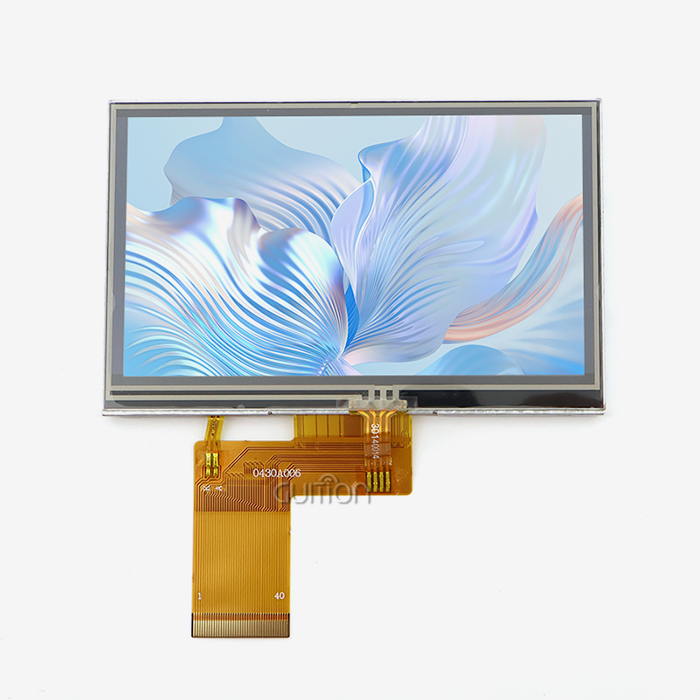
Indium Tin Oxide (ITO), etched onto glass or film in a very fine X-Y grid pattern, is typically used to make the conductive layer inside a Capacitive touch display module. At each junction node, a specialized touch controller scans this grid all the time, measuring the mutual or self-capacitance. When an electrical item, like a fingertip, moves into the electric field above the surface, it changes the local capacitance value in a way that can be measured. The controller takes that shift and turns it into screen coordinates that are accurate to within a millimeter. This sets off the right UI event.
Projected vs. Surface Capacitive: Which Matters for Your Application?
In capacitive sensing technology, there are two main architectures. Projected capacitive (P-Cap) technology puts the sensing grid under a hard cover glass. This lets multiple touches be recognized and, after software tuning, allows gloved operation. Surface capacitive technology covers the screen with a uniformly conductive covering and only checks the capacitance at the four corners. This method is easier to use and costs less, but it can only handle one touch input. Because it is durable and works with gestures, projected capacitive is the most popular choice for industrial HMI panels, automation terminals, and medical monitoring equipment.
Key Advantages and Challenges of Capacitive Touch Display Modules
Procurement engineers should be aware of the environmental limitations before committing to a design, even though choosing a Capacitive touch display module over older options has significant technical benefits. Here are some of the best things about this technology:
- Infinite touch life: capacitive sensing doesn't require the screen surface to be mechanically bent, so there are no wear-and-tear mechanisms. Studies from groups in the display industry show that projected capacitive panels can handle more than 50 million touch cycles without losing performance. This is a very important reliability measure for industrial control panels and booths.
- Multi-touch and gesture support: Mutual-capacitance detection can track multiple separate touch points at the same time, letting you pinch to zoom, rotate, and move. This makes the user experience better on commercial kiosks, smart appliances, and HMI workstations, where single-touch resistive panels just can't measure up.
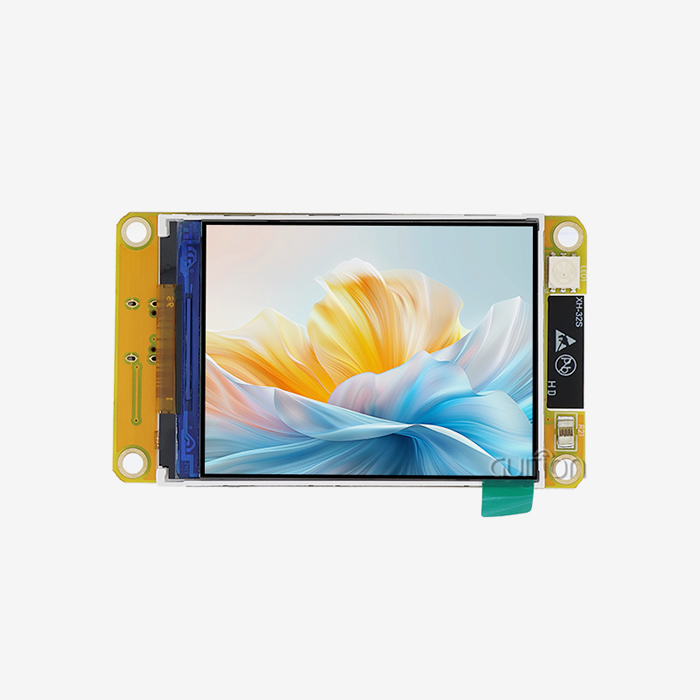
- Optical clarity: ITO-based sensor layers let more than 90% of light through, keeping the color of the display below. The IPS screen in the GUITION JC4827Q343C_I can show 65K colors and has a wide viewing range. The capacitive overlay doesn't seem to change that.
Because of these benefits, capacitive touch display modules are the most common type of interaction technology used in consumer gadgets, industrial automation, and medical devices worldwide. Still, deployments in the real world do bring up problems that need to be fixed. Standard capacitive screens can get fake touches when water pools on the surface, which can be a problem in outdoor enclosures or on plant floors. Modern touch controller ICs have water-rejection algorithms that can tell the difference between a finger and a static drip of water. Heavy machinery's electromagnetic interference (EMI) can also lower the signal-to-noise ratio. This can be safely stopped by putting the right FPC wiring and shielding layers between the LCD and the touch sensor.
Capacitive Touch Display Module vs. Other Touch Technologies
Engineers usually compare capacitive sensors to resistive and infrared technologies when they are looking at touch technology for a new product. Resistive touch panels work by sensing pressure at the point where two conductive layers touch. They can be used with a stylus or a gloved hand, and they use less material. However, they can only handle a single touch, get worse over time, and are less clear because there is air between the layers.
Infrared touch frames can tell when an IR light grid that is projected across the edge of the screen is interrupted. They work well with big screens and gloves, but dust on the bezel sensors can lead to false triggers, and the external frame makes them bulky, which isn't possible for thin industrial panels.
The speed, multi-touch capability, optical performance, and long-term longevity of a Capacitive touch display module are unquestionably superior. Investing in capacitive technology pays off in lower maintenance costs and a better user experience for applications that need to be precise, like medical monitoring equipment, energy management terminals, and smart appliance interfaces. Touch sensitivity range, cover glass thickness, sunlight readability (nits grade), and working temperature range are still the most important things to look at when buying something.
Procurement Considerations for Capacitive Touch Display Modules
Comparing unit prices isn't the only way to find a reliable capacitive touch display module supplier. Manufacturers you can trust offer quality control protocols that are written down and include High-Temperature High-Humidity (HTHH) testing at 60°C/90% RH, thermal shock cycling between -40°C and +85°C, and ESD testing at contact ±8kV. It is common for procurement managers with a lot of knowledge to ask for these test results before agreeing to large orders.
The freedom to customize is just as important. OEM customers often need cover glass with specific dimensions, custom apertures, anti-glare or anti-reflective coatings, and firmware that comes pre-loaded with UI that is specific to the application. A supplier's willingness and technical ability to meet these needs are a sign of a good long-term partnership.
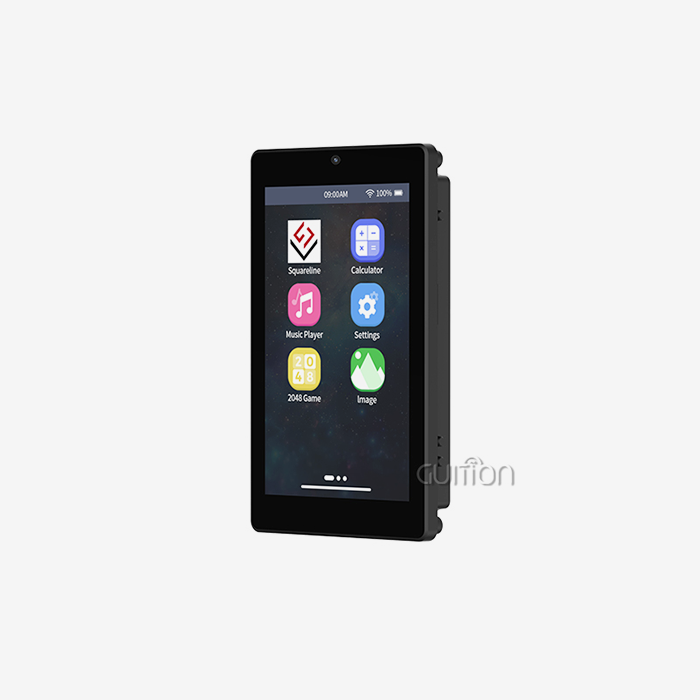
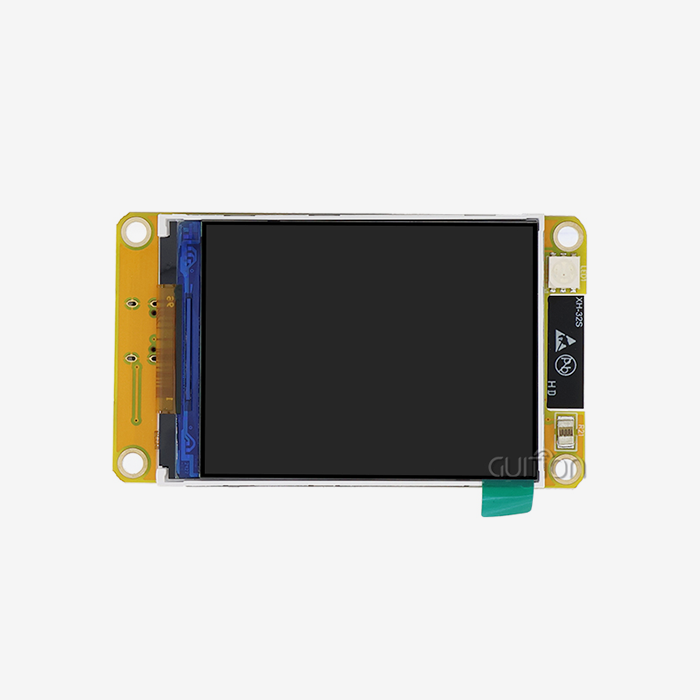
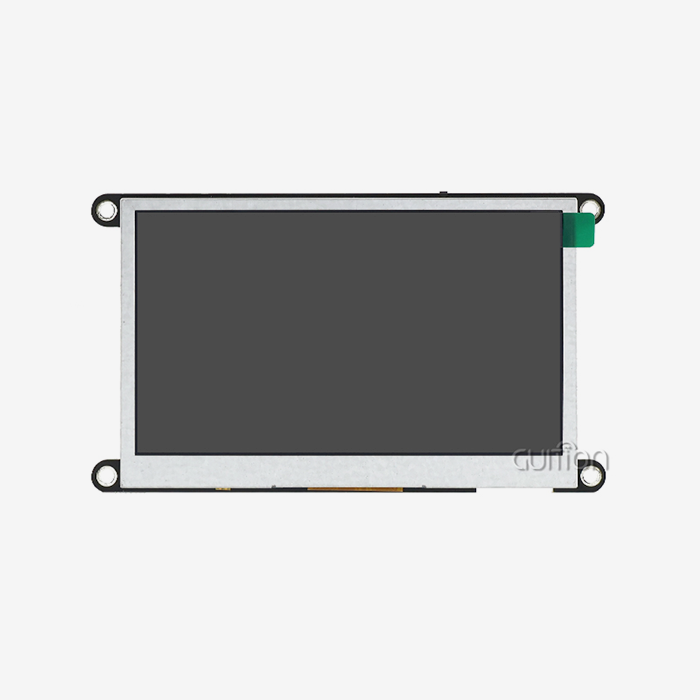
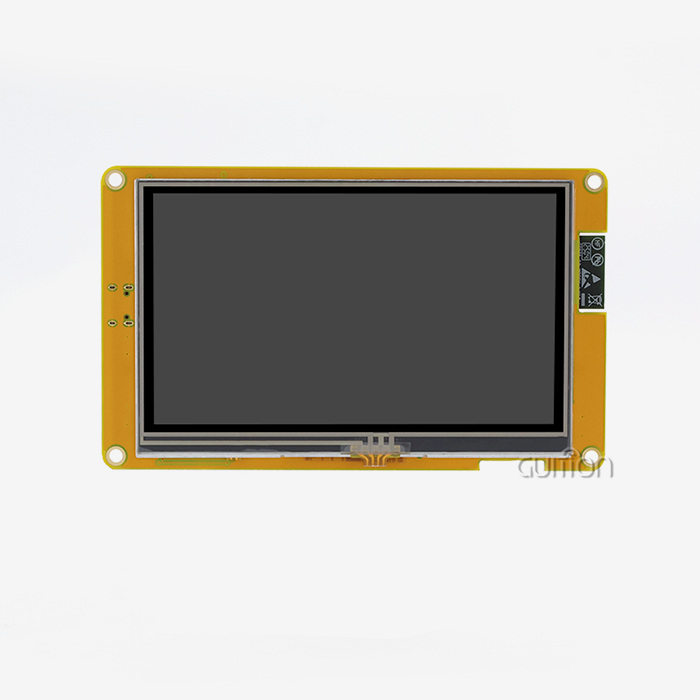
At the product level, the GUITION JC4827Q343C_I shows what a well-specified module should look like. It runs on a 400MHz single-core Artinchip D121BAV MCU and has a 4.3-inch 480x272 IPS display with a capacitive touch sensor built right in. When the module is shipped from the factory, it already has test applications installed, so engineering teams can start making prototypes right away. Having built-in WiFi and Bluetooth makes it easier to connect IoT devices, and the dedicated TF card slots and general-purpose I/O ports let you connect a wide range of peripherals.
Efficiency in development is a real difference here. Drag-and-drop UI building is supported by the online GUI development tool Guition. Engineers can add buttons, sliders, and chart controls with just one click, move them around easily, and see a preview of the results without having to write low-level display driver code. Because it works with Arduino, ESP-IDF, and the native Guition programming environment, the module can be used with current workflows without having to change the toolchain. The ability to remotely update firmware over the air (OTA) further lowers the costs of supporting units that have already been shipped.
Practical Applications and Industry Use Cases
A growing number of industries are using Capacitive touch display modules. In industrial automation, they are the main way that operators interact with CNC machines, packaging lines, and SCADA terminals, all of which need accurate input and long life. They are used by medical device makers in diagnostic and patient monitoring tools that need to have clean surfaces, support for gloved touch, and resistance to cleaning agents.
Touch-enabled HMI screens are replacing physical button arrays more and more in energy management systems and farm automation controls. This makes the enclosures simpler and allows for better data visualization. A lot of people interact with commercial booths, point-of-sale (POS) systems, and smart home control panels. The way they look and how well they work with gestures directly affect how people think of a brand.
New developments that are making adoption more likely include flexible substrate sensors that can be integrated into curved surfaces, ultra-thin bonding stacks that make device profiles thinner, and AI-enhanced touch controllers that learn how to respond better over time based on how users interact with them.
Conclusion
To provide accurate, long-lasting, and multi-touch-capable human-machine contact, a capacitive touch display module uses electric field sensors, transparent conductive electrodes, and a special driver IC. Compared to resistive or infrared options, it has better optical clarity, a mechanical life that will never end, and the gesture support that current interfaces need. Engineers and procurement workers who are making the next generation of industrial panels, medical devices, or smart products can make more confident sourcing decisions when they understand these basics.
FAQ
1. Can a capacitive touch display module work with gloves?
Yes, but the software needs to be tuned for sensitivity. Projected capacitive controls can be set up to pick up the tiny change in capacitance that is sent through latex or leather gloves that are up to 5 mm thick. This is how industrial HMI units are usually set up in places where workers have to wear safety gear.
2. How does water on the screen affect performance?
When water pools on the surface, standard capacitive sensors may pick up inputs that weren't meant to be there. Modern touch controller ICs have water-rejection algorithms that can tell the difference between a still water droplet and a moving fingertip. This way, the device can still work reliably in damp or wet conditions.
3. What interface does the touch controller use?
Due to its low power use and easy wiring, I2C is the usual link for screens smaller than 10 inches. This design is used by the GUITION JC4827Q343C_I, which makes integration easy for embedded programmers.
4. How often does calibration need to happen?
Modern projected capacitive modules are already calibrated at the factory and don't need to be recalibrated in the field on a regular basis when they are working normally. When there are big changes to the cover glass stack or the operating environment, recalibration is needed.
5. Does EMI from industrial machinery affect touch accuracy?
If you don't use the right design defenses, it can. A shielding layer between the LCD and the touch sensor, along with proper FPC grounding, keeps the signal-to-noise ratio high even in places with a lot of electromagnetic interference (EMI), such as motor control cabinets. The Capacitive touch display module remains the most reliable option for such high-interference applications.
Partner with Guition for Your Next Capacitive Touch Display Module Project
From the small 4.3-inch JC4827Q343C_I to panels up to 21.5 inches, Guition offers tried-and-true Capacitive touch display module solutions. These solutions are backed by thorough technical documentation, OTA upgrade support, and a drag-and-drop GUI development tool that speeds up your time-to-market. Our engineering team is ready to help you with your specific needs, whether you need a capacitive touch display module maker for medical devices, smart home products, or industrial screens. You can email us at david@guition.com to place an order for a document or a sample right now.
References
1. Bhalla, M. R., & Bhalla, A. V. — Comparative Study of Various Touchscreen Technologies — International Journal of Computer Applications, 2010.
2. Barrett, G., & Omote, R. — Projected-Capacitive Touch Technology — Information Display Magazine, 2010.
3. Ang, D., et al. — ITO-Based Transparent Conductive Films for Touch Panel Applications — Thin Solid Films, Elsevier, 2011.
4. Steckl, A. J. — Sensors on Flexible Substrates: Emerging Display and Touch Technologies — IEEE Transactions on Electron Devices, 2020..
5, Lee, S., & Shin, H. — Noise Rejection Techniques for Projected Capacitive Touchscreens in Industrial Environments — IEEE Transactions on Industrial Electronics, 2018.
6. Bhatt, S., & Kaur, P. — Human-Machine Interface Design for Industrial Automation Systems — Journal of Engineering Research and Applications, 2019.
Learn about our latest products and discounts through SMS or email