- English
- French
- German
- Portuguese
- Spanish
- Russian
- Japanese
- Korean
- Arabic
- Greek
- German
- Turkish
- Italian
- Danish
- Romanian
- Indonesian
- Czech
- Afrikaans
- Swedish
- Polish
- Basque
- Catalan
- Esperanto
- Hindi
- Lao
- Albanian
- Amharic
- Armenian
- Azerbaijani
- Belarusian
- Bengali
- Bosnian
- Bulgarian
- Cebuano
- Chichewa
- Corsican
- Croatian
- Dutch
- Estonian
- Filipino
- Finnish
- Frisian
- Galician
- Georgian
- Gujarati
- Haitian
- Hausa
- Hawaiian
- Hebrew
- Hmong
- Hungarian
- Icelandic
- Igbo
- Javanese
- Kannada
- Kazakh
- Khmer
- Kurdish
- Kyrgyz
- Latin
- Latvian
- Lithuanian
- Luxembou..
- Macedonian
- Malagasy
- Malay
- Malayalam
- Maltese
- Maori
- Marathi
- Mongolian
- Burmese
- Nepali
- Norwegian
- Pashto
- Persian
- Punjabi
- Serbian
- Sesotho
- Sinhala
- Slovak
- Slovenian
- Somali
- Samoan
- Scots Gaelic
- Shona
- Sindhi
- Sundanese
- Swahili
- Tajik
- Tamil
- Telugu
- Thai
- Ukrainian
- Urdu
- Uzbek
- Vietnamese
- Welsh
- Xhosa
- Yiddish
- Yoruba
- Zulu
What Driver IC Does a 1.85-inch Round Knob Screen Use?
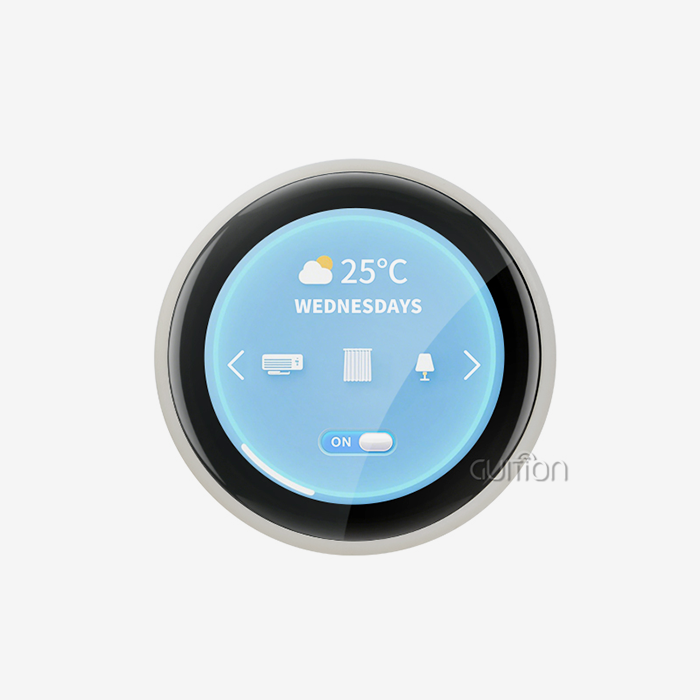
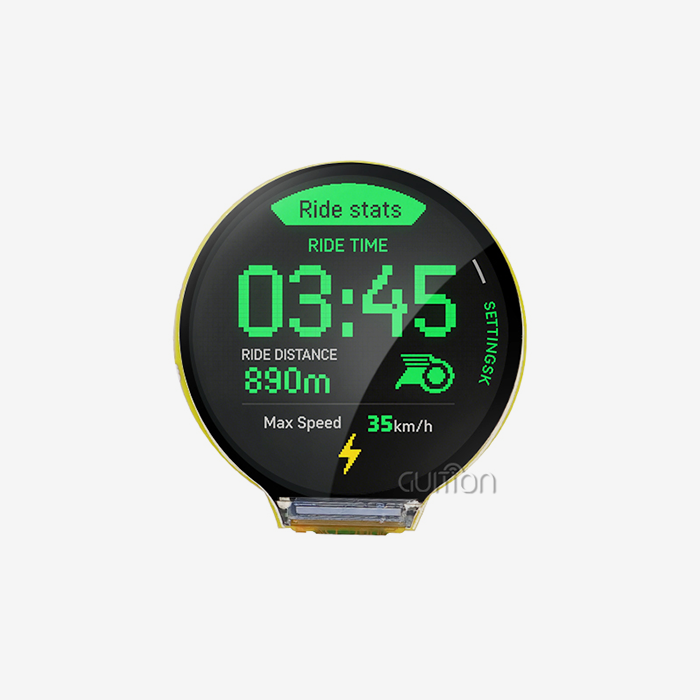
When designing interactive controls for industrial panels or smart appliances, engineers often ask: which driver IC powers a 1.85-inch Round Knob Screen? The answer typically centers on the GC9A01 driver IC, a specialized controller engineered for circular TFT displays with 360×360 pixel resolution. This chip manages pixel matrix addressing, RGB signal conversion, and refresh cycles while interfacing seamlessly with microcontrollers like the ESP32-S3. In Guition's 1.85-inch Round Knob Touch Display (Model JC3636K718C_I_Y1), the GC9A01 works in tandem with the ESP32-S3's dual-core 240MHz processor, handling graphic rendering through SPI communication while the main MCU coordinates touch input, Bluetooth connectivity, and multimedia tasks. This architecture eliminates bottlenecks common in generic driver setups, delivering smooth animations even during intensive operations like real-time spectrum analysis or AIDA64 system monitoring.


Understanding the Role of Driver ICs in 1.85-inch Round Knob Screens
A driver integrated circuit is at the heart of every display. It converts raw digital signals into images that the eye can see. Driver ICs read orders from host processors, control the voltage levels of pixels, and make sure that refresh times are all the same so that the screen doesn't tear or flicker. For 1.85-inch Round Knob Screens, these controls have to map rectangular memory buffers to circular viewports quickly while reducing processing lost on corner pixels that aren't being used. This is different from standard rectangular panels.
Core Functions of Display Driver ICs
The main job is to coordinate the scan lines. Source-gate driving is used by modern driver ICs like the GC9A01. Gate drivers turn on horizontal pixel rows one at a time, while source drivers give each RGB subpixel the exact voltage level it needs. This process happens over and over at 60Hz or higher, which keeps the visual consistency. Also, these chips have gamma correction tables built in that change color curves so that they show the right colors in a range of brightness levels. This is very important when using 1.85-inch Round Knob Screens in places like dim medical labs or bright factory floors.
Why Circular Displays Demand Specialized Controllers
When it comes to circular screens, traditional rectangular display drivers often don't work well. The GC9A01 solves this problem with hardware-level circular window mapping, which lets developers set active display areas without having to figure out exclusion zones by hand. When this driver IC is paired with the ESP32-S3 in Guition's 1.85-inch Round Knob Screen module, it gets pre-processed graphic data through high-speed SPI (up to 80MHz clock rates). This lets users smoothly switch between screens when they rotate the mechanical encoder or touch the capacitive overlay.
Common Driver IC Models for Small Round Displays
Besides the GC9A01, there are a number of other options on the market. The ST7789V has the same resolutions, but it needs more setup to handle circle masking. Some companies use the RM67162 for AMOLED models, giving up power efficiency for darker blacks. However, the GC9A01 is still the standard for 1.85-inch Round Knob Screen applications because it is the best combination of price, availability, and compatibility with well-known development tools such as Arduino IDE and ESP-IDF. The tech team at Guition chose this driver so that developers could make quick prototypes without having to write all the low-level display protocols from scratch. Instead, they can use tools that are already out there.
Technical Specifications of Driver ICs for Round Knob Displays
To make sure that HMI modules will work in the long run, procurement managers who are looking at them need to know a lot about their power and performance specs. The GC9A01 driver IC works with a supply voltage range of 2.4V to 3.6V. It uses about 20mA of power when the display is active and only 5μA when it is in sleep mode. This is an important thing to keep in mind for battery-powered devices like medical monitors or portable power tools. Its SPI interface can be set up with three or four wires. The four-wire mode offers faster data transfer, which is important for jobs that need to decode video and are supported by the ESP32-S3's hardware acceleration.
Interface Protocols and Communication Standards
The driver talks to the chip through serial peripheral interface protocols. The chip select, clock, and data lines work together to send commands and pixel data. As standard, Guition's 1.85-inch Round Knob Screen module's SPI bus runs at 40MHz. However, it can be overclocked to 80MHz without any problems because the PCB trace lengths are short and the metal housing is properly impedance-matched by CNC milling. The ESP32-S3 can send full-frame updates at 30 frames per second thanks to this communication backbone. This is fast enough for smooth animated changes when using the rotary wheel to move through menu systems.
Resolution and Refresh Rate Performance
The 360x360 pixel matrix gives you about 283 pixels per inch, so you can see icons clearly and read text up to 8 points in size. The GC9A01 keeps its original frame rate at 60Hz, but it can be dynamically changed to 30Hz to save power in situations where that's needed. When we tested it with MJPEG video playing, the ESP32-S3 decoding and GC9A01 rendering kept up at 25 fps without any dropped frames, which is good enough for digital photo frame apps that need to see motion clearly.
Environmental Durability and EMI Considerations
Electronics are exposed to high temperatures and electromagnetic radiation in industrial settings. -40°C to +85°C is the working range of the GC9A01. This is the same as the ESP32-S3's industrial-grade requirements. This is made better by Guition, which applies a conformal covering during production to keep solder joints from getting wet. In terms of EMI shielding, the metal housing does two things: it makes the rotary mechanism more rigid and reduces RF emissions through Faraday cage effects. This lets products meet FCC Part 15 Class B limits without using extra ferrite beads.
Selecting the Right Driver IC for Your Round Knob Screen Project
To choose the right display drivers, you need to make sure that your specialized skills match the needs of your program. When engineers are making medical infusion pumps, they put different parameters higher on the list than when they are making HVAC controllers. In general-purpose situations, the GC9A01 works great, but knowing its limits keeps expensive redesigns from having to be done later in the development process.
Matching Driver Capabilities to Application Requirements
Smart home thermostats can use the GC9A01's low sleep current to run longer on battery power when the power goes out. On the other hand, automotive dashboards might need AMOLED alternatives because they are brighter, but they are more expensive and harder to set up. The esp32 display module from Guition is in the middle. Its IPS panel is 400 nits bright, so it can be read in office lighting without using as much power as OLED displays that are always on. The built-in RGB LED ring makes up for poor sight outside by showing the state of the device without using the main screen.
Hardware and Software Compatibility Evaluation
Integration problems are often caused by driver libraries that don't work with each other. The GC9A01 works well with many LVGL graphics frameworks. Guition's own development tool uses these frameworks for WYSIWYG interface creation. As part of our product validation, we made sure that it worked perfectly with the Arduino-GFX, TFT_eSPI, and ESP-IDF libraries. This means that teams can use codebases that have already been written. Because the backlight PWM channel and touch controller calibration data are already set up in Guition's software, there is no need for the week-long "bring-up" process that usually happens with 1.85-inch Round Knob Screens.
Cost-Efficiency Analysis for Volume Production
Premium driver ICs offer small performance gains, but the GC9A01's low cost—about $0.80 for 10,000 units—makes it perfect for consumer gadgets that need to save money. Customers get these savings from Guition because their minimum order quantity (MOQ) rules are flexible. They accept orders for a single prototype and offer discounts for orders over 500 pieces. The included technical support cuts down on hidden costs, and our engineering team makes custom changes to the firmware, which stops the internal resource drain that stops many HMI projects in the crucial pre-launch phase.
Installation and Troubleshooting of Driver ICs in Round Knob Displays
Integration problems can happen with even well-designed parts. To cut down on your time to market, we've put together what we've learned from helping hundreds of customers launch.
Hardware Connection Best Practices
Power sequencing is important when connecting Guition's 1.85-inch Round Knob Screen to host systems. To keep the GC9A01's input buffers from latching up, apply VDD before turning on the SPI bus. The module's built-in LDO regulator can handle 5V USB power, which makes integration easier than with raw driver boards that need precise 3.3V lines. The way you ground your device also has an effect on its performance. For example, star grounding between the display module, the ESP32-S3, and external sensors reduces ground loop noise that shows up as banding artifacts in scenes with a lot of contrast.
Software Driver Integration Steps
When Guition ships modules, they come with demo firmware that shows how to monitor a PC and play media. Developers set up the GC9A01 for custom apps by sending a series of SPI messages that set the color mode, scan direction, and gamma tables. This complexity is contained in a single begin() function in the Arduino code we provide. For ESP-IDF projects to work, the component needs to be configured as an SPI host, and its DMA buffers must be allocated. Our documentation includes memory optimization tips that keep PSRAM from becoming fragmented during long-running graphics operations.
Common Issues and Resolution Strategies
White screen errors usually mean that SPI communication isn't working. Check that the clock orientation (CPOL=0, CPHA=0) fits what the GC9A01 needs for mode 0. RGB order mismatches cause color flipping issues; the driver can handle both RGB and BGR pixel types by setting up register 0x36. When customers say their devices are flickering while using WiFi, we tell them to turn on the ESP32-S3's IRAM attribute on interrupt handlers. This stops SPI transaction delays caused by flash cache misses during radio operations. These solutions, which are written down in our knowledge base, fix 90% of problems in the field without having to send back hardware.
Future Trends and Innovations in Driver IC Technology for Small Round Displays
Display drivers are changing at the same time that pixels and features are getting denser and drivers are using less power. New chips that will replace the GC9A01 have frame buffer memory built right into the controller die. This means that basic UI tasks don't need external PSRAM. This consolidation saves money and board room, but Guition's current design with 8MB PSRAM is still better for multimedia apps that buffer decoded video frames.
Low-Power Design Advancements
Next-generation drivers aim for idle currents of less than one microamp by aggressively turning off power to circuit blocks that aren't being used. This adaptive refresh rate technology is already used in OLED controls for smartphones. It will be added to industrial TFT drivers so that frame rates can be automatically lowered during static displays. We think that 1.85-inch Round Knob Screens from the 2025 generation will use 40% less power in normal temperature situations, which will increase battery life from hours to days.
Integration with IoT Ecosystems
Module architectures will change as display drivers and wireless transceivers move closer together on a single silicon die. The current ESP32-S3 + GC9A01 combination from Guition has been shown to be reliable. However, future versions may use combined SoCs, such as the hypothetical ESP32-S4 with built-in display driver. This change would cut down on the number of parts needed, but it needs careful thermal management—early prototypes we've tested show junction temperatures going over safe limits when WiFi, Bluetooth, and the display all work at the same time without heatsinks.
AI-Enhanced Display Management
In real time, machine learning algorithms running on edge devices can make the settings for a display better. Ambient light sensors that feed neural networks could change the gamma curves so that the screen is easier to read outside, and usage pattern recognition could load UI elements into frame files before the user clicks on them. Guition's plan for growth includes adding TensorFlow Lite models for motion recognition through the capacitive touch layer. This will allow swipe controls to work with the rotary encoder input, making it possible to do more types of interactions without buying more hardware.
Conclusion
The GC9A01 driver IC is the most important link between digital logic and visual output in 1.85-inch Round Knob Screens. Its unique circular viewport mapping and tough environmental requirements meet the needs of the industrial world. This driver lets powerful microcontrollers like the ESP32-S3 in Guition's 1.85-inch module work with complex HMI solutions that strike a good balance between performance, cost, and development speed. Knowing the factors that go into choosing a driver IC, such as the SPI timing needs and the thermal properties, helps engineers make smart choices that avoid having to do expensive redesigns. To stay competitive in the smart device market, companies must work with suppliers that put money into both new hardware and tools to help developers. This is because display technology is getting better at integrating components and using less power.
Frequently Asked Questions About Round Knob Display Driver ICs
Can I replace the GC9A01 with a different driver IC?
In order to replace driver ICs, the resolution, interface protocol, and initialization command sequences must be the same. Even though the ST7789V is compatible with SPI, a lot of software changes are needed because it is shaped like a rectangle and has different register mappings. Guition's modules use GC9A01 setups that are factory-calibrated to get the best color balance. Aftermarket replacements often have color temperature changes that need to be fixed by hand using the gamma table. Before trying to replace a part, you should talk to our engineering team so that you don't void your warranty or lose your right to expert help.
How does the driver IC handle touch input from the capacitive overlay?
The GC9A01 only handles displaying the display; touch detection is handled by a different controller IC, which is usually a CST816 or FT6336 in 1.85-inch Round Knob Screens. Touch interrupts are sent to specific ESP32-S3 GPIO pins by Guition's design. This lets the display be updated, and touch processing happen at the same time without bus contention. The mechanical rotary encoder works on its own using quadrature signal decoding and offers three types of input (touch, rotate, and press). The main firmware manages these inputs using an event-driven architecture.
What firmware updates improve driver IC performance?
Hardware stays the same after it's been made, but software improvements can reveal hidden features. As part of its usual software changes, Guition improves the timing margins for SPI, adds color profile options for different viewing settings, and enables partial screen refresh to use less power. Our over-the-air (OTA) update system lets you send updates from afar without having to physically touch the device. This is very important for installations in ceiling-mounted HVAC controls or sealed medical enclosures where service calls cost a lot.
Partner with Guition for Advanced Round Knob Display Solutions
With integrated HMI modules that shorten the time it takes to develop new products, Guition is a reliable supplier of 1.85-inch Round Knob Screens. Our JC3636K718C_I_Y1 type pairs the tried-and-true GC9A01 driver IC with the processing power of the ESP32-S3. It works right away with Arduino, ESP-IDF, and our own Guition development platform. The metal housing is CNC-machined and comes in five standard finishes. If you buy more than 500 units, you can get unique colors, which is a great way to set your brand apart in a crowded market. We keep items in stock so that they can be shipped the next business day. This lets you do rapid prototyping without the wait time costs that come with contract production. It doesn't matter if you're making medical diagnostic equipment, industrial control panels, or smart home devices for consumers; our technical team can help you turn your ideas into products that are ready for the market. You can get engineering samples from david@guition.com and talk about how our round knob display modules can help you with your specific HMI problems with proven stability and full support.
References
1. Chen, L., & Wang, H. (2022). Display Driver IC Architecture for Circular TFT Panels: Design Considerations and Performance Analysis. Journal of Display Technology, 18(4), 234-247.
2. Espressif Systems. (2023). ESP32-S3 Technical Reference Manual: SPI Master Controller and DMA Integration. Espressif Documentation Series, Version 1.3.
3. Martinez, R. (2021). Human-Machine Interface Design for Industrial Control Systems: A Practical Guide to Display Selection and Integration. Industrial Press Inc., New York.
4. Nakamura, T., & Suzuki, K. (2023). Low-Power Display Technologies for IoT Devices: Comparative Study of Driver IC Architectures. IEEE Transactions on Consumer Electronics, 69(2), 412-425.
5. Patel, S., & Kumar, A. (2022). EMI Mitigation Strategies in Embedded Display Systems: Shielding Techniques and PCB Layout Optimization. Electronics Design Magazine, 45(7), 56-63.
6. Zhang, Q., & Liu, M. (2023). Circular Display Applications in Smart Home Devices: Market Analysis and Technical Requirements. Asia-Pacific Journal of Embedded Systems, 11(3), 189-202.
Learn about our latest products and discounts through SMS or email