- English
- French
- German
- Portuguese
- Spanish
- Russian
- Japanese
- Korean
- Arabic
- Greek
- German
- Turkish
- Italian
- Danish
- Romanian
- Indonesian
- Czech
- Afrikaans
- Swedish
- Polish
- Basque
- Catalan
- Esperanto
- Hindi
- Lao
- Albanian
- Amharic
- Armenian
- Azerbaijani
- Belarusian
- Bengali
- Bosnian
- Bulgarian
- Cebuano
- Chichewa
- Corsican
- Croatian
- Dutch
- Estonian
- Filipino
- Finnish
- Frisian
- Galician
- Georgian
- Gujarati
- Haitian
- Hausa
- Hawaiian
- Hebrew
- Hmong
- Hungarian
- Icelandic
- Igbo
- Javanese
- Kannada
- Kazakh
- Khmer
- Kurdish
- Kyrgyz
- Latin
- Latvian
- Lithuanian
- Luxembou..
- Macedonian
- Malagasy
- Malay
- Malayalam
- Maltese
- Maori
- Marathi
- Mongolian
- Burmese
- Nepali
- Norwegian
- Pashto
- Persian
- Punjabi
- Serbian
- Sesotho
- Sinhala
- Slovak
- Slovenian
- Somali
- Samoan
- Scots Gaelic
- Shona
- Sindhi
- Sundanese
- Swahili
- Tajik
- Tamil
- Telugu
- Thai
- Ukrainian
- Urdu
- Uzbek
- Vietnamese
- Welsh
- Xhosa
- Yiddish
- Yoruba
- Zulu
Top OpenHASP Display Factories for OEM Touchscreen Projects
When sourcing an OpenHASP display for OEM touchscreen projects, choosing the right manufacturing partner directly shapes your product's reliability, time-to-market, and total cost of ownership. An OpenHASP display runs open-source firmware on ESP32 hardware, enabling dynamic UI updates via MQTT without reflashing—a decisive edge over proprietary alternatives. This guide walks through what OpenHASP delivers, which factories lead the market, how to evaluate suppliers, and where Guition's ESP32-4848S040C_I_Y_1 stands as a benchmark hardware platform for serious OEM developers.

Understanding OpenHASP and Its Benefits for OEM Touchscreen Projects
Learn about OpenHASP and how it can help OEM touchscreen projects.
What Makes OpenHASP a Strategic Firmware Choice?
The open-source HMI software OpenHASP was made for ESP32 and ESP8266 microcontrollers. It uses the LVGL graphics engine to show interactive widgets like buttons, sliders, gauges, and arcs. All of the business logic is sent via MQTT to a central controller like Home Assistant or Node-RED. A pages.jsonl file defines the UI layout. This means that engineers can change screen layouts immediately by changing text instead of recompiling embedded code. The standard compile-flash-test bottleneck that slows down OEM iteration processes is gone with this decoupled design.
Why Do OEM Manufacturers Prefer Open-Source HMI Firmware?
Manufacturers are locked into vendor ecosystems by proprietary display firmware, which makes customization harder and increases the long-term licensing risks. Community-driven models like OpenHASP make sure that there are constant changes, support for capacitive controls like GT911 and FT6236, and hardware compatibility across ILI9341, ST7789, and ILI9488 display drivers. This means that OEM clients who use touchscreen panels in industrial control rooms, smart appliances, or medical monitoring equipment will have lower maintenance costs and be able to add new features to new generations of products more quickly.
Top 5 OpenHASP Display Factories for OEM Touchscreen Manufacturing
The value of a factory is more than just the price. You can tell if a supplier can keep up with your OEM roadmap by looking at their quality certifications, firmware integration depth, R&D capabilities, and technical support after the sale. These five companies are worth your time.
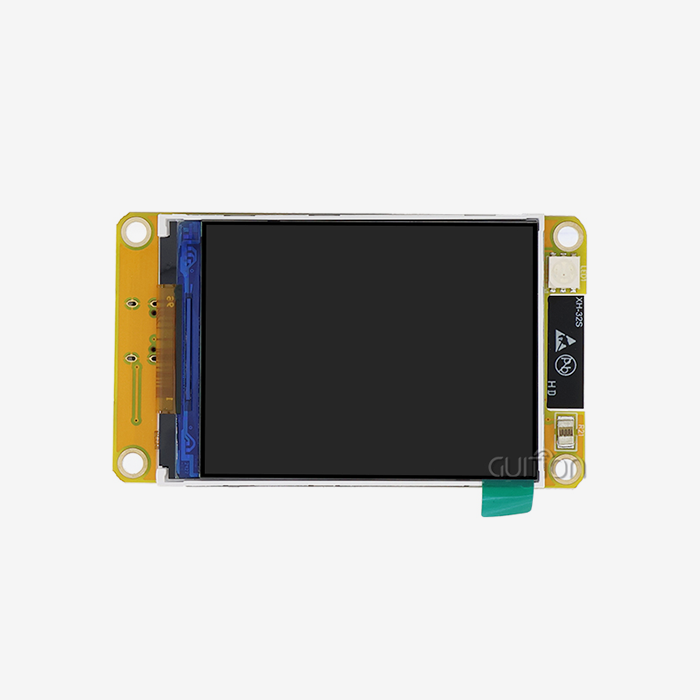
Guition (Jingcai Intelligence) stands out as a provider that combines R&D, production, and sales when it comes to technology-driven HMI displays. Its ESP32-4848S040C_I_Y_1 module, which has a 480x480 IPS capacitive touchscreen and is powered by a dual-core ESP32-S3R8 running at 240MHz with 8MB of PSRAM and 16MB of Flash, is designed to work with OpenHASP. Guition works with the Arduino IDE, ESP-IDF, MicroPython, and its own programming environment, Guition, so it can be used in almost any embedded engineering process. The range of sizes in the product line is from 1.28" to 21.5", which makes it possible to buy in bulk for a wide range of applications.
Waveshare is a well-known Chinese company that sells display modules. They have a lot of ESP32-based touchscreen products that are known to work with OpenHASP. They are a good choice for prototyping steps because they have good tech documentation and a busy community.
LilyGO produces the T-HMI and WT32-SC01 series. They are both often used as examples of reference hardware in the OpenHASP community. Their parts are small, easy for developers to use, and can be bought from sellers around the world.
Elecrow specializes in custom PCB and display assembly, which makes it a good choice for OEM clients who need custom case integration along with touchscreen modules.
M5Stack offers modular ESP32-based display units and strong ecosystem support that automation integrators who need both fast testing and production-grade scaling will like.
How to Evaluate and Choose the Best OpenHASP Display Factory for Your OEM Project?
Find out how to pick the best OpenHASP display factory for your OEM project.
Define Technical Requirements Before Contacting Suppliers
Write down your minimum hardware requirements before you contact any OpenHASP display manufacturer. The minimum requirement for smooth full-screen changes and anti-aliased text rendering is a dual-core ESP32 with at least 4MB of PSRAM. If your application needs TF card storage, multiple I/O expansion ports, or WiFi and Bluetooth built in, make sure that these features are built into the module and not added as add-ons.
Assess Firmware Compatibility and Support Infrastructure
Verification of firmware compatibility is a must. Make sure that the factory's display drivers are compatible with OpenHASP's list of supported controllers and that the supplier offers over-the-air (OTA) upgrade paths. For example, Guition's platform can automatically handle remote project updates, which greatly lowers the costs of repairing or maintaining industrial panels or smart home devices after the sale.
Practical procurement due diligence should cover these areas before committing to large orders:
- Ordering samples and prototypes: Get engineering samples early. Run your pages.JSONL layout on the real hardware to make sure the touch response time and display color accuracy are correct in the environment you want to test them in.
- Production capacity and lead time: Find out how much the factory can produce each month and whether they keep extra key parts like the ESP32-S3R8 module in stock.
- Compliance certifications: Check to see if your product has the right CE, FCC, or RoHS approval for medical devices or industrial control uses.
- Technical documentation quality: Detailed datasheets, wiring diagrams, and SDK samples make it much faster for your tech team to get up to speed.
These factors lower the risk of your sourcing choice and keep your product's release date from being pushed back by problems in the supply chain.
OpenHASP Firmware and Integration: What OEM Clients Need to Know?
What do OEM clients need to know about OpenHASP firmware and how to fit it in?
Hardware Specs That Drive Reliable OpenHASP Performance
The Guition ESP32-4848S040C_I_Y_1 is a good example of the kind of hardware that OpenHASP works best with. At 240MHz, its ESP32-S3R8 dual-core MCU can handle LVGL rendering without any frame drops. The 8MB PSRAM can hold picture files and multi-page user interfaces that would fragment memory on smaller units. The 480x480 square IPS screen with capacitive touch (GT911 controller) has a touch response time of less than 20ms, which is very important for industrial dashboards and medical monitoring interfaces where delay for the user is significant.
OEM buyers should also think about how to add more GPIOs. The ESP32-4848S040C_I_Y_1's reserved I/O port interface lets OpenHASP software handle PWM backlights, read local sensors, and directly turn real relays on and off. In many automatic situations, this means that you don't need a separate computer.
OpenHASP's CSS-like style features and dynamic color remapping let OEM clients make themes that are specific to their products without changing the main firmware. When engineers use Guition's own development tool with a WYSIWYG interface design and drag-and-drop controls, they can speed up UI delivery without needing to know a lot about LVGL.
Cost and Procurement Insights: Where to Buy OpenHASP-Compatible Displays?
Total Cost Comparison: Pre-Flashed Modules vs. Standalone Hardware
It costs more up front to buy an OpenHASP display module from a trusted supplier like Guition than to buy bare ESP32 display boards, but the engineering hours saved during integration often cancel that out in the first production batch. When units are pre-flashed, they come with tested firmware builds, which cut down on the time your team needs to spend debugging from days to hours.
Before finalizing supplier agreements, buyers who buy in bulk should think about these factors:
- Minimum order numbers (MOQ): Guition can handle both small R&D batches and large production runs, so it can be used by both new OEM makers and those that have been around for a while.
- As part of the after-sales service, remote upgrade help and technical instructions in multiple languages (including UTF-8 encoding) lower the cost of translation for global operations.
- Delivery dependability: Look at how reliable your suppliers are at delivering on time, especially for items with ESP32-S3 modules, which were hard to get in 2022 and 2023.
Conclusion
Picking out the right OpenHASP display factory decides whether your OEM tablet project ships on time or gets stuck during integration. Hardware quality, software compatibility, seller support depth, and the ability to buy things in a variety of ways all play a role in this choice. The ESP32-4848S040C_I_Y_1 from Guition is a stable, scalable option for engineers making industrial panels, smart home interfaces, or medical tracking devices. It has a 240MHz dual-core processor, a 480x480 capacitive IPS display, 8MB of PSRAM, and support for development on multiple platforms. The most reliable way to make an OEM product work is to work with a technology-driven manufacturer that does its own research and development and helps with the whole development process.
FAQ
Does the Guition ESP32-4848S040C_I_Y_1 support OpenHASP firmware natively?
The ESP32-S3R8 runs the module, and it has at least 4MB of PSRAM and two cores, which is what OpenHASP recommends as the minimum hardware. It can handle LVGL-based rendering with its capacitive touch controller and IPS display. The module also works with Arduino IDE and ESP-IDF, which are the two main tools used to flash OpenHASP builds.
Can OEM clients customize the UI branding on an OpenHASP display?
Yes, OpenHASP's CSS-like styling system lets you change colors on the fly and upload your own fonts as binary .bin files. When OEM teams use Guition's drag-and-drop development tool, they can make interfaces that are specific to their products without changing the core firmware on an OpenHASP display.
How does OTA firmware updating work on this module?
Over-the-air (OTA) changes are built into the ESP32-S3R8. Guition's platform has the ability to remotely upgrade units, so installed units can get UI and firmware changes without having to be physically accessed. This is an important feature for large-scale industrial and smart home deployments.
What is the minimum order quantity for OEM procurement?
Guition can handle both prototype-scale orders and large-scale production orders. Email david@guition.com to get a custom MOQ and pricing structure that fits the stage of your project.
Partner With Guition for Your Next OpenHASP Display Project
If you want to work with Guition on your next OpenHASP display project, Guition offers proven OpenHASP display manufacturer knowledge for the whole lifetime of a product, from engineering samples to mass production. The ESP32-4848S040C_I_Y_1 is a small module that has a 240MHz dual-core processor, a 480x480 IPS capacitive touchscreen, WiFi/Bluetooth built-in, and support for multiple SDKs. Get in touch with David at david@guition.com to start your conversation right away, whether you need a single evaluation unit or an OEM supply deal that can be expanded.
References
1. LVGL Documentation Team. LVGL – Light and Versatile Graphics Library, 2023. https://docs.lvgl.io/master/index.html
2. Guition (Jingcai Intelligence). ESP32-4848S040C_I_Y_1 Product Page, 2024. https://jingcaizhineng.aixdb.cn/
3. OpenHASP Project Contributors. OpenHASP Official Documentation, 2023. https://openhasp.haswitchplate.com/
4. Espressif Systems. ESP32-S3 Technical Reference Manual, 2023. https://www.espressif.com/sites/default/files/documentation/esp32-s3_technical_reference_manual_en.pdf
5. Home Assistant Community. OpenHASP Integration Guide, 2023. https://www.home-assistant.io/integrations/openhasp/
6. DigiTimes Research. ESP32 Supply Chain Analysis and Component Availability Report, 2023. https://www.digitimes.com/research/
Learn about our latest products and discounts through SMS or email