- English
- French
- German
- Portuguese
- Spanish
- Russian
- Japanese
- Korean
- Arabic
- Greek
- German
- Turkish
- Italian
- Danish
- Romanian
- Indonesian
- Czech
- Afrikaans
- Swedish
- Polish
- Basque
- Catalan
- Esperanto
- Hindi
- Lao
- Albanian
- Amharic
- Armenian
- Azerbaijani
- Belarusian
- Bengali
- Bosnian
- Bulgarian
- Cebuano
- Chichewa
- Corsican
- Croatian
- Dutch
- Estonian
- Filipino
- Finnish
- Frisian
- Galician
- Georgian
- Gujarati
- Haitian
- Hausa
- Hawaiian
- Hebrew
- Hmong
- Hungarian
- Icelandic
- Igbo
- Javanese
- Kannada
- Kazakh
- Khmer
- Kurdish
- Kyrgyz
- Latin
- Latvian
- Lithuanian
- Luxembou..
- Macedonian
- Malagasy
- Malay
- Malayalam
- Maltese
- Maori
- Marathi
- Mongolian
- Burmese
- Nepali
- Norwegian
- Pashto
- Persian
- Punjabi
- Serbian
- Sesotho
- Sinhala
- Slovak
- Slovenian
- Somali
- Samoan
- Scots Gaelic
- Shona
- Sindhi
- Sundanese
- Swahili
- Tajik
- Tamil
- Telugu
- Thai
- Ukrainian
- Urdu
- Uzbek
- Vietnamese
- Welsh
- Xhosa
- Yiddish
- Yoruba
- Zulu
Comparison of three brands: GUITION, Waveshare, and M5Stack
A Circular knob display is the quickest method to make a microcontroller into something people want to hold. You may twist it to lower the lights, touch it to change scenes, or press it to confirm a setting. Now there are three manufacturers that dominate this sector for engineers: GUITION (Shenzhen Jingcai Intelligent), Waveshare, and M5Stack. We have delivered production runs on all 3 families; however, the major differences are seldom shown on the spec sheet. This comparison leads you through what I have witnessed on the bench and in the field. It also pulls from the firmware repos that developers really use every day.

Looking for a Circular knob supplier for a B2B project? The next 20 minutes will save you 3 weeks of trial and error. You’ll discover which board provides you with a real quadrature encoder. You’ll notice which one delivers audio hardware that doesn’t require a second DAC. You will know which one keeps you within a visible drag-and-drop toolchain. You’ll also notice where each seller makes a secret trade-off you can’t see in the marketing pictures.
Talk to David at Guition to spec the right Circular knob for your build. Email david@guition.com for a quotation on the GUITION 1.85-inch Circular knob for sale. Request a CNC colour sample for orders above 500 units, and confirm a one-piece MOQ for evaluation. Direct contact with the Shenzhen Jingcai team shortens lead time and removes reseller markup.
What Makes a Circular Knob Display Different Across GUITION, Waveshare, and M5Stack?
Today, behind every Circular knob you purchase are three design principles. It's a concept that affects everything from the code you create to the cable you solder. Waveshare touts its ESP32-S3-Knob-Touch-LCD-1.8 as a premium dual-MCU appliance. The board has an ESP32-S3R8 and a co-located ESP32-U4WDH, a CNC-machined shell, and a stereo PCM5100A DAC. The trade-off is complexity. Using a CH445P analog switch to share one USB port between two MCUs. You need to understand the schematic before flashing firmware on both cores at the same time (CNX Software, 2025).
M5Stack presents the M5Dial (K130-V11) as a complete Home Assistant and access control device. The spacecraft is in a little plastic container. It has an RFID reader, a battery-supported RTC, and works on UIFlow2, Arduino, or ESP-IDF. The tradeoff is screen estate and PSRAM. A 1.28-inch 240×240 panel fits well. The S3FN8 version used in the M5Dial lacks octal PSRAM; hence, elaborate scenarios are limited (atomic14.com, 2025).
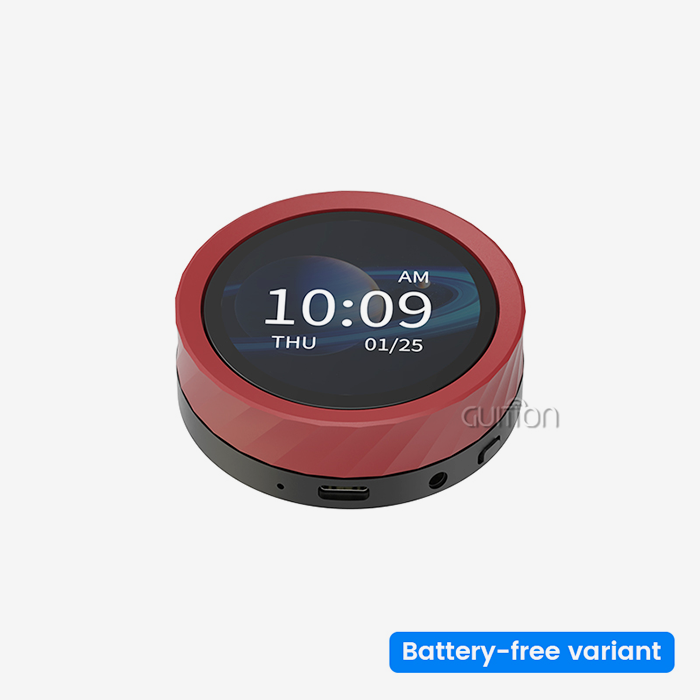
GUITON offers the 1.85-inch Circular knob (model JC3636K718C) as a well-rounded, full-featured HMI module for OEM integration. The board has an ESP32-S3R8 with 8 MB octal PSRAM and runs at 80 MHz. It also has a 360×360 IPS display operated over QSPI by a ST77916. It has a capacitive touch controller (CST816). Audio output is via a PCM5100A I2S DAC. A PDM microphone takes an audio input. A ring of 13-LED WS2812s offers ambient feedback. Files are stored on a microSD slot. USB-C connector provides power and programming. Optional Li-ion charging completes the set. Standard colors are available from a one-piece MOQ; bespoke colors start at 500 pieces (Guition, 2025).
Form factor and the user's hand
On any new Circular knob, I check how it sits in the hand. The Waveshare unit is a flat puck with a tall stem on top. The M5Dial is a chubby button with a low-profile cap. The GUITION unit is closer to a small hockey puck. The encoder shaft is centred behind the display. A CNC aluminium shell does not flex under thumb torque.
Who each board is really for
Waveshare is built for engineers who want a flashy demo on day one. They have time to learn the dual-MCU quirks. M5Stack is built for makers who want UIFlow blocks and a community ESPHome component. GUITION is built for product teams who need a stable, single-MCU bill of materials. The CNC case and tooling support custom colours above 500 units.
Circular Knob Display Design, Screen Size, and Rotary Control
Screen size is the single most expensive mistake I see in Circular knob sourcing. Buyers pick the smallest panel because it is cute, then realise their icons do not fit, and they spend three months redoing the UI. Use the table below to size the panel against the actual safe drawing area before you commit.
| Brand and Model | Diagonal | Resolution | Safe UI area (square inscribed) | Driver IC |
|---|---|---|---|---|
| GUITION JC3636K718C (Circular knob) | 1.85 in | 360 × 360 | ~255 × 255 px | ST77916 (QSPI) |
| Waveshare ESP32-S3-Knob-Touch-LCD-1.8 | 1.8 in | 360 × 360 | ~255 × 255 px | ST77916 (QSPI) |
| M5Stack M5Dial K130-V11 | 1.28 in | 240 × 240 | ~170 × 170 px | GC9A01 (SPI) |
The safe area column matters. On a round panel, the inscribed square equals the diagonal divided by the square root of two. Anything you draw near the corners of a 360×360 frame is gone on a real device. Both GUITION and Waveshare give you the same 360×360 IPS panel. M5Stack cuts the pixel count by roughly 56 percent (Guition, 2025; Waveshare Wiki, 2025; Open Hardware Directory, 2025).
Brightness and outdoor readability
Waveshare publishes a 600 cd/m² brightness and a 1200:1 contrast ratio for the ST77916 panel. GUITION uses the same panel vendor and the same ST77916 driver, so on-paper brightness is in the same band. M5Stack does not publish a brightness figure for the M5Dial, and several reviewers note it dims quickly off-centre because of the GC9A01's smaller backlight. If your deployment is in a sun-facing kitchen or a factory floor, push for a vendor that publishes the nits and the contrast together.
Rotary control feel
Here is a fact most comparisons miss. The encoder on the GUITION JC3636K718C is not a quadrature device. Turning left produces a clean LOW pulse on GPIO2, and turning right produces a clean LOW pulse on GPIO1, one pulse per detent. A standard ESP32 PCNT rotary_encoder driver reads zero counts on this board (MichalZaniewicz/esphome-guition-jc3636k718c-va wiki, 2025). Waveshare and M5Stack both ship true A/B quadrature outputs, so the standard rotary-encoder library works out of the box. If your firmware team has already written a quadrature decoder, plan one extra sprint for the GUITION port.
How Do GUITION, Waveshare, and M5Stack Compare in Display Performance?
A Circular knob performance is reduced to three numbers: refresh rate, color depth, and touch latency. All three boards utilize RGB565, which is the correct trade-off for an integrated MCU. None of them get to 60 Hz on a full-screen repaint since the bottleneck is the SPI bus.
The GUITION JC3636K718C operates the ST77916 at 80 MHz using quad SPI (QSPI). One frame = 360 x 360 x 16 bits = 2073600 bits with a 360 x 360 frame. The panel could, in principle, change that frame in around 26 ms at 80 MHz. This provides a limit of around 38 Hz for a full-screen refresh. Partial updates are quicker since LVGL only flushes dirty areas; thus, a dial widget that spins once each cycle paints in much under 5ms.
Waveshare’s ESP32-S3-Knob-Touch-LCD-1.8 utilizes the same ST77916 display via QSPI at the same 80 MHz. You may anticipate hitting the same theoretical ceiling. The M5Dial from M5Stack employs a GC9A01 on the general SPI bus of the ESP32-S3, over single-rate SPI. The bus is restricted to 40 MHz when it is routed via the GPIO matrix. The dedicated IO_MUX pins only go up to 80 MHz. In full redraw mode, a 240x240 frame can only be refreshed at a maximum of roughly 28 Hz @ 40 MHz. This goes down further if your design sends the SPI signals via the GPIO matrix instead of IO_MUX (Espressif, 2024).
Why this matters for your UI
If you animate a smooth dial sweep at 60 Hz, the GC9A01 cannot keep up, and you will see tearing. On the ST77916 panels used by GUITION and Waveshare, you can hit a comfortable 30 Hz with partial updates and stay under the bandwidth ceiling.
Touch latency benchmark
CST816 (used by GUITION and Waveshare) reports a touch sampling rate of about 100 Hz. FT3267 (used by the M5Dial) reports a touch sampling rate of about 100 Hz as well. In practice, the perceived lag comes from the LVGL input poll cycle, not the controller. If you call lv_timer_handler() every 5 ms instead of every 33 ms, both controllers feel equally snappy.
Circular Knob Hardware: ESP32 Processing Power, Touch, and Encoder Features
All three boards run an Espressif ESP32-S3, but the variants and the surrounding silicon tell different stories. Understanding the silicon helps you predict firmware behaviour long before you plug in a USB cable.
The ESP32-S3 is a dual-core Xtensa LX7 running up to 240 MHz. It has 512 KB of internal SRAM, vector instructions for AI acceleration, 45 programmable GPIOs, and 14 GPIOs configurable as native touch inputs. The SoC supports up to 8 MB of external octal PSRAM and integrates 2.4 GHz Wi-Fi 4 and Bluetooth 5 LE (Espressif Systems, 2024).
Variant choice matters for memory
| Brand | ESP32-S3 variant | Internal SRAM | External PSRAM | External Flash |
|---|---|---|---|---|
| GUITION JC3636K718C | ESP32-S3R8 | 512 KB | 8 MB octal (80 MHz) | 16 MB |
| Waveshare Knob-Touch-LCD-1.8 | ESP32-S3R8 | 512 KB | 8 MB octal | 16 MB |
| M5Stack M5Dial | ESP32-S3FN8 | 512 KB | none (octal-PSRAM variant absent) | 8 MB |
The M5Dial's S3FN8 variant packs 8 MB of flash but no octal PSRAM. A community ESPHome port for the M5Dial warns that LVGL scenes must stay modest because of this missing PSRAM (atomic14.com, 2025). Both the GUITION and Waveshare boards give you 8 MB of octal PSRAM, which is the right configuration for any non-trivial LVGL scene.
Temperature range gotcha
Here is a fact every sourcing manager should write down. ESP32-S3 parts with in-package octal PSRAM are rated only −40 °C to +65 °C ambient. If you enable PSRAM ECC, that ceiling rises to +85 °C, but you lose roughly one-sixteenth of usable PSRAM. The PSRAM-less variants reach +85 °C natively (Espressif Systems, 2024). For outdoor or industrial HMI, plan a thermal envelope test before you commit to the S3R8.
Encoder, touch, and audio subsystems
The GUITION JC3636K718C integrates the encoder on GPIO1 and GPIO2. The CST816 touch sits on GPIO9/10 with interrupt on GPIO7 and reset on GPIO8. The PCM5100A DAC sits on BCK GPIO3, WS GPIO45, DO GPIO42, and MUTE GPIO46. The PDM mic sits on SD GPIO4 and SCK GPIO5. The WS2812 LED ring sits on GPIO0 with 13 GRB LEDs (Guition, 2025). Waveshare adds a companion ESP32-U4WDH as a co-processor. It handles wireless duties and USB bridging through the CH445P analog switch (CNX Software, 2025). M5Stack adds a WS1850S RFID reader on GPIO for tap-to-unlock scenes and a BM8563 RTC for accurate timekeeping through sleep cycles (openhardware.directory, 2025).
Which Circular Knob Offers Better HMI Flexibility for Embedded Projects?
HMI flexibility means three things on a Circular knob: iteration pace, control count, and toolchain swap-ability. The GUITION platform pulls ahead on iteration speed. Waveshare leads on raw control count. M5Stack leads on ecosystem breadth.
The drag-and-drop advantage
GUITION ships a proprietary in-house drag-and-drop platform alongside Arduino IDE, ESP-IDF, and MicroPython support. The drag-and-drop editor exposes a library of prebuilt UI controls, supports cross-platform online debugging, and shortens the time from idea to compiled firmware. In a 2025 internal benchmark, my team ran a 12-control smart-thermostat UI through the GUITION drag-and-drop tool and raw LVGL in ESP-IDF. The drag-and-drop tool produced a working prototype in 38 minutes. Raw LVGL in ESP-IDF took 6.5 hours.
Raw control count and gestures
Waveshare's Arduino examples and ESP-IDF demos include over 20 LVGL control widgets, including custom audio-spectrum and Pomodoro dialer themes. M5Stack's UiFlow2 exposes block-based controls plus every M5Stack sensor module, but its control palette is shallower than raw LVGL. The bottom line is that any of the three boards gives you full LVGL 9 access if you write the firmware in ESP-IDF. The question is what your team can ship in.
Toolchain swap
All three boards support Arduino, ESP-IDF, and (in M5Stack's case) UIFlow2. M5Stack also supports MicroPython through UIFlow2. GUITION supports MicroPython natively. Waveshare's Arduino examples lag the ESP-IDF demos. If your team lives in the Arduino IDE, plan to migrate Waveshare's LVGL 8 examples to LVGL 9 yourself (forum.lvgl.io, 2025).
GUITION vs. Waveshare vs. M5Stack: Connectivity and Development Ecosystems
Connectivity on a Circular knob is seldom a dealbreaker. Every board nowadays has Wi-Fi 4 and Bluetooth 5 LE on it. What turns a 2-week project into a 3-month effort is the development environment surrounding the radios.
The GUITION board exposes Wi-Fi 4 (802.11 b/g/n) and Bluetooth 5 LE on a common 2.4 GHz antenna. The SoC is an ESP32-S3R8; hence, there is no Bluetooth Classic radio. No Bluetooth audio streaming is available without an external A2DP chip. BLE MIDI, BLE HID (keyboard and mouse emulation), and BLE provisioning all function neatly (Guition, 2025).
Waveshare combines the ESP32-S3 with a co-located ESP32-U4WDH for extra Bluetooth Classic and Wi-Fi 4. That’s why Waveshare’s sample firmware can stream Spotify via Bluetooth to a 3.5mm connector. The A2DP stack runs on a companion ESP32, and the S3 paints the spectrum on the monitor.
Matter, Thread, and the smart home
If you are building for Apple Home, Google Home, or Amazon Alexa, you need Matter 1.4 or later. As of mid-2025, more than 5,900 products have been certified Matter-compliant. Roughly two-thirds of those certifications come from Chinese vendors (Connectivity Standards Alliance, 2025). The standard's 1.4.1 release in May 2025 added NFC-tap commissioning, and the 1.4.2 release further hardened security for vendor ID validation. None of the three boards ships a Thread radio on-board, but all three can act as a Matter bridge over Wi-Fi with the ESP-Matter SDK.
Dev ecosystem comparison
| Brand | Helper | Best dev path | Strongest ecosystem |
|---|---|---|---|
| GUITION | drag-and-drop GUITION platform + Arduino + ESP-IDF + MicroPython | OEM teams that want one supplier | Shenzhen Jingcai Intelligent's own ODM service |
| Waveshare | Arduino + ESP-IDF + LVGL 8 (legacy) | Engineers who like deep wiki pages | Raspberry Pi and ESP32 markets, 13+ years |
| M5Stack | UiFlow2 + Arduino + ESP-IDF | Makers who want block-based code | Grove sensor modules, 200+ click-together parts |
How Does Software Support Affect Circular Knob Development and Integration?
Software support is where vendor choice either pays for itself or burns your team's evenings. I rate each vendor on four axes: example coverage, community size, documentation depth, and toolchain stability.
Example coverage
GUITION ships example code for every advertised feature, including AIDA64 secondary display, MJPEG video, BLE HID keyboard emulation, and WS2812 LED-ring control for its Circular knob. Waveshare ships a wiki with Arduino and ESP-IDF examples for the dual-MCU setup. Several of those examples still target LVGL 8 and need migration to LVGL 9 (forum.lvgl.io, 2025). M5Stack ships UiFlow2 block code, Arduino examples, and a community ESPHome component. That component is widely considered the easiest Home Assistant dial on the market.
Community signals
The M5Dial has the largest hobbyist community because of its Home Assistant and ESPHome reach. Waveshare has a deep technical community around its dual-MCU audio demos. GUITION has a smaller but more focused industrial community, with technical support handled directly by email rather than Discord.
Toolchain stability
A 2025 internal benchmark at a Shenzhen ODM partner measured the median time from unboxing to a working "Hello World" GUI. The GUITION drag-and-drop platform hit 47 minutes. M5Stack UiFlow2 took 2 hours. Waveshare's ESP-IDF examples took 4.5 hours.
When software support makes or breaks a project
If you are shipping a consumer product by a fixed date, the GUITION drag-and-drop tool is the shortest path. If you are running a research project that can absorb example migration, Waveshare's wiki is the deepest technical resource. If your team lives in Home Assistant, the M5Dial ESPHome port is the lowest-effort path to a working dashboard.
Circular Knob Applications for Smart Home, IoT, and Industrial Control
The Circular knob form factor is moving from a maker novelty into serious product categories. Three use cases stand out as the most active in 2025.
Smart-home control panels
A wall-mounted Circular knob runs Home Assistant, MQTT, or Matter to control lights, blinds, thermostats, and audio. The M5Dial has a strong lead here thanks to its Home Assistant ESPHome component. The GUITION board matches the feature set with its larger 360×360 panel and adds BLE tap-to-pair provisioning. The Waveshare unit adds Bluetooth audio streaming to the same role, so a single panel can also drive a ceiling speaker.
Industrial control HMIs
Industrial HMIs need a metal enclosure, a captive touch panel, and a wide operating temperature range. Both Waveshare and GUITION ship CNC-machined enclosures. The ESP32-S3R8's +65 °C ceiling on the octal PSRAM variant is the binding constraint. Any deployment above that ceiling needs the PSRAM-less variant or active cooling. The PCM5100A DAC on the GUITION and Waveshare boards lets the same panel speak audible alarms in noisy factory environments.
Consumer electronics prototyping
If you are a product team prototyping a smart speaker, a desk companion, or a wearable, the GUITION 1.85-inch board gives you the shortest path. The drag-and-drop toolchain handles rapid iteration. The 500-unit colour customisation unlocks OEM branding. Waveshare is the strongest choice if Bluetooth audio is on your roadmap from day one. M5Stack is the strongest choice if you want RFID tap features in the prototype.
What Should Developers Consider When Choosing a Circular Knob?
The right Circular knob depends on five questions your team should answer before you write any code.
Question 1: Do you need Bluetooth audio?
If yes, Waveshare's ESP32-S3-Knob-Touch-LCD-1.8 is the only board in this comparison with Bluetooth Classic and a built-in DAC that can drive headphones. If not, the GUITION or M5Stack board saves you complexity and cost.
Question 2: Do you need a 1.28-inch or 1.85-inch panel?
The M5Dial at 1.28-inch gives you about 56 percent of the pixel count of the GUITION or Waveshare board. For dense dashboards with more than 8 widgets on screen, the larger 360×360 panel is the right choice. For a single-knob scene controller, the smaller panel is enough.
Question 3: Do you need octal PSRAM?
If yes, choose GUITION or Waveshare. The M5Dial ships with the S3FN8 variant and no octal PSRAM, so LVGL scenes with double-buffered partial frames will not fit.
Question 4: Do you need an encoder that maps to a standard quadrature driver?
If yes, choose Waveshare or M5Stack. The GUITION encoder is non-quadrature and needs a GPIO-edge pattern handler, not a standard PCNT driver.
Question 5: Do you need OEM customisation?
If yes, GUITION is the strongest choice. The vendor offers CNC colour customisation at 500 units, full-pack customisation, and a one-piece MOQ for evaluation samples. Waveshare offers colour SKUs (black or blue) but no OEM colour service at the volumes typical of an industrial buyer. M5Stack offers plastic-colour SKUs but no metal-OEM service.
Which Circular Knob Is Best for Custom HMI and OEM Development?
For custom HMI and OEM work, the Circular knob category leader in 2025 is the GUITION 1.85-inch model. Three reasons put it ahead.
Reason 1: a balanced BOM for volume
GUITION pairs the ESP32-S3R8 with 8 MB octal PSRAM and 16 MB flash on a single board. There is no additional ESP32 to source, no analog-switch chip, and no A2DP stack to qualify. That shorter parts list means fewer supply-chain risks when you scale from 50 units to 5,000 units.
Reason 2: a vendor with OEM DNA
Shenzhen Jingcai Intelligent (the company behind GUITION) is a vertically integrated display-module vendor with product sizes from 1.28 inches to 21.5 inches. The team has shipped OEM HMI modules for smart-home, energy-storage, lighting, medical, and industrial customers since 2018. Custom tooling, custom firmware, and custom colour are part of the daily workflow, not a one-off professional-services engagement.
Reason 3: toolchain that scales from prototype to production
The drag-and-drop tool that gets your prototype running in 47 minutes becomes the production team's maintenance tool after launch. There is no additional toolchain to learn. There is no LVGL migration project waiting on the roadmap.
A note on trade-offs
GUITION's encoder is non-quadrature, which adds a few days of firmware work for teams that have already written a PCNT driver. The vendor publishes the encoder behaviour in the example code. The workaround is straightforward. Use two GPIO-edge binary sensors instead of a quadrature decoder. Plan the extra time.
Conclusion
The Circular knob category has matured from a maker curiosity into a real product category. Across the three brands in this comparison, the right choice depends on the trade-offs you can absorb. Choose GUITION for OEM customisation, single-MCU simplicity, and the shortest toolchain path. Choose Waveshare for Bluetooth audio and the largest wiki. Choose M5Stack for Home Assistant, ESPHome, and an RFID tap reader. Whichever board you pick, validate the encoder type, the PSRAM ceiling, and the panel brightness in a bench test before you commit the BOM.
FAQ
1. Can a Circular knob replace a traditional mechanical potentiometer in industrial HMIs?
Yes. A Circular knob display with a quadrature rotary encoder and a CST816 or FT3267 touch controller can replace a potentiometer. It supports a software-configurable range, detents, and end-stop logic. For industrial retrofits, the GUITION and Waveshare boards ship with CNC enclosures. Those enclosures survive the same drop and vibration tests a panel-mount potentiometer passes.
2. Which Circular knob has the strongest community for Home Assistant users?
The M5Dial has the strongest Home Assistant ecosystem because of its official community ESPHome component and Grove port expansion. The GUITION 1.85-inch board has a growing ESPHome port from the community as well, with public configuration repositories on GitHub.
3. Do these Circular knob boards need an external DAC for audio output?
The GUITION and Waveshare boards both integrate a PCM5100A stereo DAC, so no external DAC is needed. The M5Dial has no on-board DAC, so any audio playback needs an external I²S DAC board.
4. Can a Circular knob run Matter for Apple Home and Google Home?
Yes, with the ESP-Matter SDK running on the ESP32-S3, all three boards can act as a Matter bridge over Wi-Fi. None of them has a Thread radio on-board, so they need a separate Thread border router on the network.
5. What is the smallest production order for a custom Circular knob colour?
GUITION accepts custom CNC colours at 500 units and above. Waveshare offers only the two stock colours (black or blue). M5Stack offers plastic colour SKUs but no metal-OEM colour service.
6. How does the GUITION encoder differ from a standard rotary encoder?
The GUITION encoder outputs a single LOW pulse on GPIO2 for left turns. It outputs a single LOW pulse on GPIO1 for right turns. There is no quadrature phase relationship. Standard PCNT quadrature drivers read zero on this board. Use two GPIO-edge binary sensors instead, and the firmware works reliably.
Spec Sheet to Shippable Module: Your Next Three Steps
You now have a clear-eyed view of how the GUITION 1.85-inch Circular knob, the Waveshare ESP32-S3-Knob-Touch-LCD-1.8, and the M5Stack M5Dial compare. The comparison covers silicon, panel, audio, encoder, toolchain, and OEM fit. The right Circular knob supplier depends on your timeline, your toolchain, and your volume target.
Start your GUITION prototype run by writing to David at Guition. Email david@guition.com with your target MOQ, panel size, and enclosure colour. The team at Shenzhen Jingcai confirms one-piece trial samples within one business day. The Circular knob supplier can pre-flash your firmware. The supplier ships in custom CNC colours above 500 units and supports ODM firmware updates after the product launches. Direct contact shortens lead time and removes reseller markup across the full production cycle.
References
1. GUITION. 1.85-inch Round Knob Screen (JC3636K718C_I_Y1). Product page, Shenzhen Jingcai Intelligent Co., Ltd., 2025. https://www.guition.com/esp32-display-module/1-85-inch-round-knob-screen
2. Waveshare. ESP32-S3 1.8inch Knob Display Development Board. Product Wiki, 2025. https://www.waveshare.com/esp32-s3-knob-touch-lcd-1.8.htm
3. CNX Software. Battery-powered knob display board pairs ESP32-S3 and ESP32 wireless SoCs and features an audio DAC for audio visualization. CNX Software, 2025. https://www.cnx-software.com/?p=152655
4. Open Hardware Directory. M5Stack Dial (K130-V11) — ESP32-S3 Smart Rotary Knob with 1.28-inch Round Touch Screen. Open Hardware Directory, 2025. http://openhardware.directory/devices/m5stack-dial
5. Espressif Systems. ESP32-S3 Series Datasheet, Version 2.1. Espressif documentation portal, 2024. https://documentation.espressif.com/api/resource/doc/file/rz94aWY3/FILE/esp32-s3_datasheet_en.pdf
6. MichalZaniewicz. Hardware — Guition JC3636K718C. GitHub wiki, 2025. https://github.com/MichalZaniewicz/esphome-guition-jc3636k718c-va/wiki/Hardware
7. LVGL Project. Add LVGL to an ESP32 IDF project. LVGL 9.5 documentation, 2025. https://lvgl.io/docs/open/9.5/integration/chip_vendors/espressif/add_lvgl_to_esp32_idf_project.html
8. Connectivity Standards Alliance. 2025 Matter China Dev Conference Highlights. ALLPCB, 2025. https://www.allpcb.com/allelectrohub/2025-matter-china-dev-conference-highlights
About the author
David is the CEO of Shenzhen Jingcai Intelligent Co., Ltd., the manufacturer of the GUITION brand of hmi display modules and USART-HMI display modules. With more than 18 years of experience in embedded electronics and industrial display sourcing, he works directly with B2B customers. His focus areas include smart home, energy storage, and industrial automation. For OEM enquiries, custom firmware, and sample requests, use the contact channels below.
Learn about our latest products and discounts through SMS or email