- English
- French
- German
- Portuguese
- Spanish
- Russian
- Japanese
- Korean
- Arabic
- Greek
- German
- Turkish
- Italian
- Danish
- Romanian
- Indonesian
- Czech
- Afrikaans
- Swedish
- Polish
- Basque
- Catalan
- Esperanto
- Hindi
- Lao
- Albanian
- Amharic
- Armenian
- Azerbaijani
- Belarusian
- Bengali
- Bosnian
- Bulgarian
- Cebuano
- Chichewa
- Corsican
- Croatian
- Dutch
- Estonian
- Filipino
- Finnish
- Frisian
- Galician
- Georgian
- Gujarati
- Haitian
- Hausa
- Hawaiian
- Hebrew
- Hmong
- Hungarian
- Icelandic
- Igbo
- Javanese
- Kannada
- Kazakh
- Khmer
- Kurdish
- Kyrgyz
- Latin
- Latvian
- Lithuanian
- Luxembou..
- Macedonian
- Malagasy
- Malay
- Malayalam
- Maltese
- Maori
- Marathi
- Mongolian
- Burmese
- Nepali
- Norwegian
- Pashto
- Persian
- Punjabi
- Serbian
- Sesotho
- Sinhala
- Slovak
- Slovenian
- Somali
- Samoan
- Scots Gaelic
- Shona
- Sindhi
- Sundanese
- Swahili
- Tajik
- Tamil
- Telugu
- Thai
- Ukrainian
- Urdu
- Uzbek
- Vietnamese
- Welsh
- Xhosa
- Yiddish
- Yoruba
- Zulu
Capacitive touch display module for Medical Device Applications
When it comes to modern medical device design, the capacitive touch display module has become a foundational component. These integrated HMI assemblies combine a responsive touch sensor with a high-clarity display panel, enabling clinicians and patients to interact with equipment through intuitive, glove-compatible interfaces. Unlike older resistive screens that depend on physical pressure, a projected capacitive touch display module detects input by measuring changes in an ITO electrode grid — delivering speed, hygiene, and multi-touch precision that today's clinical environments demand. This guide walks procurement professionals, embedded engineers, and medical OEMs through everything they need to evaluate and source the right capacitive touch display solution.

Comparing Capacitive Touch Display Technologies for Medical Procurement
Instead of depending on marketing claims, you should look closely at success data when choosing the right touch technology. When it comes to the measures that count most in healthcare settings, projected capacitive modules always do better than infrared and resistive options.
Here's a quick look at the most important qualities for medical buying teams:
- Touch accuracy and repeatability: Projected capacitive panels achieve sub-millimeter coordinate linearity and low jitter, critical for parameter entry on infusion pumps or ventilator controls. Resistive panels drift over time; infrared panels are vulnerable to contamination in sterile zones.
- Glove and wet-finger operability: Advanced PCAP IC controllers—such as those from Goodix or Ilitek—support sensitivity-threshold tuning that enables reliable input through latex gloves up to 5 mm thick, without generating false touches from saline or gel spills.
- Environmental endurance: Medical-grade capacitive touch display modules meet ESD ratings of Contact ±8 kV and Air ±15 kV and endure High-Temperature High-Humidity tests at 60 °C / 90% RH for up to 500 hours — benchmarks resistive panels rarely match.
These technical differences directly lead to lower costs for upkeep and fewer broken devices on the ward floor.
Procurement Considerations: Buying Capacitive Touch Display Modules for Medical Devices
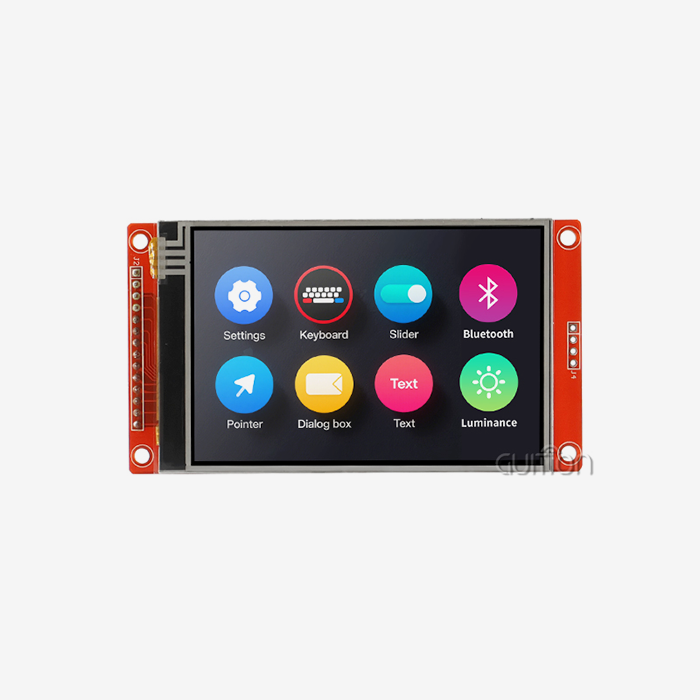
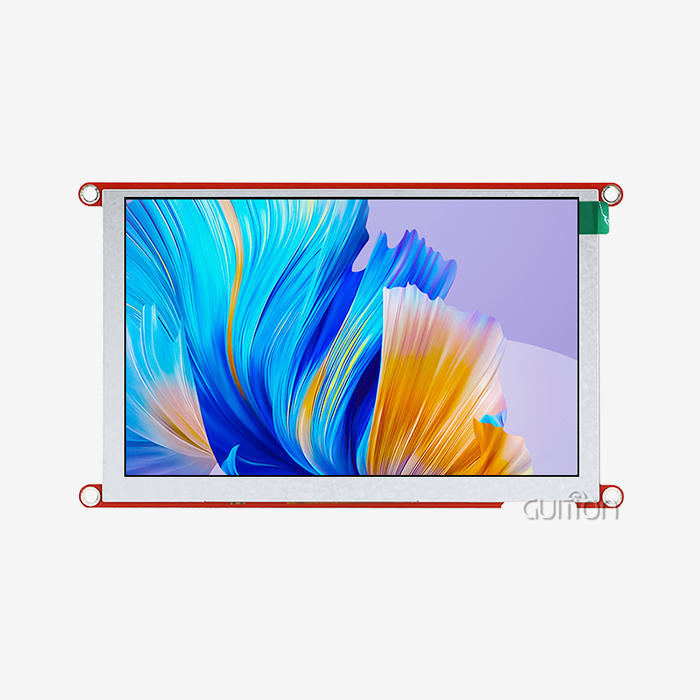
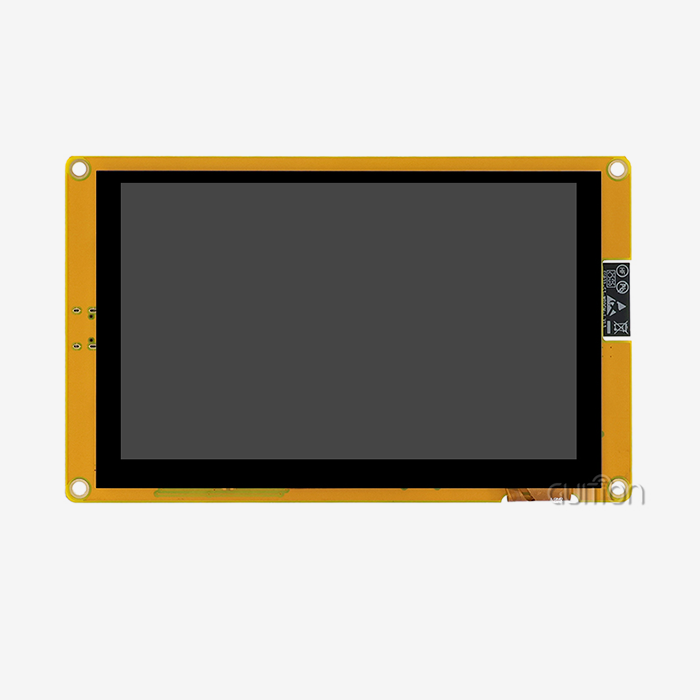
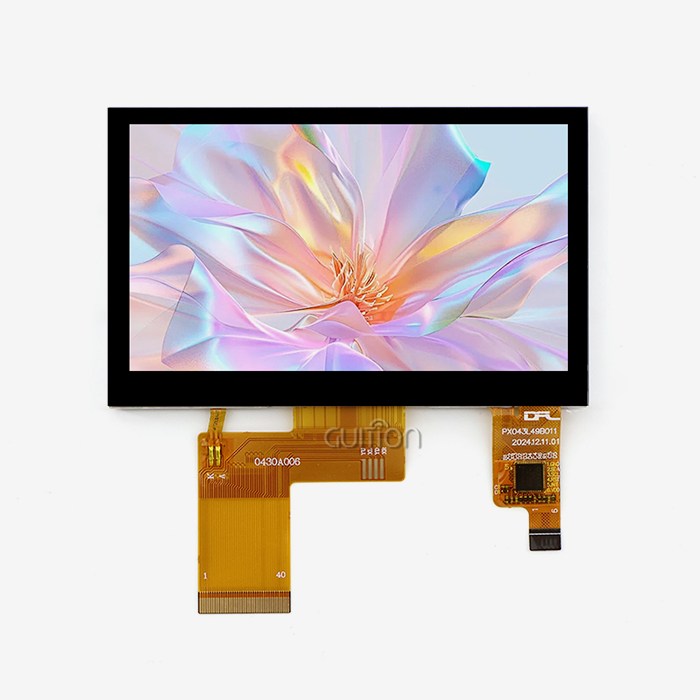
Technical fit, regulatory compliance, and supply-chain reliability must all be considered by procurement teams when looking for a Capacitive touch display module for medical applications. When teams are looking at 4.3-inch HMI options, the GUITION JC4827Q343C_I is a good place to start.
The part is made on an Artinchip D121BAV single-core MCU that runs at 400 MHz, which is fast enough to handle complex dynamic UI display without any frame drops. It has a 480 × 272 IPS screen with 65K colors and wide viewing angles, so it can be read from the side, which is popular in clinical settings. The capacitive touch sensor built in can detect input from both bare fingers and gloves. The module comes pre-programmed with test apps, so prototyping can start as soon as it gets to the factory.
The JC4827Q343C_I has important features for buying, such as the ones below. Each point shows a real engineering benefit that lowers the overall risk of the project:
- Cross-platform compatibility: The module supports Arduino, ESP-IDF, and the proprietary Guition development mode, accommodating engineers with different workflow preferences and reducing onboarding time.
- Built-in WiFi and Bluetooth: Wireless connectivity enables remote telemetry and OTA firmware delivery — eliminating the need for physical service visits to update deployed medical terminals.
- Drag-and-drop GUI tooling: Guition's online GUI development environment allows UI designers to place buttons, charts, and sliders without writing low-level graphics code, compressing development cycles significantly.
- Multi-language and UTF-8 encoding: Global medical OEMs can deploy a single hardware SKU across multiple regions simply by switching language packs — no separate firmware builds required.
- Reserved I/O ports for TF cards and sensors: Flexible peripheral connectivity supports integration with pulse-oximetry sensors, barcode readers, and data-logging modules common in medical device architectures.
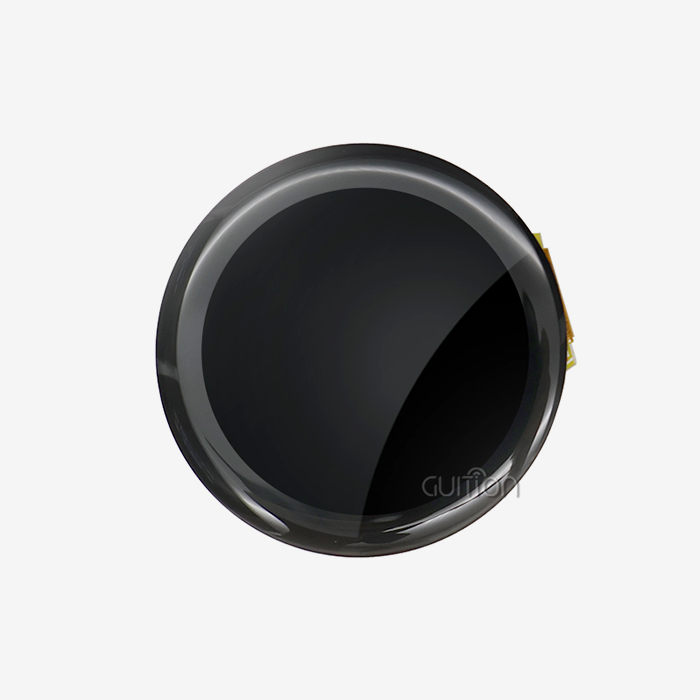
Fast time-to-market, low technical overhead, and scalable after-sales upkeep are some of the main problems that medical device R&D managers bring up. In addition to the JC4827Q343C_I, GUITION has a full line of products from 1.28" to 21.5", which can be used for everything from wearable patient monitors to large-format clinical workstations.
Troubleshooting and Maintaining Capacitive Touch Display Modules in Medical Devices
Common Issues and Recalibration Protocols
Ghost touches and dead zones are the two most common ways that a Capacitive touch display module can go wrong in hospital settings. Most of the time, ghost touches are caused by water pooling on the cover glass or EMI from imaging equipment next to it. Most cases of water interference can be fixed without replacing any hardware. This is done by adjusting the IC controller's firmware settings, especially the mutual-capacitance sensitivity level. Most of the time, dead zones mean that an ITO trace is broken or the bonding layer is damaged, which means that the module needs to be replaced under guarantee.
Cleaning and Sterilization Compatibility
For a touch screen medical display to work, it needs to be maintained in a way that protects against infections and extends the life of the hardware. Isopropyl alcohol (70%) and quaternary ammonium chemicals are safe for most cover glass surfaces that have been chemically hardened. If the module manual doesn't say that ultrasonic cleaning and steam autoclaving are okay, don't use them. Regularly looking at the bezel seal stops water from getting in, which can damage the sensitive sensor layer over time.
Future Trends and Innovations in Capacitive Touch Display Modules for Medical Devices
Three trends are coming together for the next generation of medical HMI displays: flexible substrate touch screens for curved device housings, AI-assisted gesture recognition for clean no-touch interaction, and tighter integrated system integration that makes the whole HMI stack smaller. When procurement teams look at suppliers, they need to look at more than just their current specs. They also need to look at their plans for firmware updates and hardware iterations. With GUITION's remote over-the-air (OTA) upgrade feature, deployed devices can get new features without having to be physically recalled. This logistical benefit becomes more valuable as regulatory agencies increase their post-market surveillance requirements.
Conclusion
Patient safety, regulatory approval, and the total cost of ownership can all be affected by choosing the wrong Capacitive touch display module for a medical device. There is a clear and important difference in technology between a consumer-level screen and a clinical-grade projected capacitive module. The JC4827Q343C_I from GUITION is a good example of a well-equipped 4.3-inch medical HMI display. It has a 400 MHz processor, IPS color accuracy, wireless connection, and an easy-to-use drag-and-drop programming toolchain. Teams that base their buying decisions on proven performance data and the dependability of their suppliers will always do better than teams that try to find the lowest unit price.
FAQ
Can a capacitive touch display module operate reliably with medical gloves?
Yes. Modern PCAP IC controllers let you change the sensitivity threshold so you can reliably input data while wearing latex or nitrile gloves that are up to 5 mm thick. Some tweaking of the firmware is needed during integration, but current medical-grade modules can work with gloves on.
What certifications should a medical-grade touch display module carry?
For the US market, the most important standards are ISO 13485 quality management certification and FDA 510(k) clearance (if needed). IEC 60601-1 compliance for electricity safety in hospital settings is also good for modules. Before placing a bulk order, you should always ask for proof of certification.
How does optical bonding improve a medical touch display?
A clear glue is used in optical bonding to fill the space between the cover glass and the display screen. This gets rid of internal reflections, makes the screen easier to read in direct sunlight, and makes the system stronger, all of which are important for small and portable medical devices.
Does the GUITION JC4827Q343C_I support remote firmware updates?
Yes. The module allows over-the-air (OTA) remote upgrades, enabling deployed units to receive firmware changes without requiring physical access. This is especially helpful for companies that manufacture medical devices with many installed bases across various locations.
Partner with GUITION for Your Next Capacitive Touch Display Module Project
Medical device makers, industrial automation integrators, and IoT solution providers all over the world rely on GUITION, a reputable Capacitive touch hmi display module producer. Our JC4827Q343C_I and the rest of our 1.28"–21.5" product line combine reliable hardware with the easy-to-use Guition GUI development tool. This lets you speed up prototypes and save money on engineering costs. Our team is ready to help you with your project from the specifications to the delivery, whether you need a single unit for testing or a lot of them for production. To get a price right away, email us at david@guition.com or go to https://jingcaizhineng.aixdb.cn/.
References
1. Bhalla, M. R., & Bhalla, A. V. — "Comparative Study of Various Touchscreen Technologies." International Journal of Computer Applications, 2010.
2. Hillis, W. D. — "Touch Sensitive Displays and Their Medical Applications." IEEE Transactions on Biomedical Engineering, 2015.
3. Grand View Research — Medical Display Market Size, Share & Trends Analysis Report. Grand View Research, 2023.
4. IEC — IEC 60601-1: Medical Electrical Equipment — General Requirements for Basic Safety and Essential Performance. International Electrotechnical Commission, 2020.
5. MarketsandMarkets — Human Machine Interface (HMI) Market — Global Forecast to 2027. MarketsandMarkets, 2022.
6. Shneiderman, B. — Designing the User Interface: Strategies for Effective Human-Computer Interaction, 6th ed. Pearson, 2016.
Learn about our latest products and discounts through SMS or email