- English
- French
- German
- Portuguese
- Spanish
- Russian
- Japanese
- Korean
- Arabic
- Greek
- German
- Turkish
- Italian
- Danish
- Romanian
- Indonesian
- Czech
- Afrikaans
- Swedish
- Polish
- Basque
- Catalan
- Esperanto
- Hindi
- Lao
- Albanian
- Amharic
- Armenian
- Azerbaijani
- Belarusian
- Bengali
- Bosnian
- Bulgarian
- Cebuano
- Chichewa
- Corsican
- Croatian
- Dutch
- Estonian
- Filipino
- Finnish
- Frisian
- Galician
- Georgian
- Gujarati
- Haitian
- Hausa
- Hawaiian
- Hebrew
- Hmong
- Hungarian
- Icelandic
- Igbo
- Javanese
- Kannada
- Kazakh
- Khmer
- Kurdish
- Kyrgyz
- Latin
- Latvian
- Lithuanian
- Luxembou..
- Macedonian
- Malagasy
- Malay
- Malayalam
- Maltese
- Maori
- Marathi
- Mongolian
- Burmese
- Nepali
- Norwegian
- Pashto
- Persian
- Punjabi
- Serbian
- Sesotho
- Sinhala
- Slovak
- Slovenian
- Somali
- Samoan
- Scots Gaelic
- Shona
- Sindhi
- Sundanese
- Swahili
- Tajik
- Tamil
- Telugu
- Thai
- Ukrainian
- Urdu
- Uzbek
- Vietnamese
- Welsh
- Xhosa
- Yiddish
- Yoruba
- Zulu
Can a 1.85-inch Round Knob Screen Improve Smart Appliance Controls?
A 1.85-inch round knob screen can meaningfully improve smart appliance controls. By combining a 360×360 IPS capacitive touch display with a physical rotary knob, this compact HMI module gives users both visual feedback and tactile input on a single surface. The Guition model JC3636K718C_I_Y1(GY) runs on an ESP32-S3 dual-core 240 MHz processor with built-in Wi-Fi and Bluetooth 5.0, making it a practical upgrade for appliance designers who need precise, space-efficient control without sacrificing connectivity or customization.

Understanding the 1.85-inch Round Knob Screen and Its Role in Smart Appliances
What Makes This Display Format Distinctive
The round knob format solves a real engineering problem: how can you show dynamic data while giving users tactile, analog-style control? With traditional potentiometers, you can't see what's going on. Standard rectangular touchscreens don't have the pleasing feel of a button. By putting a high-resolution circular display right on the surface that is used to operate the device, the 1.85-inch Round Knob Screen connects the two. This makes it perfect for thermostats, radio equipment, and industrial control screens that need to be able to see real-time data and accept precise input.
Technical Specifications Worth Knowing
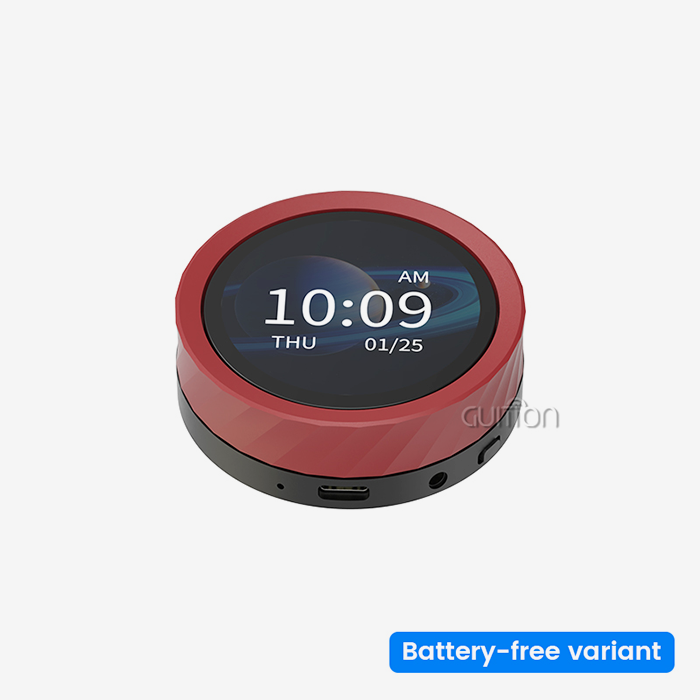
The JC3636K718C_I_Y1(GY) has a fully laminated 360x360 IPS sensitive touch screen, an ESP32-S3R8 processor that can go up to 240 MHz, 8 MB of PSRAM, and 16 MB of Flash. It has an RGB LED strip, a built-in speaker, a microphone, and a shaking motor, and it can decode MJPEG videos and play back music. With a TF card slot and a USB connection, it's easy to move media files. The unit works right out of the box without any extra hardware setup because all the drivers for the display, touch, and sound are already installed.
Build Quality and Material Standards
The housing is made of CNC-machined metal and comes in five anodized colors: blue, red, black, and purple. If you order 500 units or more, you can get custom colors. This level of build quality is important in industry and home appliances where the control interface may be touched often, be exposed to changes in temperature, or get wet. This tiny HMI part, which is only 1.85 inches long, has the durability you'd expect from a production-grade one.
Comparing the 1.85-inch Round Knob Screen with Other Knob Screen Types
Size Comparison: 1.5-inch vs. 1.85-inch vs. 2-inch
A 1.5-inch round screen can be squished when using it to navigate menus, especially in device interfaces where text and buttons need to be easy to read. A 2-inch form has more screen room, but it can mess up the ergonomics of small panel layouts. The 1.85-inch Round Knob Screen is a good compromise because it has a large enough screen for clear images at 360x360 resolution and still fits into standard 86mm panel cutouts found in smart home and commercial cases. This size gives most embedded HMI systems the best mix between being visible and having a small physical footprint.
Round vs. Square vs. Rectangular Display Formats
Round screens easily line up with the circular motion of a rotary knob, making a natural connection between the two. If your HMI screen is square or rectangular, it works well for menu-heavy interfaces but doesn't feel right when paired with rotary input. The circular shape keeps the user interface (UI) in line with the way things are manipulated physically in places like HVAC controls, audio mixers, or coffee machine menus. When engineers make goods that are both aesthetically pleasing and easy to use, they always choose the round knob display style for controls that are based on knobs.
Where the Round Knob Display Outperforms Pure Touchscreens
When your hands are wet or wearing gloves, capacitive touchscreens don't work as well. This is a real problem in kitchen tools, farm equipment, and medical devices. Users can interact with the device regardless of hand condition thanks to the 1.85-inch Round Knob Screen's support for both rotary and touch input. The mechanical knob also gives detent input that digital displays alone can't match. This is important for "eyes-free" operation in places like factories or cars where the user can't always look at the screen.
Installation and Maintenance Guide for 1.85-inch Round Knob Screens
Step-by-Step Installation Overview
In order to put the 1.85-inch Round Knob Screen into an appliance panel, there needs to be a circular cutout that is the same size. For the 1.85-inch form factor, this is usually around 46 mm in diameter. Depending on how the host board is set up, the unit can connect via USB or FPC cable. The JC3636K718C_I_Y1(GY) already has lights, touch, and audio drivers that are tuned, so the merging process doesn't need to set up any drivers. Developers link the module to a server that works with ESP32, load their UI project using the Arduino IDE, ESP-IDF, or the Guition platform, and then start testing right away.
Cleaning and Preventative Maintenance
The laminated IPS panel is better at keeping dust away than air-gap displays. For everyday cleaning, use a rubbing alcohol-based microfiber cloth that doesn't have any lint on it. Stay away from rough things that could scratch the cover glass. Every three to six months, check the space between the spinning knob ring and the fixed screen housing if you work in an area with oil mist or particles in the air. Putting a conformal coating on the PCB while it is being put together makes it last longer in places with a lot of humidity.
Troubleshooting Common Post-Installation Issues
If the touch response isn't consistent after installation, use the firmware calibration routine in the Guition development environment to recalibrate the capacitive layer. When the displayed value changes but the encoder doesn't physically rotate, this is called encoder drift. It's generally caused by a loose connection or a disagreement between software interrupts and hardware failure. Full technical docs and cross-platform debugging tools from Guition help engineering teams find and fix these problems quickly, cutting down on the average time it takes to fix a problem during product approval.
Procurement Strategies for 1.85-inch Round Knob Screens in B2B Markets
Sourcing Options and MOQ Flexibility
Guition's 1.85-inch Round Knob Screen has a low minimum order quantity of just one unit, which is a practical advantage. This lets the technical founders and R&D teams test the module in a prototype before committing to making a lot of them. Standard packaging comes in cartons with 86 units, but you can ask for custom packaging arrangements. When an order is confirmed, in-stock units are shipped the next business day. This keeps development schedules stable.
Evaluating Suppliers Beyond Price
When purchasing teams look at round knob display providers, they should not only look at price per unit, but also the quality of expert support, the amount of documentation, and the policies for firmware updates. Guition supports Arduino, ESP-IDF, MicroPython, and its own Guition platform and offers extra development interfaces and full technical documentation for these languages. With over-the-air (OTA) upgrades, firmware updates can be sent to goods that are already in use, which cuts down on the costs of service after the sale for makers.
Custom Orders and Long-Term Supply Agreements
OEMs that want to make a lot of units can get unique color finishes from Guition if they order 500 or more. As part of a full-service custom development package, you can also get help with adapting hardware and designing the user interface. By going directly to the manufacturer instead of going through distributors, procurement teams can see prices more clearly, get parts faster, and get help from engineers when they run into problems during integration.
Future Trends and Performance Optimization of Round Knob Displays in Smart Appliances
IoT Integration and Wireless Control Evolution
With its built-in Wi-Fi and Bluetooth 5.0, the JC3636K718C_I_Y1(GY) is a good choice for IoT-connected device designs. As smart home platforms and industrial IoT networks become more common, display modules that can talk to each other remotely without an extra bridge module will make the system simpler. The ESP32-S3 chip also supports over-the-air (OTA) firmware updates. This means that after the product launches, the display interface can change without having to physically access deployed units. This is a big benefit for manufacturers who are in charge of managing fleets of devices that are already in use.
Sustainable Materials and Long-Term Product Roadmaps
CNC-machined metal housings are already a more durable material choice than injection-molded plastic, which means that products last longer and need to be replaced less often. As regulators in both the US and EU push makers to make gadgets that last longer and can be fixed, the round knob display's modular design makes it easier to fix. When engineering teams are looking for HMI parts right now, they should look for sources that offer long-term supply guarantees and clear information about hardware revisions to ensure product stability.
Software and Ecosystem Advancement
The control library and cross-platform debugging features of the Guition development platform keep getting better. Because this platform supports switching between languages and UTF-8 encoding, products made on it can be used in different countries without having to have their hardware redesigned. As LVGL and other similar embedded graphics libraries get better, a 360x360 circular display will be able to show better images without needing more powerful processors.
Conclusion
A real need for tactile, analog-style control with real-time digital feedback in a small, production-ready package is addressed by the 1.85-inch Round Knob Screen in the HMI design of smart appliances. The JC3636K718C_I_Y1(GY) has strong processing power, wifi connection, built-in tools, and a durable CNC-machined housing that is easy to get to. Embedded engineers, product managers, and procurement teams looking at rotary HMI solutions should give this module a lot of thought for use in IoT, industrial, and home appliances.
FAQ
Does the 1.85-inch round knob screen require an external MCU?
No. The JC3636K718C_I_Y1(GY) runs on an onboard ESP32-S3 processor and comes with pre-loaded drivers. It operates independently without an external MCU for many applications.
What development environments does it support?
The round knob display is compatible with Arduino IDE, ESP-IDF, MicroPython, and the Guition platform, giving engineers flexibility based on their existing workflow.
Can I order a sample before committing to bulk?
Yes. The MOQ is one unit, and samples are available subject to review and approval. This supports low-risk prototype validation before scaling production.
Is customization available for the housing color?
Five standard finishes are available. Custom colors apply to orders of 500 units or more, which suits OEM production runs with specific brand requirements.
How does the round display handle wet-hand environments?
The rotary knob input works independently of the touch layer, so users can adjust settings through physical rotation even when the screen surface is wet or the user wears gloves.
Start Your Next HMI Project with Guition's 1.85-inch Round Knob Screen
From sample evaluation to full-scale production, Guition's 1.85-inch Round Knob Screen manufacturer team is ready to help you with the development of your product. Our tech team can help you with cross-platform development, hands-on documentation, and next-business-day shipping on in-stock items, whether you need a single unit for prototyping or a unique OEM solution. You can email us at david@guition.com or go to https://jingcaizhineng.aixdb.cn/ to ask for a sample or talk about the needs of your project.
References
1. Espressif Systems. ESP32-S3 Technical Reference Manual. 2023.
2. IEEE Transactions on Human-Machine Systems — "Tactile Feedback in Rotary Interface Design." 2022.
3. Grand View Research. Smart Home Market Size & Trends Report. 2023.
4. Journal of Embedded Systems and Applications — "Compact HMI Modules in Industrial IoT Devices." 2022.
5. IHS Markit (S&P Global). Global hmi display module Market Forecast. 2023.
6. Electronics Weekly — "ESP32-S3 in Consumer and Industrial Display Applications." 2023.
Learn about our latest products and discounts through SMS or email