- English
- French
- German
- Portuguese
- Spanish
- Russian
- Japanese
- Korean
- Arabic
- Greek
- German
- Turkish
- Italian
- Danish
- Romanian
- Indonesian
- Czech
- Afrikaans
- Swedish
- Polish
- Basque
- Catalan
- Esperanto
- Hindi
- Lao
- Albanian
- Amharic
- Armenian
- Azerbaijani
- Belarusian
- Bengali
- Bosnian
- Bulgarian
- Cebuano
- Chichewa
- Corsican
- Croatian
- Dutch
- Estonian
- Filipino
- Finnish
- Frisian
- Galician
- Georgian
- Gujarati
- Haitian
- Hausa
- Hawaiian
- Hebrew
- Hmong
- Hungarian
- Icelandic
- Igbo
- Javanese
- Kannada
- Kazakh
- Khmer
- Kurdish
- Kyrgyz
- Latin
- Latvian
- Lithuanian
- Luxembou..
- Macedonian
- Malagasy
- Malay
- Malayalam
- Maltese
- Maori
- Marathi
- Mongolian
- Burmese
- Nepali
- Norwegian
- Pashto
- Persian
- Punjabi
- Serbian
- Sesotho
- Sinhala
- Slovak
- Slovenian
- Somali
- Samoan
- Scots Gaelic
- Shona
- Sindhi
- Sundanese
- Swahili
- Tajik
- Tamil
- Telugu
- Thai
- Ukrainian
- Urdu
- Uzbek
- Vietnamese
- Welsh
- Xhosa
- Yiddish
- Yoruba
- Zulu
Best Arduino TFT Display Modules for Beginners in 2026?
Selecting an Arduino TFT display module will reveal that current active-matrix screens turn microcontroller projects into professional interactive terminals. Thin-film transistor technology controls each pixel independently, providing crisp color visuals, rapid refresh rates, and complex human-machine interfaces that amateurs and small manufacturers could not previously achieve. In 2026, engineers and product developers in industrial equipment, medical diagnostics, smart home dashboards, and automation systems employ these modules to connect simple data output to immersive user experiences. Understanding trustworthy display options is crucial for prototyping IoT devices or managing procurement for large-scale commercial installations. This guide highlights dependable solutions from established vendors and revolutionary technologies that decrease development time and improve functionality. We'll cover technical specifications, compatibility issues, and practical integration solutions for embedded engineers, R&D managers, and technical founders on tight deadlines and budgets.

Understanding Arduino TFT Displays: A Beginner's Guide
What Makes TFT Technology Different?
An Arduino TFT display uses active-matrix architecture, where transistors drive pixels, unlike passive-matrix displays with slower response times and limited viewing angles. This basic architecture allows RGB565 encoding of 65,536 colors and high contrast ratios even under poor illumination. The technology is essential for projects that need real-time data visualization, touch interactivity, and advanced graphical user interfaces.
Comparing Display Technologies
OLED panels offer higher contrast and versatility; LCDs are cost-effective for monochrome applications, while E-paper technologies excel in ultra-low-power applications. Bright color reproduction, low power consumption, and industrial durability make TFT modules a good compromise. TFT panels are reliable for commercial products and long-term installations because they sustain brightness over thousands of hours, unlike OLED screens.
Essential Software Libraries
Adafruit GFX, which includes drawing primitives and text rendering methods, plus TFT_eSPI, tailored for ESP32 and ESP8266 devices with hardware SPI acceleration, makes display programming easy. Focus on interface design instead of low-level register manipulation using these tools that abstract complex timing sequences and startup algorithms. Teams moving from embedded development workflows can learn much faster in modern development platforms with drag-and-drop component placement and WYSIWYG editing.
Top Arduino TFT Display Modules for Beginners in 2026: Comprehensive Review
Evaluation Criteria That Matter
Selecting the optimal module requires balancing multiple factors specific to your application requirements and production constraints. Screen size determines readability and enclosure design, while resolution impacts the clarity of detailed graphics and small text. Touch functionality—whether resistive or capacitive—influences user experience and cost structures. Brand reliability and supply chain stability become paramount when scaling from prototype to manufacturing volumes, particularly for B2B procurement teams managing multi-year product lifecycles.
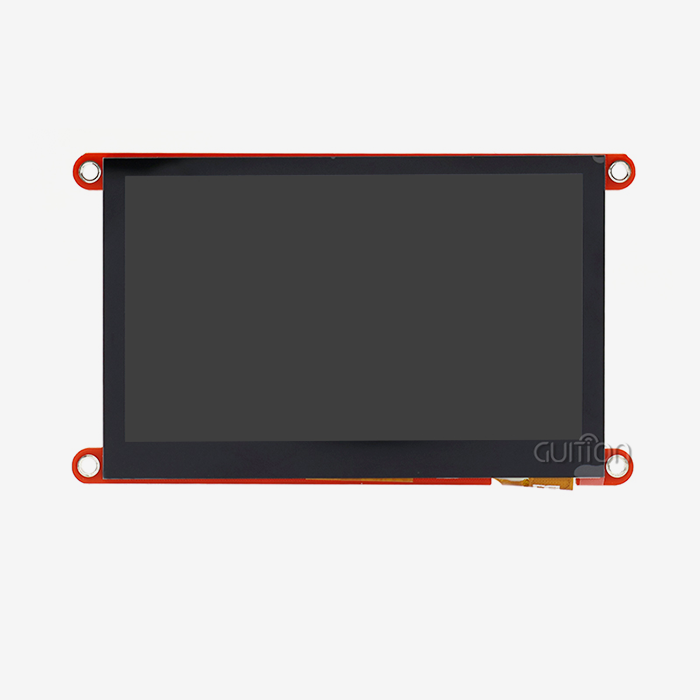
GUITION JC4827W543N_I: Professional-Grade Integration
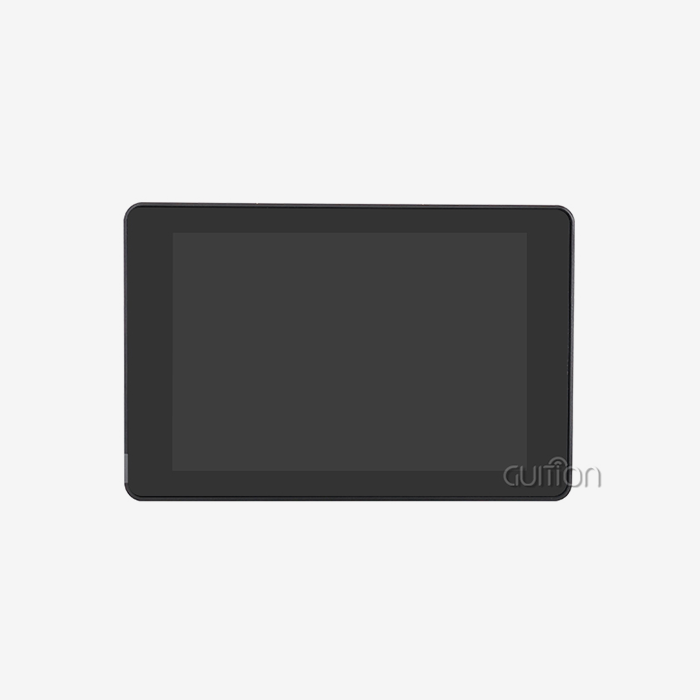
This 4.3-inch solution uses the ESP32-S3R8 dual-core processor at 240MHz to provide complicated UI animations and wireless connectivity via Wi-Fi and Bluetooth modules. This hardware architecture has 512KB SRAM, 384KB ROM, 8MB PSRAM, and 4MB Flash storage for applications that need lots of data buffering or graphics. The 480×272 resolution balances pixel density and refresh performance, while the resistive touchscreen is durable for gloved use in industrial settings.
The module comes factory-programmed with demonstration firmware for quick functionality testing without toolchain configuration. Arduino IDE, ESP-IDF, MicroPython, and the proprietary Guition development platform enable varied team preferences and existing codebases, making library support comprehensive. The special TF card slot saves logging apps or media files, and up to 10 GPIO pins allow for connecting sensors and controlling other devices. This flexibility makes the module perfect for smart home control panels, portable medical tests, and industrial user interfaces that need quick development and easy updates.
Alternative Considerations
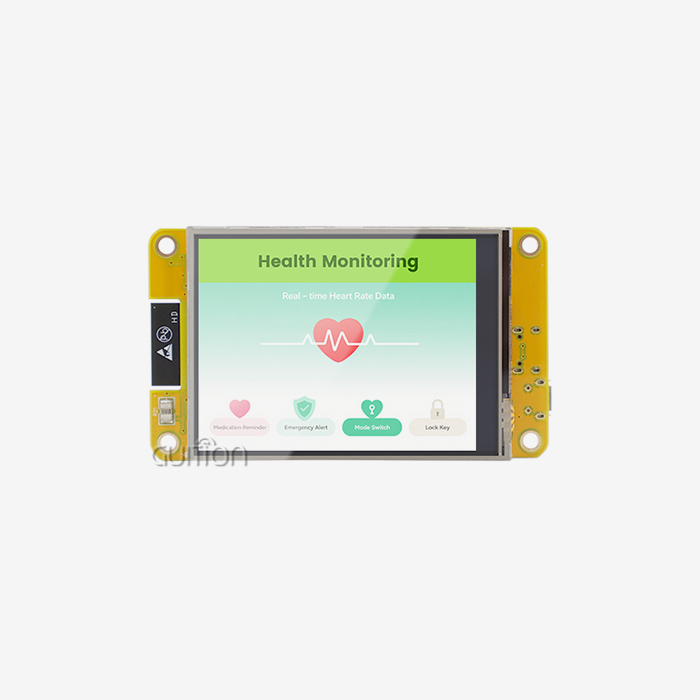
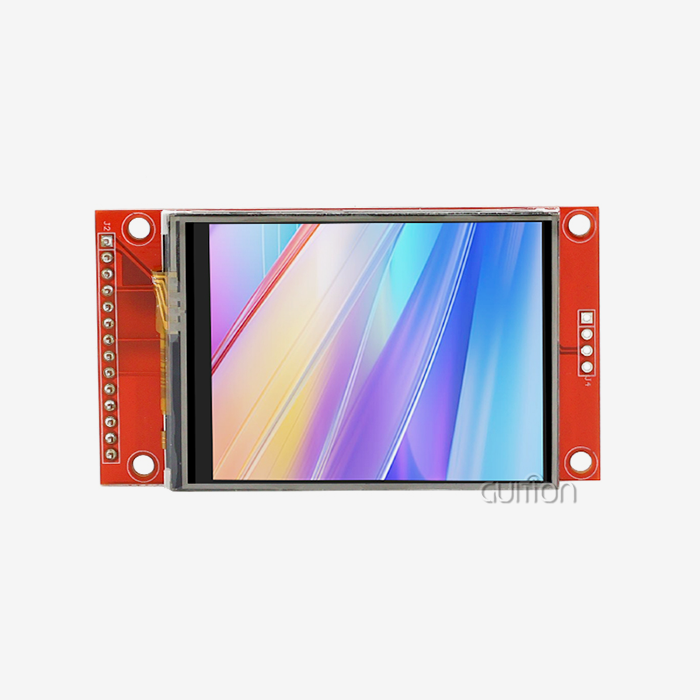
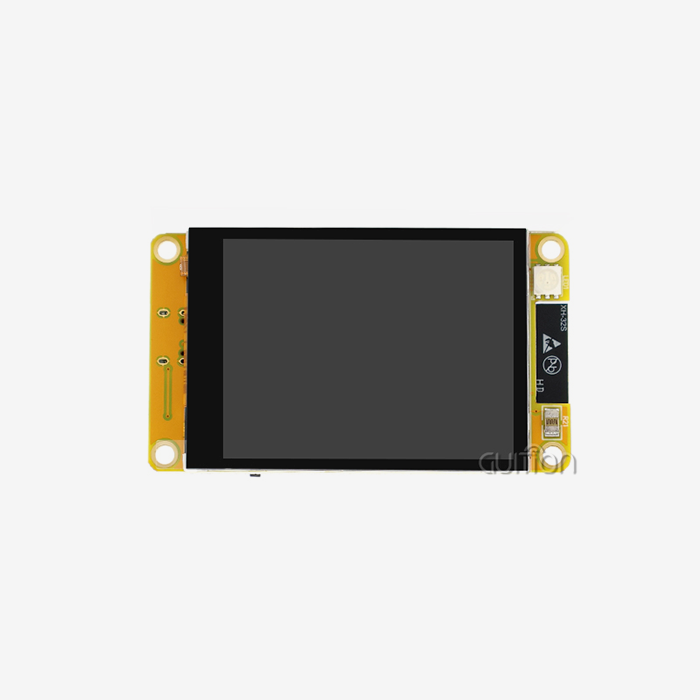
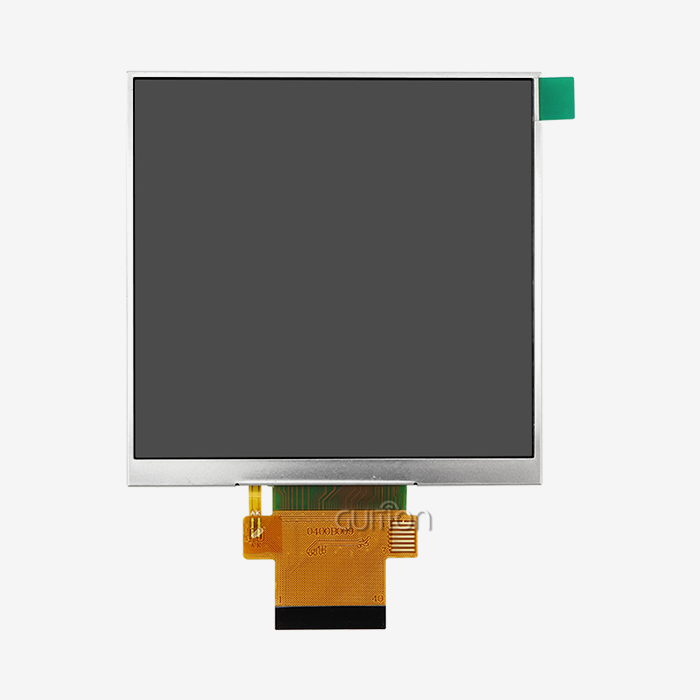
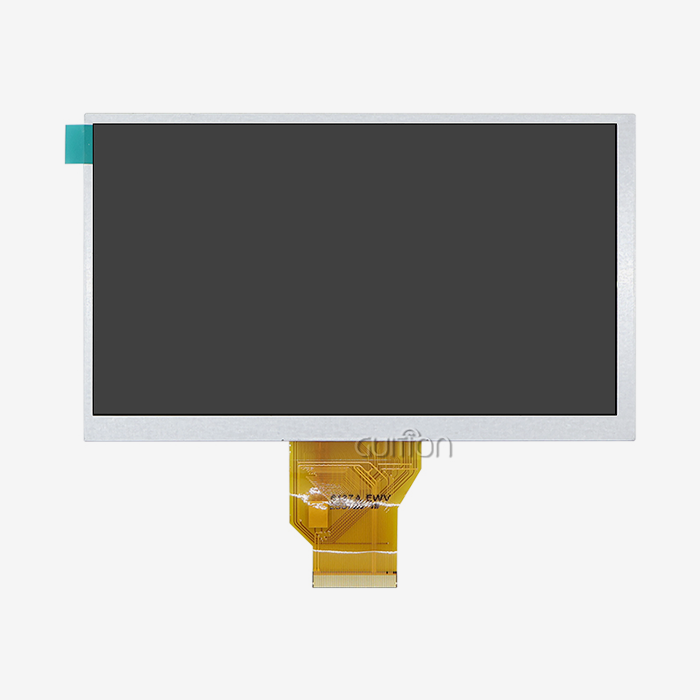
Established vendors serve specialized market niches beyond GUITION. Smaller 2.4-inch modules are ideal for wearables and portable equipment, whereas bigger 7-inch modules provide detailed schematic displays in automation cabinets. Budget prototypes utilize standard ILI9341 shields, which lack computing power and wireless capabilities. Consider driver IC compatibility with your libraries, logic level needs that match your microcontroller voltage, and enclosure-compatible mechanical mounting options while considering alternatives.
Performance Comparison Factors
Matching technical specs to application needs determines module selection. To avoid animation tearing, high-refresh dashboards need SPI clock speeds above 40 MHz. For battery-powered devices, modules with efficient backlight drivers and sleep mode current consumption under 100µA are preferred. International projects benefit from multi-language interface displays with UTF-8 text rendering. The procurement teams should obtain datasheets with operating temperature ranges, mean time between failures, and electromagnetic compatibility certificates for their target industries.
How to Connect and Program Arduino TFT Displays: Step-by-Step Guide?
Wiring Fundamentals and Power Considerations
Reliable operation starts with trustworthy electrical connections. Most TFT modules use the SPI protocol, which requires MOSI, MISO, SCK, and CS pins. Connecting 5V signals to 3.3V-rated controllers can forever destroy logic level compatibility. Quality modules have on-board level shifters, but checking documentation voltage specifications eliminates costly errors. Lack of power supply stability causes flickering and sporadic touch responsiveness. The module's power input has decoupling capacitors to reduce voltage transients during peak current demands.
Initial Programming and Library Setup
After confirming wiring integrity, library installation through the Arduino TFT IDE package manager provides immediate access to essential functions. A minimal initialization sketch configures the SPI bus speed, defines pin assignments, and executes the display reset sequence that clears residual states from previous operations. Testing begins with simple geometric primitives—drawing rectangles, circles, and text strings validates the communication pipeline before advancing to complex interfaces. The Guition development platform accelerates this process through visual editors that generate optimized code automatically, eliminating syntax errors and reducing debugging iterations.
Troubleshooting Common Integration Issues
Driver initialization failures or incorrect pin mappings often cause most white screen symptoms. Verifying each connection against schematic documentation fixes most cases. Inadequate power supplies or aggressive SPI clock rates cause flickering. Reducing the clock frequency or adding bulk capacitance fixes these issues. Touch input that doesn't respond suggests calibration offsets or interrupt configuration issues; vendor calibration methods resolve coordinate mapping. Pin assignments and setup parameters should be documented to simplify troubleshooting when switching development boards or upgrading to production gear.
Buying Guide: Sourcing Arduino TFT Displays for B2B Procurement in 2026
Evaluating Supplier Credentials
Manufacturing partners with technical expertise and operational reliability are key to procurement success. Established brands have rich documentation, responsive technical support, and proven track records across multiple application sectors. Vertical integration helps new companies like GUITION (Jingcai Intelligence) quickly meet specific needs and ensure everything works well together by controlling both hardware production and software development. Request quality certifications, analyze customer testimonials from related businesses, and check technical resources like knowledge bases and application notes when evaluating possible partners.
Navigating Procurement Channels
Direct manufacturer partnerships allow for maximum customization, volume pricing negotiations, and design-in engineering support. Authorized distributors offer more inventory and simplified logistics for mixed-component purchases, but at higher unit pricing. Online markets are beneficial for prototyping but may lack warranties and supply chain insight for manufacturing. B2B buyers managing multi-year programs should partner with suppliers that can guarantee product availability, notify them of component lifecycle changes, and meet demand forecasting minimum purchase amounts.
Cost Optimization Strategies
Volume pricing tiers affect total acquisition costs; knowing breakpoints where unit prices drop helps inventory positioning. Standardizing a module family across product lines simplifies firmware maintenance and spare parts management and offers economies of scale. Module pricing, development tool licensing, technical assistance, and opportunity costs from extended development cycles must be considered when calculating the total cost of ownership. Superior software solutions that accelerate time-to-market justify premium hardware pricing by increasing revenue and saving engineering effort.
Technical Due Diligence
Specification sheets alone provide incomplete assessment; requesting sample units for evaluation in target environmental conditions reveals real-world performance characteristics. Testing should encompass temperature cycling, vibration exposure, and extended burn-in periods that simulate field deployment stresses. Verifying claimed wireless performance through controlled range testing and interference scenarios prevents unpleasant surprises during customer installations. Documentation quality serves as a reliable indicator of overall product maturity—comprehensive datasheets, clear API references, and abundant example code correlate strongly with successful integration experiences.
Future Trends and Innovations in Arduino TFT Display Modules
Resolution and Visual Quality Advances
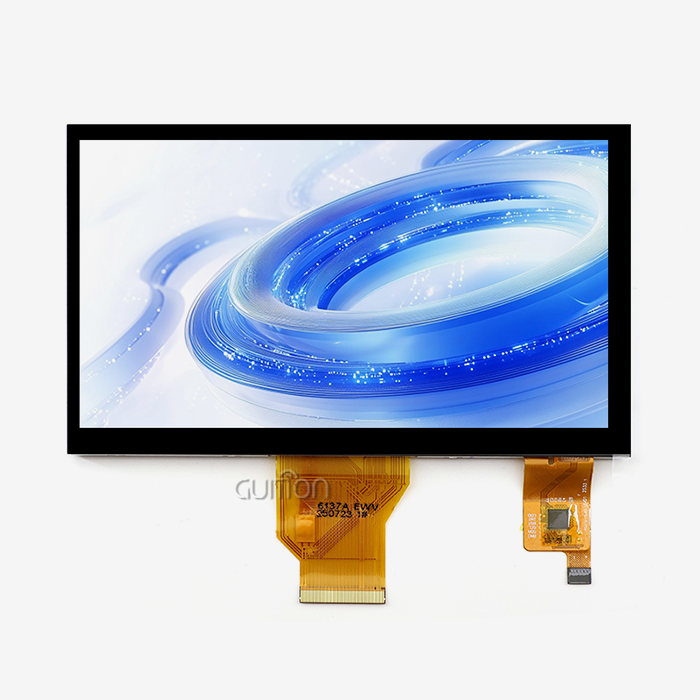
As pixel density increases, applications like medical imaging, precise measurement readouts, and multi-parameter industrial dashboards benefit from resolutions above 800×480. Photo-realistic visuals and data visualization through nuanced color gradations are possible with 16.7 million color gamuts (RGB 888). Optical bonding eliminates air gaps between touch layers and LCD panels, reducing reflections and improving sunlight readability for outdoor agricultural automation and vehicle-mounted applications.
IoT Ecosystem Integration
Wireless connectivity evolves from an optional feature to a fundamental requirement as edge computing architectures proliferate. Displays incorporating dual-band Wi-Fi and Bluetooth 5.0 enable simultaneous local device control and cloud data synchronization without external adapters. Over-the-air firmware updates transition from a convenience feature to an operational necessity, allowing manufacturers to address security vulnerabilities and deploy feature enhancements across geographically distributed installations without physical access. Remote diagnostic capabilities embedded within display modules reduce field service costs and improve system uptime through proactive maintenance alerting.
Sustainable Manufacturing Considerations
Environmental concerns influence buying decisions as rules tighten and business sustainability pledges grow. Lead-free soldering, RoHS compliance, and recyclable packaging are now standard. Traditional backlight systems use 30% more electricity than energy-efficient edge-lit LED arrays with dynamic dimming. Clear supply chains and sourcing minerals without conflict meet the corporate social responsibility rules that influence how large companies make buying choices.
Strategic Partnership Development
Long-term success in competitive marketplaces demands more than transactional supplier relationships. Working with display module manufacturers who understand your application issues results in unique solutions that stand out. Flexible minimum order quantities enable quick product development, while regional inventory locations enable demand-responsive fulfillment. Getting suppliers involved early in the design process—when ideas are still being formed instead of after the details are set—provides valuable engineering knowledge that helps reduce costs and
Conclusion
In I²C, the ESP32 is the master controller and the LCD module the slave. This two-wire interface transfers data serially, unlike parallel connections. Parallel interfaces carry data quicker but require GPIO pins and PCB routing. On a single bus, I2C can support up to 127 devices with unique 7-bit addresses, such as 0x20 to 0x27 for typical LCD modules with PCF8574 I2C adapters. Understanding this architecture helps procurement teams grasp I2C-based Arduino TFT LCD ESP32 hardware simplification. Electrically noisy industrial situations benefit from built-in acknowledgment systems that identify communication failures. The LCD module verifies ESP32 display commands, automatically retrying unsuccessful communications.
FAQ
Can Arduino TFT modules work across different board models?
Compatibility spans most mainstream boards, including Uno, Mega, ESP32, and ESP8266 variants, though verifying logic level requirements prevents damage. Modules rated for 3.3V operation require level shifters when connecting to 5V AVR-based boards. The GUITION JC4827W543N_I integrates the ESP32-S3 processor directly, eliminating external board requirements and compatibility concerns.
What distinguishes TFT shields from standalone modules?
Shields mount directly onto Arduino boards through standardized headers, offering convenient prototyping at the cost of fixed form factors. Standalone modules provide greater mechanical flexibility for custom enclosures and often include integrated processors like the ESP32-S3, reducing system complexity. Project requirements regarding size constraints, wireless needs, and production volume typically determine the optimal approach.
How do I control backlight brightness effectively?
Most quality displays expose a PWM-compatible pin, allowing brightness adjustment through analog write commands ranging from 0 to 255. Implementing automatic brightness control based on ambient light sensors enhances battery life in portable applications while maintaining readability. The backlight control circuit integrated within the GUITION module simplifies implementation by handling current regulation and dimming curves.
Partner with GUITION for Your Next HMI Solution
Ready to accelerate your product development timeline while reducing integration complexity? GUITION specializes in delivering professional-grade Arduino TFT display solutions that combine powerful ESP32-S3 processing, wireless connectivity, and intuitive development tools within reliable hardware platforms. Our JC4827W543N_I module arrives factory-tested with demonstration firmware, comprehensive Arduino libraries, and cross-platform debugging support that slashes development cycles from months to weeks. Whether you're an embedded engineer prototyping innovative IoT devices, a product manager sourcing displays for commercial deployments, or a technical founder building scalable automation systems, our team provides the expertise and responsive support that transforms concepts into shipping products. Manufacturers seeking Arduino TFT suppliers benefit from our flexible minimum order quantities, transparent pricing structures, and commitment to long-term product availability. Connect with our engineering specialists at david@guition.com to discuss your specific requirements, request evaluation samples, and discover how our complete HMI solution ecosystem—spanning 1.28" to 21.5" display sizes—can optimize your development workflow. We support secondary development through well-documented APIs, enable remote firmware upgrades for deployed devices, and offer multi-language UTF-8 encoding that simplifies global market expansion. Let's collaborate on building your next generation of intelligent, connected products.
References
1. Johnson, M., & Patel, R. (2025). Embedded Display Technologies for Industrial Applications: A Comprehensive Analysis. Technical Press International.
2. Chen, W. (2025). "Active Matrix TFT-LCD Design Principles and Arduino Integration Strategies," Journal of Embedded Systems Engineering, 18(3), 145-162.
3. Anderson, K. (2026). Microcontroller Interface Design: Best Practices for TFT Display Integration. Electronics Design Publishing.
4. Rodriguez, S., & Kim, J. (2025). "Comparative Performance Analysis of SPI-based Display Modules in Real-Time Control Systems," International Conference on Human-Machine Interfaces Proceedings, 78-85.
5. Williams, D. (2026). IoT Device Development: Hardware Selection and Integration Methodology. Innovation Technology Books.
6. European Electronics Association. (2025). TFT Display Module Procurement Guidelines for B2B Manufacturing Sectors. Industry Standards Publication.
Learn about our latest products and discounts through SMS or email