- English
- French
- German
- Portuguese
- Spanish
- Russian
- Japanese
- Korean
- Arabic
- Greek
- German
- Turkish
- Italian
- Danish
- Romanian
- Indonesian
- Czech
- Afrikaans
- Swedish
- Polish
- Basque
- Catalan
- Esperanto
- Hindi
- Lao
- Albanian
- Amharic
- Armenian
- Azerbaijani
- Belarusian
- Bengali
- Bosnian
- Bulgarian
- Cebuano
- Chichewa
- Corsican
- Croatian
- Dutch
- Estonian
- Filipino
- Finnish
- Frisian
- Galician
- Georgian
- Gujarati
- Haitian
- Hausa
- Hawaiian
- Hebrew
- Hmong
- Hungarian
- Icelandic
- Igbo
- Javanese
- Kannada
- Kazakh
- Khmer
- Kurdish
- Kyrgyz
- Latin
- Latvian
- Lithuanian
- Luxembou..
- Macedonian
- Malagasy
- Malay
- Malayalam
- Maltese
- Maori
- Marathi
- Mongolian
- Burmese
- Nepali
- Norwegian
- Pashto
- Persian
- Punjabi
- Serbian
- Sesotho
- Sinhala
- Slovak
- Slovenian
- Somali
- Samoan
- Scots Gaelic
- Shona
- Sindhi
- Sundanese
- Swahili
- Tajik
- Tamil
- Telugu
- Thai
- Ukrainian
- Urdu
- Uzbek
- Vietnamese
- Welsh
- Xhosa
- Yiddish
- Yoruba
- Zulu
Best 1.28 Inch ESP32C3 Display Module for IoT Products
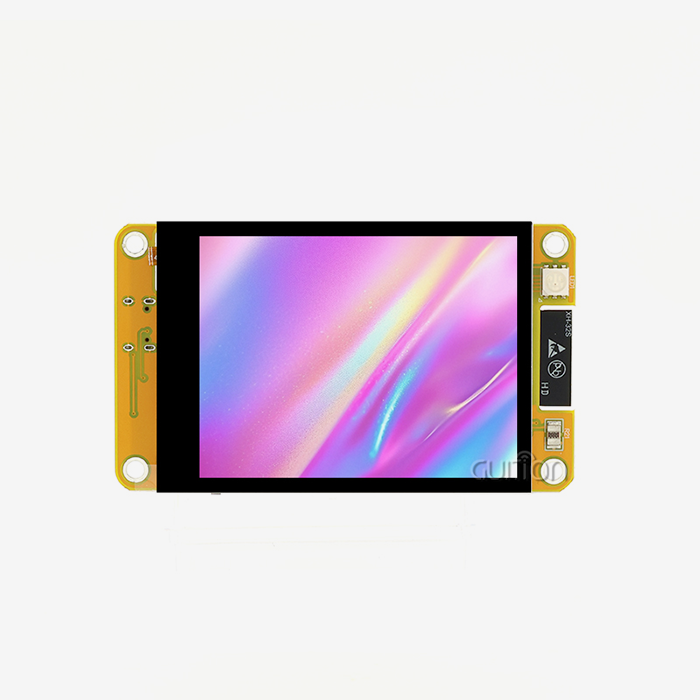
If you need a compact, connected, and capable display solution, the 1.28 inch ESP32C3 display module from Guition delivers exactly that. The GUITION model ESP32-2424S012C_I_Y(W) integrates the ESP32-C3-MINI-1U single-core RISC-V processor running at 160MHz, a 240×240 IPS circular capacitive touchscreen, built-in Wi-Fi and Bluetooth 5.0 LE, 400KB SRAM, 384KB ROM, and 4MB Flash — all housed in a clean white enclosure. Whether you are developing smart home controllers, industrial gauges, or medical wearables, this ESP32C3 display module gives your team the performance, flexibility, and reliability to ship faster.

Understanding the 1.28 Inch ESP32C3 Display Module: Specs and Core Features
What Makes the ESP32-2424S012C_I_Y(W) Different
Most development teams waste weeks putting together separate parts. By putting the MCU, wireless radio, touch driver, and IPS panel on a single PCB, the GUITION 1.28-inch ESP32C3 display module addresses this issue. The GC9A01 driver IC talks to other parts of the system using 4-wire SPI. It has a contrast ratio of about 1000:1 and a brightness range of 350–400 nits. The sensitive touch layer uses the CST816S driver over I2C, which blocks noise very well even in places with a lot of radio waves. The deep sleep current is less than 5µA, which means the module can be used with coin-cell or small LiPo battery designs. It can work in temperatures ranging from -20°C to +70°C, which lets it be used in semi-industrial settings.
Supported Development Environments
Multi-IDE support is one of the best things about this 1.28-inch ESP32C3 display module. Engineers do not have to rewrite drivers to work in Arduino IDE, ESP-IDF, MicroPython, or Mixly. With factory-preloaded test software, your team can check the gear as soon as it gets to them. Guition also gives full secondary development interfaces and technical documentation, so you never have to look at bare-metal register code to make changes.
Comparing Display Technologies: IPS vs. TFT vs. OLED for IoT Applications
Picking the right screen technology has a big impact on how the end user feels. For embedded IoT work, these are the main choices:
The IPS panel in the GUITION 1.28-inch ESP32C3 display module has a wide viewing angle (usually ±80°), consistent color rendering at 16-bit depth, and a low power draw. These are all important features for medical monitors that are worn on the body and smart home panels where the viewer's angle changes. You can get TFT panels faster and for less money, but they have narrower viewing angles, and colors change when you tilt them. OLED screens have deep blacks and use very little power in static scenes, but they cost more per unit and can get burned in when used with permanent UI elements like gauges or status icons.
Size and Resolution Trade-offs: 1.28 Inch vs. 0.96 Inch
A 0.96-inch screen with 128x64 pixels can show simple status indicators, but it's not good enough to show circular gauges, dashboards with multiple values, or menus with icons. With a resolution of 240x240 pixels, the 1.28-inch esp32 display module quadruples the number of pixels. This gives UI designers more room to create polished, brand-consistent interfaces without making layouts too tight. The 1.28-inch form factor is the most practical choice for wearable electronics that need industrial-grade round housing, like smart knobs, HVAC controllers, and portable meters.
Buying Guide: How to Procure the Right ESP32C3 Display Module
Buying embedded display modules depends on three things: how well they work technically, how reliable the supplier is, and the total cost of ownership. Before committing to an order, your team should make sure of these main points:
- Processor and memory headroom: When SPI DMA is turned on and double buffering is set up, the ESP32-C3 can handle LVGL graphics at 30+ frames per second at 160MHz and 400KB of SRAM. Make sure the Flash has at least 4MB of space for OTA update partitions.
- Touch controller quality: The CST816S capacitive controller reliably detects gestures even through protective glass overlays, which is important for industrial panels that need to be cleaned with solvents.
- Wireless certification: The ESP32-C3-MINI-1U already has FCC/CE certification, which speeds up the regulatory process for your product and cuts down on the time it takes to get to market.
- MOQ and bulk pricing flexibility: For OEM runs, make sure the supplier offers sample orders and tiered pricing. Guition can handle both small amounts for prototypes and large-scale production plans.
- After-sales and documentation depth: Check to see if the seller offers schematic files, library code, and direct tech help. All three are provided by Guition.
These factors protect your project's schedule and keep you from having to pay extra for re-spins. It's not a luxury to find a supplier who offers verified firmware examples, certifications, and quick technical support; it's a way to lower the risk in the supply chain.
Integrating the 1.28 Inch ESP32C3 Display Module Into Your IoT Product
Hardware Connection and Power Management
The ESP32 Display Module has IO port interfaces for GPIO, UART, SPI (for the display), and I2C (for the touch screen). To keep the signal strong at 80MHz clock speeds, when connecting to a host board, keep SPI lines short and the same length. The ESP32-C3 can draw up to 350mA in bursts while Wi-Fi is being sent. To keep your LDO or DC-DC regulator from brownout resetting, it must stay above 500mA peak. For designs that use batteries, make heavy use of the ESP32-C3's deep sleep modes—a sleep current of less than 5µA greatly increases the life of coin cells.
Software Configuration with LVGL
Most people who use this type of module use the open-source graphics library LVGL. Turn on SPI DMA clearing, set the SPI speed to 80MHz, and give SRAM two draw buffers. The GC9A01 driver sees the screen as a 240x240 square on the inside. To keep UI elements in the viewable circle, place them 120 pixels from the center. The Guition UI development tool speeds up this process even more. With drag-and-drop controls, one-click cross-platform debugging, and remote OTA upgrade support, your team can make changes without touching the hardware after it's been released.
Why Choose Guition's Verified 1.28 Inch ESP32C3 Display Modules for Your Next IoT Project
Guition is a technology company that does research and development, production, and sales. They have a range of products that include HMI display options from 1.28 inches to 21.5 inches. The GUITION ESP32-2424S012C_I_Y(W) shows that the company wants to make embedded HMI development easier without lowering the level of dependability needed in industrial settings.
The module's RSA-3072-based secure boot meets the IoT security compliance needs that enterprise procurement teams are asking for more and more. Support for multiple languages and UTF-8 encoding lets a single SKU be used all over the world. With remote OTA upgrades, your team can send software changes to units that have already been sent out without having to send service technicians to the field. This cuts down on the cost of running the business after the sale.
Real-world deployments of this 1.28-inch ESP32C3 display module span smart HVAC knob controllers processing mesh Wi-Fi signals, industrial IoT gauges that replace mechanical needle meters on factory floors, and prototype medical wearables that send pulse oximetry data to mobile apps over Bluetooth LE to mobile apps. Each scenario benefits from the same unified hardware platform.
Conclusion
In order to speed up the development of IoT products, the GUITION ESP32-2424S012C_I_Y(W) 1.28 inch ESP32C3 display module combines an MCU, wireless connectivity, an IPS display, and capacitive touch. It has a 160MHz RISC-V core, 400KB SRAM, 4MB Flash, and a deep sleep profile of less than 5µA, all of which meet the performance, storage, and power requirements of competitive IoT hardware. Support for multiple IDEs makes it easier for engineering teams to get started. Guition is a good long-term platform choice for OEMs and system builders building at any scale because it has a lot of documentation, can work with over-the-air (OTA), and has flexible purchase terms.
FAQ
Q1: Can I use LVGL with the GUITION 1.28 inch ESP32C3 display module?
Yes, set the ESP32-C3's SPI clock to 80MHz and enable SPI DMA. Also, set up double buffering. When you use LVGL, this makes rendering smooth at 30 FPS or more. To stay inside the viewable circle, keep all UI elements within a 120-pixel radius of the center.
Q2: What Bluetooth standard does the ESP32-C3 support?
The ESP32-C3 only works with Bluetooth 5.0 Low Energy (BLE). Since it doesn't work with Bluetooth Classic (BR/EDR), it's better for data tracking and sensor sync than for sending high-quality music.
Q3: How much current does the module draw during Wi-Fi transmission?
When active RF transmission is going on, the ESP32-C3 can spike up to 350mA. To keep things running smoothly and avoid brownout restarts, your voltage regulator needs to be able to handle more than 500mA of peak current.
Q4: Is the standard module waterproof for outdoor use?
The standard 1.28-inch ESP32C3 display module is not made to be exposed to water outside. To get close to IP65 standards for condensation protection, the display screen needs to have conformal PCB coating and optical bonding.
Q5: Which development environments are supported?
The module works with Arduino IDE, ESP-IDF, MicroPython, and Mixly, which are most of the embedded development tools that professional IoT teams use.
Partner With Guition — Your Trusted 1.28 Inch ESP32C3 Display Module Supplier
The technical depth of Guition is combined with the flexibility of B2B purchasing terms. The GUITION ESP32-2424S012C_I_Y(W) 1.28 inch ESP32C3 display module can be ordered as a sample or in large quantities at a price that is competitive with the MOQ. Our team provides schematics, library code, and direct technical support to protect your project timeline. Reach out today at david@guition.com to request a sample or discuss custom display requirements.
References
1. Espressif Systems. ESP32-C3 Series Datasheet. Espressif Systems, 2023.
2. Lvgl.io. LVGL — Light and Versatile Graphics Library Documentation. LVGL Project, 2024.
3. Maier, A., Sharp, A., & Vagapov, Y. "Comparative Analysis of IoT Development Frameworks." IEEE Internet of Things Journal, 2019.
4. Hahm, O., Baccelli, E., Petersen, H., & Tsiftes, N. "Operating Systems for Low-End Devices in the Internet of Things: A Survey." IEEE Internet of Things Journal, 2016.
5. Gartner Research. Market Guide for IoT Edge Computing and Embedded Intelligence. Gartner, 2023.
6. Raspberry Pi Foundation & Embedded Computing Editorial Team. "Choosing Display Modules for Embedded IoT Applications." Hackspace Magazine, 2022.
Learn about our latest products and discounts through SMS or email