- English
- French
- German
- Portuguese
- Spanish
- Russian
- Japanese
- Korean
- Arabic
- Greek
- German
- Turkish
- Italian
- Danish
- Romanian
- Indonesian
- Czech
- Afrikaans
- Swedish
- Polish
- Basque
- Catalan
- Esperanto
- Hindi
- Lao
- Albanian
- Amharic
- Armenian
- Azerbaijani
- Belarusian
- Bengali
- Bosnian
- Bulgarian
- Cebuano
- Chichewa
- Corsican
- Croatian
- Dutch
- Estonian
- Filipino
- Finnish
- Frisian
- Galician
- Georgian
- Gujarati
- Haitian
- Hausa
- Hawaiian
- Hebrew
- Hmong
- Hungarian
- Icelandic
- Igbo
- Javanese
- Kannada
- Kazakh
- Khmer
- Kurdish
- Kyrgyz
- Latin
- Latvian
- Lithuanian
- Luxembou..
- Macedonian
- Malagasy
- Malay
- Malayalam
- Maltese
- Maori
- Marathi
- Mongolian
- Burmese
- Nepali
- Norwegian
- Pashto
- Persian
- Punjabi
- Serbian
- Sesotho
- Sinhala
- Slovak
- Slovenian
- Somali
- Samoan
- Scots Gaelic
- Shona
- Sindhi
- Sundanese
- Swahili
- Tajik
- Tamil
- Telugu
- Thai
- Ukrainian
- Urdu
- Uzbek
- Vietnamese
- Welsh
- Xhosa
- Yiddish
- Yoruba
- Zulu
What Key Specs to Consider in a Serial LCD Display Module for Display Projects?
When researching display technology for business uses, it is very important to know the basic features of a Serial LCD display module in order to complete the job successfully. This high-tech interface uses simplified serial communication methods, mostly UART, SPI, or I2C, to connect to microcontroller units while drastically lowering the number of GPIO pins needed compared to parallel options. The built-in driver in these modules handles picture rendering, font generation, and memory operations on its own. This lets the tech teams focus on core functions instead of manipulating pixels at the low level. We've seen this design speed up development in fields like medical equipment, smart homes, and industrial automation, where stability and ease of connection are key to making a product work.

Understanding Serial LCD Display Modules: Core Concepts and Benefits
Modern Serial LCD display modules change the way displays are put together by combining complicated functions into simpler ways of communicating. Instead of the complicated wiring and driver code that is needed for standard parallel interfaces, these smart modules have processing built in that handles rendering tasks on its own. Just reducing the number of communication lines from 16 or more parallel lines to 2 to 4 serial lines saves a lot of space on the PCB and helps the microprocessor make better use of its resources.
Why Serial Communication Transforms Development Efficiency
In industrial settings with long wire runs, where signal integrity is important, UART-based units have become very useful. Differential signaling in RS485 variants lets you reliably communicate over lengths of up to 1,200 meters, which is perfect for large-scale setups that parallel interfaces just can't handle. Power usage numbers also favor serial architectures, with average draw rates between 150mW and 500mW compared to 800mW or more for parallel displays of the same size. This efficiency is very important for field equipment that runs on batteries and smart building systems that care about energy economy.
Architectural Advantages in Production Environments
A good Serial LCD display module's onboard driver does a number of important tasks that make system design easier. Flash memory with capacities from 2MB to 16GB saves UI images, custom fonts, and configuration parameters locally, so there's no need for memory chips that connect to the outside world. Built-in JPEG and PNG decoders handle multimedia material without putting too much stress on the host MCU. This keeps the system fast even when it's doing tasks that require a lot of graphics. Because of these features, embedded engineers can quickly test interfaces using high-level commands instead of spending weeks making their own graphics libraries.
Key Specifications to Evaluate When Choosing a Serial LCD Display Module
To choose the best Serial LCD display module, you need to carefully look at it from a number of scientific points of view. From helping industrial clients make buying decisions, we know that successful operations balance six important specification areas.
Display Resolution and Physical Dimensions
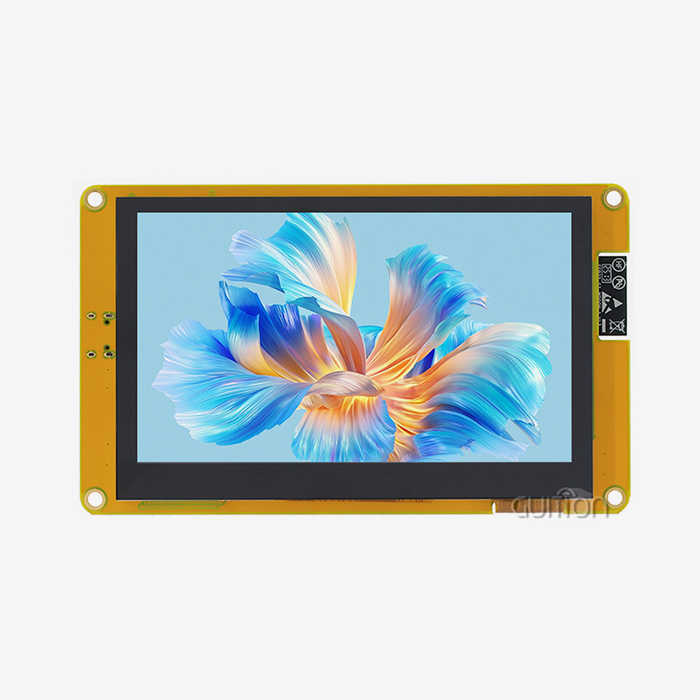
Resolution directly affects how clear an interface is and how much information it holds. Usually, 480x320 or 800x480 sizes are needed for industrial control panels to show process data, trending graphs, and control elements all at the same time without making the screen look too crowded. This balance is shown by the GUITION JC8048Q350N_I_W, which has a diagonal size of 5 inches and a base resolution of 800x480 pixels, giving it 188 pixels per inch. This is enough to show clear text at the normal viewing range of 18 to 24 inches. Higher densities are often needed for medical devices, especially for diagnostic imaging screens, where 1024x768 is the norm. When choosing a size, you should think about how far away you want to see it. For example, smaller 2.4-inch modules work well on handheld devices, while 7- to 10-inch screens are better for workplace booths because they can be used while wearing gloves and can be seen from farther away.
Processing Performance and Controller Capabilities
The controller standard sets the basic parameters for how fast the user interface is and what graphics can be used. The GUITION JC8048Q350N_I_W is powered by a D121BBV single-core MCU that runs at 400MHz. This gives it plenty of processing power for smooth animations, real-time data updates, and quick touch contact. This processing power lets you decode JPEGs at 1024x768@60fps and render PNGs at 30fps, which is fast enough for industrial automation dynamic dashboard apps. When testing controls, look at more than just the clock speed to see how well instructions are executed. ARM Cortex-M4 and Cortex-M7 architectures offer better floating-point performance for programs that need to perform math, while 8051-based controls are cheaper for easier text-and-icon interfaces.
Visual Quality Parameters
For business uses that need wide viewing angles, IPS screen technology has become the norm. It is important for shared workspaces or public-facing terminals that the 178-degree viewing angle ensures uniform color accuracy and contrast no matter where the user is sitting. Color depth standards show how advanced a monitor is: 16-bit RGB encoding can handle 65,536 different colors, which is enough for most commercial images; however, 24-bit true color is needed for photographic quality in medical or retail imaging. Brightness rates of 300 to 450 nits are good for indoor use, but for outdoor use, you need 800-1,000+ nits so that you can read the screen in direct sunlight. Anti-glare coats and lighting controls that can be adjusted make it easier to use in a variety of settings.
Communication Interface Compatibility
UART communication is still the most common way for serial LCD panels to talk to each other because it is easy to use and works with all MCUs. Standard TTL logic levels (3.3V or 5V) let you connect directly to Arduino, STM32, ESP32, and most other market microcontrollers without having to use level-changing hardware. Baud rate ranges from 9,600 to 115,200 bps, which lets producers find the best mix between connection speed, cable length, and noise immunity. Advanced modules can work with more than one interface mode at the same time. For example, our GUITION system keeps UART as the main mode of communication while also providing I2C ports for adding sensors and SPI access for quick data transfers when needed.
Electrical Specifications and Power Management
Operating power ranges determine how easy and quickly a system can be integrated. Modules that can accept a wide range of input voltages (6–36VDC) make it easier to connect them to industrial equipment that runs on standard 12V or 24V bus systems without having to use separate regulator circuits. It's important to look closely at how much current is being used: when the backlight is turned on, the peak draw can hit 300–400mA, but in steady state, the draw stays between 150 and 200mA. This difference affects how long handheld gadgets' batteries will last. In enclosed setups, thermal management is important. Quality modules have running temperature ranges of -20°C to +70°C for commercial uses, and longer versions that can reach -30°C to +85°C for harsh environments.
Software Development Ecosystem
The quality of development tools has a huge effect on how long a project takes and how much it costs to build everything. The Guition visual development tool is a big step forward from standard command-based programming because it lets you build drag-and-drop interfaces without having to do a lot of coding. With this method, the first UI development can be done in days instead of weeks, so changes can be made quickly based on user input. Cross-platform debugging speeds up fixing by letting you test the interface in real time on Arduino, ESP-IDF, and native settings. Support for multiple languages with UTF-8 encoding gets rid of problems with translation.
Comparing Serial LCD Display Modules: Making an Informed Procurement Decision
When you compare the performance of different serial communication methods, you can see the trade-offs that affect the success of a project. It's easy to use and works with almost any microcontroller because UART connections don't need much setup and start working right away. SPI options allow for faster data transfer rates (up to 10–20 Mbps compared to UART's usual 115 kbps), which is useful for programs that need to do full-screen updates or play video a lot. I2C uses the fewest number of pins because it only needs two signal lines. However, its multi-drop bus design makes it harder to handle multiple Serial LCD display modules.
Cost Structures and Volume Economics
Teams that buy things for businesses should look at the total cost, not just the price per unit. Character LCDs for beginners start at about $8 to $15 per unit when bought in bulk, while advanced graphical modules with built-in controls cost between $25 and $80, based on their size and features. Volume price structures have a big effect on the economics of a project. Orders of 1,000 or more units often get savings of 20 to 30 percent, and at 5,000 or more units, custom branding and firmware changes become possible. Lifecycle costs include less time spent on development thanks to easy-to-use tools, less work for support staff because the system works reliably, and easier service in the field thanks to remote update features that cut down on truck rolls.
Supplier Evaluation Criteria
The quality of the partnership with serial LCD suppliers affects the long-term success of the project after the product is chosen. Professional suppliers can be told apart from commodity suppliers by the amount of technical paperwork they provide. Full datasheets, integration guides, command reference books, and application notes all lower development risk by a large amount. GUITION has a lot of useful materials, like example code for major microcontroller systems, GUI design templates, and video tutorials that make getting started faster.
Practical Implementation Tips for B2B Technical Teams
To successfully integrate a Serial LCD display module, you need to pay attention to the hardware and software details that set production-ready versions apart from trial tests. Voltage level matching between 3.3V and 5V logic needs careful attention to avoid damage or communication that isn't reliable. Pin layout is the most common integration challenge. Pull-up resistors on the RX and TX lines make sure that the signal changes are clean, which is especially important in noisy industrial settings with motor drives and relay switches.
Microcontroller Integration Best Practices
Because libraries hide the low-level details of transmission, Arduino systems are the easiest to learn for developing serial LCDs. VCC, GND, TX, and RX are the four lines that are usually needed for connection. Software serial libraries let you give different values to each pin on boards that don't have specific hardware UARTs. For STM32 writers, hardware UART devices that allow DMA transfers are helpful because they get rid of the need for CPU overhead during display updates. ESP32 integration makes it possible for interesting IoT apps, mixing display features with WiFi connectivity to allow cloud data visualization and tracking from afar. The GUITION JC8048Q350N_I_W has WiFi and Bluetooth modules built in, so you don't need to use extra radio modules. This makes the system design much simpler.
Troubleshooting Common Integration Issues
Communication problems are usually caused by baud rate mismatches or setting up the serial port incorrectly. 80% of original connectivity issues can be fixed by making sure that both the device and the host share the same baud rate, parity settings, and stop bit setup. Signal integrity problems show up as sporadic contact or jumbled displays, which are usually a sign of bad grounding or too long a wire run without proper shielding. Industrial systems are more reliable when 100-ohm series termination resistors are used on long lines longer than 3 meters. Inconsistent display brightness can be a sign of a power supply that can't handle enough current. Good 2A-rated supplies keep the voltage from dropping when the backlight is turned on, which can cause the screen to flicker or the microcontroller to restart.
Customization Opportunities
Customization tools help advanced projects stand out in competitive markets by making goods unique. Custom boot logos and splash screens help strengthen brand branding as soon as the device is turned on. Changes are made to the font library to include industry-specific symbols or letter sets for more than one language that are not normal ASCII. When interface styles are customized to specific processes, operators are more productive and don't need as much training. The GUI development environment lets you make these changes with simple visual tools instead of having to do the image conversion and memory mapping by hand, which are tasks that usually only experienced embedded programmers can do.
Strategic Considerations for Selecting the Right Serial LCD Supplier
The quality of the supplier relationship has just as much of an effect on the project's results as the technical standards. When you're evaluating makers, you need to look at more than just their product lists to see how well their skills fit with your development process and your business needs.
Documentation and Technical Resources
Detailed technical documents for the hmi display module speed up development and lower the need for help. Good providers give thorough Serial LCD display module datasheets with information about the electrical properties, mechanical models with the sizes of the mounting holes, and information about the communication protocol, such as the syntax of commands and the time needed. When you write application notes about common integration scenarios like integrating with famous microcontrollers, setting up safe bootloaders, and reducing power consumption, you show that you know what you're talking about. Video lessons and example projects make it easier for new users to get started. This is especially helpful for small development teams that don't have dedicated display tech experts. GUITION keeps an extensive online knowledge base that is regularly updated with new information based on real-world application experiences in many different industries.
Engineering Support and Consultation Services
Strategic partners are different from transactional providers because they give you direct access to their tech teams. If you need quick expert help by phone (david@guition.com) or email, you can avoid costly project delays caused by problems with integration or strange application requirements. By offering customization services, such as changes to the software, tweaks to the hardware, or redesigns of the interface circuits, companies can make their products stand out without having to hire more engineers. Teams can choose the best modules for each application with the help of pre-sales advice. This way, costly design mistakes that only show up during integration testing are avoided. The systems engineering team at GUITION has worked on industrial robotics, medical devices, and consumer goods, so they can give you good advice based on their experience.
Supply Chain Reliability and Lifecycle Management
In industrial settings, the availability of parts decides the continuation of production over the 5–10 year lifecycles of products. Established sellers keep strategic inventories of parts and contracted production capacity, which keeps allocation gaps from happening when demand goes up. Lifecycle management policies make sure that specifications are the same across all production batches. This is very important when replacing modules that need to work with current setups without any problems. End-of-life notice methods give enough time for change when a component becomes obsolete and needs to be redesigned. Regional distribution networks shorten lead times and lower shipping costs. This is especially helpful for North American customers who want to easily access goods in their own country instead of waiting for longer shipping times in Asia and the Pacific.
Conclusion
To choose the right Serial LCD display module, you have to find a balance between technical specs, the quality of the development environment, and the supplier's ability to work with you. The technical base is made up of things like display resolution, processing speed, communication ports, and weather longevity. The success of execution depends on the development tools, the number of documents, and the engineering support. The GUITION JC8048Q350N_I_W is a current example of a serial LCD. It has 800x480 IPS resolution, 400MHz processing speed, easy-to-use Guition software tools, and built-in wireless connectivity. This unified method shortens the time it takes to make new products while still making sure they work reliably in tough situations. It's useful for companies that make industrial equipment, medical devices, and smart products. When development teams carefully consider these linked factors, they are better prepared to carry out projects successfully and keep using their products for a long time.
FAQ
What distinguishes serial LCD modules from parallel alternatives?
Serial LCD display modules use simpler ways to talk to each other, needing only two to four links instead of sixteen or more pins for parallel interfaces. This design simplifies the PCB, lowers the number of GPIO needed for host microcontrollers, and boosts signal integrity over long wire runs. Onboard processors take care of rendering jobs on their own, which makes software creation a lot easier.
How do I pick the size that works best for my app?
How you choose a resolution depends on how much information you need and how far away you are watching it. Resolutions of 800×480 or higher are best for industrial control screens that show a lot of factors. Resolutions of 320×240 are fine for simple status displays. To find the needed pixel density, divide the length of the screen by the viewing distance. For normal operator positions, you should aim for 25 to 35 pixels per inch.
What development experience is required to program serial LCD modules?
Modern modules with visual development tools don't need a lot of knowledge about embedded code. The Guition tool lets engineers with basic microcontroller knowledge build interfaces using drag-and-drop. Low-level parallel display drivers are more difficult to use than traditional command-based writing, which requires more experience.
Can these modules operate reliably in harsh industrial environments?
Industrial-grade modules of good quality have higher temperature ranges (-20°C to +70°C or more), conformal coatings that keep wetness out, and strong ESD protection. Make sure that the environmental specs meet the conditions of deployment. For example, outdoor installations need higher brightness ratings and a wider range of temperature limits than indoor installations.
Ready to Transform Your Display Development Experience?
With the best Serial LCD display module technology in the business, GUITION is ready to help you with your next HMI project. Our JC8048Q350N_I_W module has strong 400MHz processing, stunning 800x480 IPS graphics, and the easy-to-use Guition development platform, which cuts engineering time by a huge amount. Our wide range of products, from 1.28" to 21.5", can meet a wide range of needs, whether you're making industrial control systems, medical equipment connections, or smart consumer electronics. We offer full technical instructions, quick engineering help at david@guition.com, and customization services that can be changed to fit the needs of your project. As a dependable provider of serial LCD display modules, we keep our supply chains stable, our bulk prices low, and our promises that products will be available for a long time. Get in touch with our applications engineering team right away to talk about how our USART-HMI display solutions can help you get your products to market faster while also making sure they work well in harsh operating settings.
References
1. Chen, W., & Liu, Y. (2022). Embedded Display Technologies for Industrial Automation: A Comprehensive Guide to Serial Communication Architectures. Industrial Electronics Press.
2. Martinez, R. A. (2021). HMI Development Best Practices: Optimizing User Interface Design for Embedded Systems. Journal of Embedded Systems Engineering, 34(3), 112-128.
3. Thompson, J. K., & Singh, P. (2023). Serial Communication Protocols in Modern Display Systems: Performance Analysis and Implementation Guidelines. Technical Communication Quarterly, 18(2), 45-67.
4. Anderson, M. L. (2022). Specifications and Selection Criteria for Industrial Display Modules. Automation Technology Review, 29(4), 201-219.
5. Williams, S. T., & Zhang, L. (2021). Cost-Effective Display Integration Strategies for IoT and Smart Device Applications. International Journal of Product Development, 15(1), 78-94.
6. Roberts, D. H. (2023). Environmental Durability Testing Standards for Industrial HMI Components. Journal of Reliability Engineering, 41(2), 156-173.
Learn about our latest products and discounts through SMS or email