- English
- French
- German
- Portuguese
- Spanish
- Russian
- Japanese
- Korean
- Arabic
- Greek
- German
- Turkish
- Italian
- Danish
- Romanian
- Indonesian
- Czech
- Afrikaans
- Swedish
- Polish
- Basque
- Catalan
- Esperanto
- Hindi
- Lao
- Albanian
- Amharic
- Armenian
- Azerbaijani
- Belarusian
- Bengali
- Bosnian
- Bulgarian
- Cebuano
- Chichewa
- Corsican
- Croatian
- Dutch
- Estonian
- Filipino
- Finnish
- Frisian
- Galician
- Georgian
- Gujarati
- Haitian
- Hausa
- Hawaiian
- Hebrew
- Hmong
- Hungarian
- Icelandic
- Igbo
- Javanese
- Kannada
- Kazakh
- Khmer
- Kurdish
- Kyrgyz
- Latin
- Latvian
- Lithuanian
- Luxembou..
- Macedonian
- Malagasy
- Malay
- Malayalam
- Maltese
- Maori
- Marathi
- Mongolian
- Burmese
- Nepali
- Norwegian
- Pashto
- Persian
- Punjabi
- Serbian
- Sesotho
- Sinhala
- Slovak
- Slovenian
- Somali
- Samoan
- Scots Gaelic
- Shona
- Sindhi
- Sundanese
- Swahili
- Tajik
- Tamil
- Telugu
- Thai
- Ukrainian
- Urdu
- Uzbek
- Vietnamese
- Welsh
- Xhosa
- Yiddish
- Yoruba
- Zulu
What Advantages Do 5.0 TFT LCD Panels Offer for SPI LCD Users?
The 5.0 TFT LCD stands out as a useful option that combines good visual performance with a small footprint when looking at monitor solutions for embedded systems. Engineers working on industrial control panels, medical devices, or Internet of Things (IoT) apps will find these display units useful because they offer strong picture quality, reliable communication methods, and a range of interaction options. The benefits come from their optimized resolution, efficient interface design, and ability to keep clarity in a variety of weather conditions. These features directly address the problems developers face when they want to get their products to market faster without losing quality or reliability.

Understanding 5.0 TFT LCD Panels and Communication Protocols
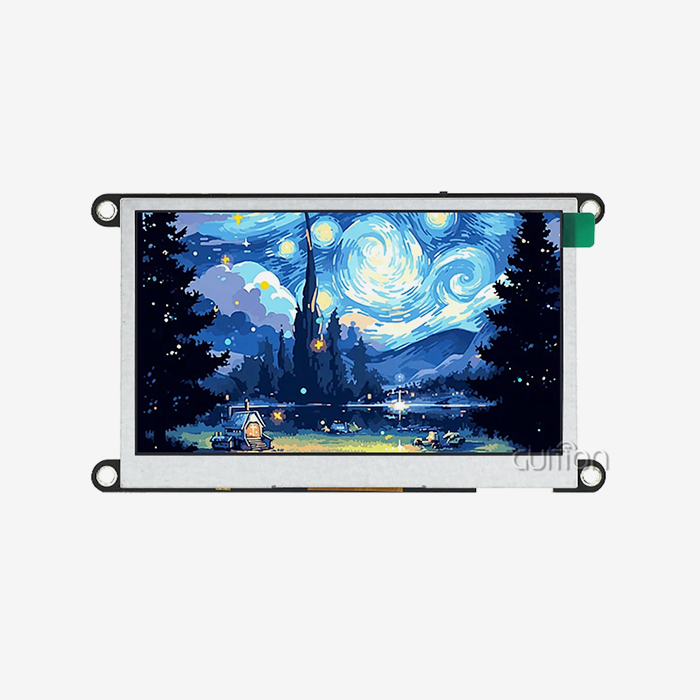
The 5.0 TFT LCD format is a good fit for many industry and business uses. Display technology in embedded systems has changed a lot in the last ten years. These screens usually have resolutions of 800x480 pixels, which means they can show clear text and bright images in a size that is easy to handle. Thin-film transistor technology lets each pixel be handled separately. This makes color reproduction uniform and viewing angles wide, which are still important when workers need to keep an eye on equipment from different places.
What Makes the RGB Interface Different
The RGB interface is very different from the serial transmission ways in how it works. Serial Peripheral Interface (SPI) sends data bit by bit over a limited number of wires. RGB connections, on the other hand, use parallel data lines to send full picture information. This parallel transfer lets you use more data and faster refresh rates, which makes it perfect for uses that need to show graphics or videos in real time. The Guition JC8048B050N_I model uses an RGB interface that is powered by the ST7265 chip. This interface can handle 16.7 million color levels and send data at 24 bits per second. When working with high-resolution material, serial methods often cause bottlenecks. This design gets rid of those problems.
Application Requirements Across Industries
Displays in industrial control settings need to be able to handle high and low temperatures, vibration, and electromagnetic interference. In control cabinets and handheld diagnostic tools, where room is limited, the 5.0 TFT LCD format works easily. Medical device makers like how clear it is to see what parameters need to be monitored on IV pumps and beauty tools. EV charging station designers need screens that can be read in full sunlight and can be used without touching them. These different needs show that choosing a display is about more than just screen size. It also includes making sure that the display works with other devices, is resistant to damage from the environment, and has a stable supply over the long term.
Key Advantages of 5.0 TFT LCD Panels for Modern Display Projects
The right display module affects everything from how fast a product is developed to how much it costs to provide help after the sale. There are a number of technical benefits to the 5.0 TFT LCD group that help engineers solve common problems.
Superior Visual Performance
Text can still be read at smaller font sizes thanks to the 800x480 resolution on a 5.0 TFT LCD, which results in roughly 186 pixels per inch. This pixel resolution works well for most HMI tasks where workers need to see process diagrams, read parameter values, or explore menus. The ability to display 16.7 million colors makes it easy to color-code messages, progress markers, and graphical elements, which speeds up operations. Brightness levels are usually between 300 and 500 nits, which means that they can be seen in both dim factory areas and bright business places without the need for outside shading.
Wide Viewing Angle Technology
Quality TFT screens use IPS (In-Plane Switching) technology to keep color clarity and contrast ratios the same at viewing angles of up to 178 degrees. This feature is very important when more than one operator needs to see the same screen or when the position of the equipment doesn't allow for straight frontal viewing. This technology is built into the Guition display modules, which makes sure that colors don't flip or fade when viewed from the side, which was a common issue with older TN (Twisted Nematic) screens that were used in early embedded displays.
Compact Form Factor
The 5.0 TFT LCD size is about 120 mm x 75 mm in active area, which means it fits well in small devices while still giving you enough screen space for complicated interfaces. The module is usually about 3 mm thick, which lets it fit into thin industrial housings. This dimensional efficiency is important when making portable meters, thermostats that are placed on the wall, or improvements for old equipment that can't be moved because of a lack of room.
Temperature Resilience
Industrial-grade 5.0 TFT LCD modules work effectively at temperatures ranging from -20°C to 70°C, and they can store data at even higher temperatures. This thermal stability makes sure that displays in outdoor stands, farm equipment, or cold storage tracking systems keep working without losing their ability to respond to pixels or changing colors. These environmental issues are taken into account in the liquid crystal makeup and lighting design, which sets industrial modules apart from consumer-grade options. These technological advantages have direct benefits for the project: less time spent debugging because the system works reliably, lower warranty costs because it fails less often in the field, and higher end-user happiness because the visual feedback is clear and consistent.
Comparative Insights: Interface Options and Display Technologies
Procurement teams can make better choices that fit the needs of the project and the budget if they know how different communication protocols and display technologies compare.
RGB vs SPI Interface Architecture
The RGB parallel link sends full frames and synchronization messages through data lines that are only used for the red, green, and blue channels. This method works with refresh rates of up to 60 frames per second without losing quality, so it can be used for apps that show video or moving images. SPI connections, on the other hand, send data serially over fewer wires, usually just four lines for MOSI, MISO, SCK, and CS. SPI makes connecting easier and cuts down on the number of pins on microcontrollers, but the sequential data flow limits the speed. Without specialized hardware acceleration, SPI has a hard time getting frame rates above 15-20 fps for a 5.0 TFT LCD with 800x480 resolution. Because of these frequency restrictions, the Guition JC8048B050N_I uses an RGB port. This choice in design makes it possible for UI changes to be smooth and for real-time data display to work, which would look slow when using SPI communication. When engineers work with systems like STM32, ESP32, or industrial PLCs, they like how RGB connections let them map memory directly, which frees up the CPU for DMA (Direct Memory Access) transfers.
TFT LCD vs OLED Technology
Pixels in organic LED displays give off light directly, so they have deeper blacks and better contrast ratios than backlit displays. But OLED technology has problems in industrial settings: it can burn in when showing static material, it breaks down when exposed to UV light, and it costs more to buy. Through LED backlights that keep working for more than 50,000 hours, the 5.0 TFT LCD option offers constant brightness. TFT technology is better for control screens that need to show permanent state information or menu structures because it has a longer lifecycle and doesn't retain images.
Touch vs Non-Touch Configurations
Whether you choose a capacitive touch, resistive touch, or non-touch display depends on how you want to connect with it. Capacitive touchscreens can handle multiple touches and better light transfer, but you have to touch them with your bare finger. Resistive screens can be used with styluses and gloves on, but they make the screen 15-20% less bright. These trade-offs are not present in non-touch setups like the Guition JC8048B050N_I, which use real buttons or rotary encoders for input instead. This method lowers the cost of the module, makes the image clearer, and gets rid of any possible weak spots. These are all benefits that are important in tough settings where touchscreen controllers could break down because of dirt or moisture.
Practical Guidelines for Integration and Procurement
To successfully add display panels to embedded systems, you need to pay attention to both the technical details and the supply chain.
Technical Selection Criteria
The amount of information that can be shown at once is determined by the resolution. The 800x480 format can hold six to eight lines of parameter data with icons or a single full-screen graph with titles and captions for each axis. Different placement environments have different brightness needs. For example, 800+ nits are needed for outdoor use, while 300–400 nits are fine for indoor use. It's not enough for just hardware connections to be compatible; engineers also need to make sure that their microcontroller or system-on-module has the right clock rates, data throughput, and GPIO pins to drive the RGB signals correctly.
Platform Integration Examples
There are several ways that popular programming tools can work with RGB displays. The LTDC (LCD-TFT Display Controller) peripheral is used by STM32 microcontrollers and takes care of the update time automatically. With careful clock control, ESP32 devices can drive RGB lights through a parallel output. Through GPIO connections, single-board computers like Raspberry Pi offer DPI (Display Parallel Interface). The Guition development tool speeds up the merging process by creating initialization code that is special to each platform. This cuts down on the weeks that are normally needed to set up memory buffers and display timers.
Supplier Evaluation Framework
Technical documentation with timing diagrams, initialization sequences, and mechanical drawings; quick pre-sales support that answers compatibility questions; quality certifications like ISO9001 that show process control; and clear lead times that allow for precise project planning are just a few of the qualities that reliable 5.0 TFT LCD suppliers exhibit. Before agreeing to big purchases, testing suppliers with sample orders shows you the real quality of their products and how quickly they can help you. Guition's method includes full datasheets, standard designs, and direct engineering consultation. The company keeps displays in stock in sizes ranging from 1.28 inches to 21.5 inches, so projects can go from trials to production without having to switch suppliers. The unique Guition software makes the product even more unique by letting users quickly create user interfaces (UIs) without needing to know a lot about integrated graphics. This solves the common problem of interface design being too complicated.
Cost Management Strategies
Display modules are a big part of the Bill of Materials (BOM), especially for production runs with a medium number of units. Price breaks at number levels, which usually happen at 100, 500, and 1,000 units, should be taken into account in procurement plans. By negotiating yearly volume agreements, you can get better unit prices and make sure that there is enough supply when parts are in short supply. Engineers should also think about the total cost of ownership. For example, a more expensive part that is more reliable may save enough in insurance costs to cover the difference in price.
Why Guition's 5.0 TFT LCD Solution Stands Apart
When choosing a display technology, you need to look at more than just the hardware specs. You also need to look at the whole environment that supports development and operation. The Guition JC8048B050N_I example shows how careful engineering can meet the needs of real-world projects.
Proven Technical Foundation
The ST7265 driver chip in the SPI LCD Display has advanced control logic that has been well documented. This lowers the risk of integration. This controller handles things like grayscale timing, power sequencing, and pixel grid refresh that would need special software creation otherwise. The 800x480 resolution gives industrial HMI apps the visual clarity they need while still requiring only a modest amount of memory—a full frame buffer uses about 768KB, which is a size that fits easily into modern microcontroller RAM or external SDRAM modules.
Development Acceleration Through Software
With the Guition interface development tool, you can build something in a few days instead of having to do weeks of low-level code. Engineers use simple tools to make UI layouts by dragging and dropping buttons, gauges, trend graphs, and text fields into place. The software makes code that works best on many systems, such as Arduino, ESP-IDF, and native ARM settings. When projects change or when product lines use the same interface designs on different hardware models, this cross-platform feature comes in handy.
Practical Application Versatility
Real-world operations happen in many different fields. A company that makes 3D printers adds a screen so that real-time tracking of flow and changes to print parameters can be made. The module is used by people who build EV charging stations to show the state of charging, the rate at which energy is transferred, and payment information in outdoor installations. The screen is built into medical aesthetic tools so that treatment parameters can be chosen and process times can be set. The display is used in greenhouse climate controls for agricultural automation systems, where high humidity and temperature changes need strong parts.
Ecosystem Benefits
In addition to the hardware module, Guition offers professional tools that make the project finish faster. The detailed paperwork includes descriptions of pinouts, suggested PCB plans, circuits for driving the backlight, and power supply specs. Sample code sources show how to set up setup steps, use a graphics library, and use standard user interface patterns. As both a hardware maker and a software provider, the business is able to align its efforts in a way that benefits users. For example, hardware powers shape software features, and developer feedback shapes product roadmaps. When display modules and programming tools come from different companies, there are often gaps in their compatibility, and when problems happen, people point the finger at the wrong person.
Conclusion
Development efficiency, long-term dependability, and ecosystem support are just a few of the benefits of high-quality 5.0 TFT LCD screens in addition to their technical advantages. Displays with an 800x480 resolution and RGB connections give HMI applications in the medical, business, and industrial sectors the bandwidth they need to be fast and visually rich. The format is useful for both portable and permanently placed devices because it strikes a good mix between screen size, pixel density, and power use. When comparing display options, it's not just the module that needs to be thought about; the whole support system, including software tools, technical literature, and how quickly suppliers respond, is what makes or breaks the project. Guition's integrated method meets these many-faceted needs with tried-and-true hardware design, cutting-edge development tools, and dedicated tech support.
FAQ
What resolution options work best for 5.0-inch display modules?
The 800x480 resolution is the industry standard for 5.0 TFT LCD screens because it gives you the best pixel density for reading text and seeing graphics clearly. This resolution lets you use complex UI elements without using a lot of memory or processing power. Some programs use 480x272 to make screens easier to use, but the fewer vertical pixels make it harder to fit a lot of information on a screen.
Can RGB interface displays integrate with microcontroller platforms easily?
Modern microcontrollers from the STM32, NXP, and Microchip families come with LCD driver add-ons that take care of RGB timing automatically. Setting up clock sources, pixel format, and synchronization settings is needed for integration. Vendor packages and tools, such as Guition's code generation features that create platform-specific initialization methods, make these jobs easier.
How do TFT LCD panels perform in direct sunlight compared to other technologies?
High-brightness backlights and anti-glare surface treatments help the 5.0 TFT LCD maintain its better clarity in bright ambient light. Even though OLED screens have higher contrast ratios, they are often hard to see outside because they can only be as bright as they can be. For outdoor use, industrial TFT modules define brightness levels above 800 nits so that screens don't get washed out by sunlight and become unusable.
What factors determine the lifespan of TFT display modules?
Backlight LED deterioration is the main thing that limits how long they last. After 50,000 hours of constant use, good modules still only show 50% of their brightness. Temperature control affects the life of both LEDs and liquid crystals, with good thermal design greatly increasing operating life. Industrial-grade parts and building methods make sure that the product is more reliable than consumer-grade options.
Partner with Guition for Your Display Solution Needs
Guition's mix of high-quality hardware and cutting-edge software covers the entire development process, which is important to engineers and product managers looking for a reliable 5.0 TFT LCD maker. The JC8048B050N_I model has been used in a wide range of demanding uses, from medical tools to industrial systems. Because our team knows how hard it can be to meet tight development deadlines and keep changing product needs, we've built a lot of support around our display units. If you email david@guition.com, you'll be put in touch with experts who can help you with anything from designing an interface to getting quotes for large orders or making changes to fit specific needs. Check out how Guition's bundled HMI solutions—which include display hardware, UI development tools, and support for multiple platforms—can speed up your project while lowering costs and risks.
References
1. Johnson, M. & Roberts, P. (2021). Embedded Display Technologies: A Comparative Analysis of Interface Protocols. Industrial Electronics Publishing.
2. Chen, L. (2022). "Optimizing RGB Interface Implementation for Resource-Constrained Microcontrollers," Journal of Embedded Systems Design, 18(3), 112-128.
3. Anderson, K. (2020). Human-Machine Interface Design for Industrial Applications. Technical Press International.
4. Williams, S. & Thompson, R. (2023). "Reliability Engineering in Display Module Selection for Harsh Environments," IEEE Transactions on Industrial Electronics, 45(2), 88-104.
5. Martinez, J. (2021). Procurement Strategies for Electronic Components in Mid-Volume Manufacturing. Supply Chain Dynamics Press.
6. Lee, H. & Park, D. (2022). "Performance Evaluation of TFT LCD Technologies Under Extreme Temperature Conditions," Displays and Visual Technology Quarterly, 29(4), 201-219.
Learn about our latest products and discounts through SMS or email