- English
- French
- German
- Portuguese
- Spanish
- Russian
- Japanese
- Korean
- Arabic
- Greek
- German
- Turkish
- Italian
- Danish
- Romanian
- Indonesian
- Czech
- Afrikaans
- Swedish
- Polish
- Basque
- Catalan
- Esperanto
- Hindi
- Lao
- Albanian
- Amharic
- Armenian
- Azerbaijani
- Belarusian
- Bengali
- Bosnian
- Bulgarian
- Cebuano
- Chichewa
- Corsican
- Croatian
- Dutch
- Estonian
- Filipino
- Finnish
- Frisian
- Galician
- Georgian
- Gujarati
- Haitian
- Hausa
- Hawaiian
- Hebrew
- Hmong
- Hungarian
- Icelandic
- Igbo
- Javanese
- Kannada
- Kazakh
- Khmer
- Kurdish
- Kyrgyz
- Latin
- Latvian
- Lithuanian
- Luxembou..
- Macedonian
- Malagasy
- Malay
- Malayalam
- Maltese
- Maori
- Marathi
- Mongolian
- Burmese
- Nepali
- Norwegian
- Pashto
- Persian
- Punjabi
- Serbian
- Sesotho
- Sinhala
- Slovak
- Slovenian
- Somali
- Samoan
- Scots Gaelic
- Shona
- Sindhi
- Sundanese
- Swahili
- Tajik
- Tamil
- Telugu
- Thai
- Ukrainian
- Urdu
- Uzbek
- Vietnamese
- Welsh
- Xhosa
- Yiddish
- Yoruba
- Zulu
How to Evaluate Rotary Encoder Quality in a 1.85-inch Round Knob Screen?
Evaluating rotary encoder quality in a 1.85-inch round knob screen requires examining five core dimensions: mechanical durability (rated cycle life ≥100,000 rotations), signal output accuracy (quadrature pulse error <1%), electrical reliability (contact resistance stability under load), environmental resistance (operating range of -40°C to +85°C), and integration compatibility with your target MCU platform. For the Guition JC3636K718C model specifically, the rotary knob pairs with an ESP32-S3 processor and a 360×360 IPS display, making encoder-to-UI latency — ideally under 50ms — a measurable benchmark worth verifying before bulk procurement.

Understanding the Core Components of a Round Knob Display Module
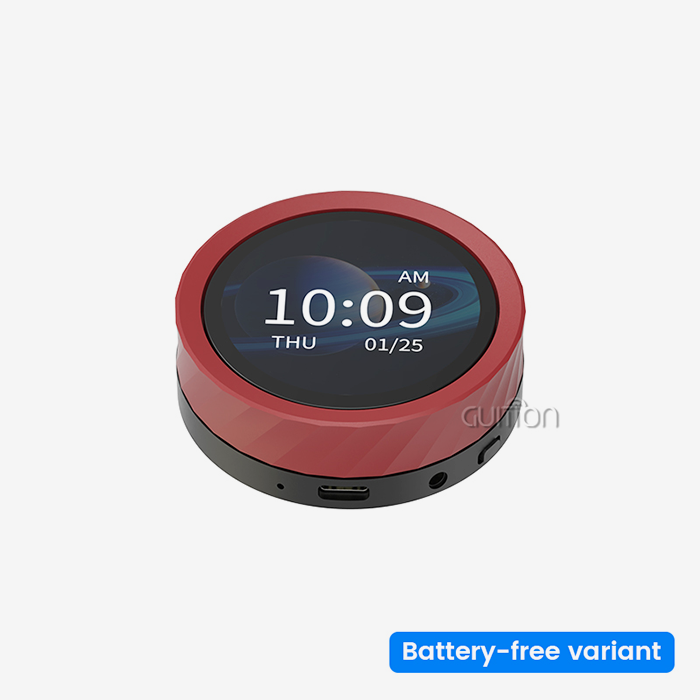
Before you can rate an encoder's quality, you need to know what's inside a small monitor button. The 1.85-inch Round Knob Screen consists of three useful layers: a circular IPS display panel, a capacitive touch layer, and a mechanical or magnetic rotating encoder. Because every layer talks to every other layer, a bug in one makes the whole thing worse for the user.
Display and Touch Layer Architecture
The touchscreen on the Guition JC3636K718C is a 360x360 IPS capacitive screen that is fully protected. It's easier to read in bright sunlight and there are no more air gaps between the glass and the screen when the screen is fully laminated. This is important for places where the light isn't always stable, like industrial control screens and medical tracking gear.
Rotary Encoder Mechanism Types
Electronic encoders and mechanical contact encoders are the two types of encoders that can be found in knob screen modules. Even though mechanical encoders are not expensive, they break down after some time. Hall-effect encoders don't use real links; instead, they use magnetic fields. This makes them last up to 500,000 to 1,000,000 cycles. These systems are better for heavy-duty daily use or industrial processes because they last longer.
Processor and Memory Configuration
The ESP32-S3R8 dual-core MCU on board has 8 MB of PSRAM and 16 MB of Flash. It runs at 240 MHz and has enough space for the 1.85-inch Round Knob Screen to handle encoder pulses, make circle UI animations, and stay connected to both WiFi and Bluetooth 5.0 at the same time. Processors that don't have enough memory often lose encoder pulses when they have to process a lot of user interface data. This makes users angry because they miss inputs.
Criteria for Evaluating Rotary Encoder Quality
When used in real life, not all rotary encoders for small knob screens work the same way. A organized quality review checks four areas that buying teams can measure and compare to datasheets from providers.
Mechanical Durability and Rated Cycle Life
Cycle life is the best way to measure how long something lasts. Find out from your supplier how many times the part is supposed to be able to be turned. Round knob display units with professional-grade encoders should be able to handle at least 100,000 cycles. High-end Hall-effect encoders can handle more than 500,000 cycles. Also, check out what the shaft is made of. CNC-machined metal shafts work better than plastic ones when torque loads are applied over and over again.
Signal Accuracy and Pulse Resolution
How well the UI responds to user input is directly related to the number of pulses per revolution (PPR), which are used to measure encoder resolution. If the PPR value is 24 PPR or more, the dial on the screen moves more smoothly. The quadrature signal output pattern can be found in the instructions. Pulse spacing isn't even when encoders aren't made well, which makes the on-screen behave in a way that is hard to fix with firmware alone.
Environmental and Electrical Resistance
When used in factories, encoders have to deal with humidity, shaking, and changes in temperature. Before you buy a round knob display module, make sure it can work in ranges between -20°C and +70°C. You can't use a gadget outside or for cooking if it doesn't have ingress protection (IP65 or better). During electrical tests, the contact bounce time should be checked. A signal that is clean and can be used for real-time HMI reply is one that is less than 5ms.
Comparing Round Knob Display Modules Across Form Factors
People rarely decide what to buy on their own. When people are shopping, they often compare the 1.85-inch round knob style to bigger 2-inch versions, touchscreen-only screens, or displays with square knobs.
Round vs. Square Knob Displays
Displays with round knobs work well in places where turning them feels like turning real dials. Smart thermostats, recording gear, and industrial parameter computers are all good examples of this. When it comes to high-end appliance design, square knob modules don't have the clear rotating metaphor that makes knob interfaces famous. However, they do work better with grid-based panel layouts.
1.85-inch vs. Larger Knob Screen Sizes
The 1.85-inch Round Knob Screen JC3636K718C's 1.85-inch screen can show a lot of information while still taking up little room on the panel. Its size is 360x360. It costs more and takes more panel cuts to go to a 2-inch or bigger module, but in most HMI situations it makes the screen a little easier to read. That being said, bigger screens are better for apps that need to show a lot of information. On the other hand, 1.85-inch screens work better with small industrial tools or buttons that you wear.
Key Differentiators in the Guition JC3636K718C
A CNC machine cuts the JC3636K718C's metal case, which comes in five standard colors: red, black, purple, dark gray, and blue. You can also get the color you want made just for you if you buy 500 units or more. This one is different from others on the market that use plastic housing because it was made with more care. You don't need to buy any extra parts because the speaker, microphone, vibration motor, RGB LED strip, and TF card slot are all built in. This is very useful for groups working on projects with short due dates.
Installation, Maintenance, and Troubleshooting for Long-Term Performance
Getting the most from a round knob display module requires proper installation and a consistent maintenance schedule. Skipping either shortens encoder lifespan and increases after-sales costs.
Installation Best Practices
Mount the module on a rigid PCB footprint that matches the manufacturer's specified panel cutout diameter. Loose mounting allows the encoder body to rotate inside the panel under user torque, creating mechanical stress on the solder joints. Apply thread-locking compound to the retention nut and verify FPC cable routing clears moving parts before final assembly.
Routine Maintenance and Calibration
Clean the encoder shaft area regularly with compressed air to remove particulate buildup. In environments with oil or humidity exposure, quarterly inspection of O-ring seals preserves IP-rated protection. Calibration of the encoder's zero-position reference in firmware should occur after any hardware replacement to maintain UI alignment accuracy.
Diagnosing Common Encoder Failures
Signal dropout during rotation usually points to worn encoder contacts or a damaged FPC cable. Erratic UI jumps despite steady rotation often indicate pulse bounce issues addressable through firmware debounce filtering. Increasing UI latency beyond 50ms typically signals MCU resource saturation — a problem the ESP32-S3's dual-core architecture handles by distributing encoder interrupt handling and UI rendering across separate cores.
Procurement Strategies for Sourcing High-Quality Knob Display Modules
Smart procurement starts with verifiable supplier credentials, not just price comparisons.
Verifying Supplier Authenticity and Certifications
Request CE, FCC, and RoHS certifications before committing to volume orders. Legitimate 1.85-inch round knob screen suppliers provide complete technical datasheets, schematic files, and SDK documentation. Guition supports Arduino IDE, ESP-IDF, and MicroPython development environments, and the proprietary Guition platform — a concrete sign of genuine technical depth rather than purely trading activity.
Sampling and Trial Order Strategy
The JC3636K718C carries an MOQ of just 1 unit, meaning you can run a functional prototype evaluation before scaling. In-stock units ship the next business day after order confirmation. This low-barrier trial model protects your engineering budget and validates encoder performance under your specific application conditions before committing to the 86-unit carton standard packaging.
Negotiating OEM and Bulk Orders
For volume buyers, OEM customization is available. Custom housing colors require a minimum of 500 units. Packaging can be tailored to your logistics requirements. Discussing lead times, warranty terms, and after-sales technical support coverage upfront prevents supply chain disruptions — particularly relevant for medical device developers and industrial equipment manufacturers operating under compliance obligations.
Conclusion
We can't just look at the rotary encoder on the surface to judge it. It has to be inside a small knob display module. How well a product works after thousands of hours rests on how long it lasts mechanically, how accurate the signals are, how well it can handle environmental factors, and how well it can combine MCUs. The Guition JC3636K718C 1.85-inch Round Knob Screen handles these measurements with its Hall-compatible encoder design, ESP32-S3 processing power, and fully integrated hardware platform. It can be used for both early-stage development and large-scale production runs because there is no minimum order quantity (MOQ) and the SDK works with everything.
FAQ
How do I confirm a rotary encoder meets my project's PPR requirements?
Make sure you understand the pulses-per-revolution (PPR) standard and ask the seller for the encoder's full manual. For smooth circle-shaped UI movement on a 360x360 display, you should have 24 PPR or more. As another test, write down the encoder's output at its fastest speed while the sample is being looked at.
What causes a knob display encoder to fail prematurely?
Going over the expected cycle life leads to mechanical contact wear most of the time. Bad mounting that passes user force to solder joints is another reason. Water getting in because the IP seal isn't good enough is another. FPC cable stress from bad cable routing during installation is another. With hall-effect encoders, contacts are much less likely to wear out.
Can the JC3636K718C be customized for OEM branding?
Your choice of color for the housing is possible if you buy 500 units or more. You can also change how the packages look. You can make your own boot animations, fonts, and interface tools with the Guition development platform.
Is the round knob display compatible with Arduino development?
The JC3636K718C can be used with ESP-IDF, the Arduino IDE, and the Guition platform. When writing firmware, tech teams don't have to start from scratch because it works on more than one platform. They can use the working setting they like best.
What is an acceptable encoder-to-display response latency?
Response times for professional HMI apps should be less than 50ms. The ESP32-S3 dual-core MCU in the round knob display module makes UI frames on one core and handles encoder interrupts on the other. This keeps response delay within accepted ranges when the system is not busy.
Ready to Source a Reliable 1.85-inch Round Knob Screen? Contact Guition Today
The JC3636K718C 1.85-inch Round Knob Screen is available from Guition with same-day or next-day shipping on in-stock items and no minimum order size requirements. Our expert team is ready to help you with your project from the beginning to the end, whether you need one sample for engineering review or a lot of OEM parts with special finishes. Feel free to email David at david@guition.com or visit https://jingcaizhineng.aixdb.cn/ to learn more about the product and talk to someone about it.
References
1. Fraden, J. Handbook of Modern Sensors: Physics, Designs, and Applications. Springer, 2016.
2. Heidenhain Corporation. Rotary Encoders: Product Overview and Technical Principles. HEIDENHAIN, 2020.
3. Texas Instruments. Rotary Encoder Interface Design Guide. Texas Instruments Application Report, 2019.
4. Espressif Systems. ESP32-S3 Technical Reference Manual. Espressif Systems, 2022.
5. IEC Standard 61076-3. Connectors for Electronic Equipment — Environmental and Mechanical Performance Requirements. International Electrotechnical Commission, 2021.
6. Maxim Integrated. Optical vs. Magnetic Rotary Encoders: Key Differences and Selection Criteria. Maxim Integrated Application Note, 2018.
Learn about our latest products and discounts through SMS or email