- English
- French
- German
- Portuguese
- Spanish
- Russian
- Japanese
- Korean
- Arabic
- Greek
- German
- Turkish
- Italian
- Danish
- Romanian
- Indonesian
- Czech
- Afrikaans
- Swedish
- Polish
- Basque
- Catalan
- Esperanto
- Hindi
- Lao
- Albanian
- Amharic
- Armenian
- Azerbaijani
- Belarusian
- Bengali
- Bosnian
- Bulgarian
- Cebuano
- Chichewa
- Corsican
- Croatian
- Dutch
- Estonian
- Filipino
- Finnish
- Frisian
- Galician
- Georgian
- Gujarati
- Haitian
- Hausa
- Hawaiian
- Hebrew
- Hmong
- Hungarian
- Icelandic
- Igbo
- Javanese
- Kannada
- Kazakh
- Khmer
- Kurdish
- Kyrgyz
- Latin
- Latvian
- Lithuanian
- Luxembou..
- Macedonian
- Malagasy
- Malay
- Malayalam
- Maltese
- Maori
- Marathi
- Mongolian
- Burmese
- Nepali
- Norwegian
- Pashto
- Persian
- Punjabi
- Serbian
- Sesotho
- Sinhala
- Slovak
- Slovenian
- Somali
- Samoan
- Scots Gaelic
- Shona
- Sindhi
- Sundanese
- Swahili
- Tajik
- Tamil
- Telugu
- Thai
- Ukrainian
- Urdu
- Uzbek
- Vietnamese
- Welsh
- Xhosa
- Yiddish
- Yoruba
- Zulu
How Can a Serial HMI display Simplify Machine Interfaces?
A serial HMI display simplifies machine interfaces by separating the UI layer from the host controller's logic. Instead of requiring your MCU to render every pixel, the display handles all graphics, touch events, and page transitions locally. Your host simply sends lightweight UART commands to update values or switch screens. This architecture cuts firmware complexity, reduces bus traffic, and accelerates time-to-market — making the serial HMI display one of the most practical choices for engineers building industrial panels, medical devices, smart appliances, and automation systems.

Understanding Serial HMI Displays and Their Role in Machine Interfaces
Before picking a display technology, it's helpful to know how these things work and why experts keep coming back to them for tough jobs.
How Serial Communication Works in HMI Systems
As the baud rate goes from 9600 to 921600 bps, a Serial HMI display can talk over UART, RS232, or RS485 ports. The host sends command strings in ASCII or hexadecimal, and the display reads them, changes the screen locally, and sends them back to the host. So, the host MCU doesn't have to do pixel drawing. Instead, it can read sensors, log data, or run control loops.
Why UART-Based Displays Suit Legacy Equipment
PLCs and controllers with RS232 or RS485 ports are still used on a lot of factory floors. A UART HMI module can be added without any extra hardware connections. This straight compatibility cuts down on the cost of parts and the time needed to wire them together. This is a big plus for system designers who want to update old equipment without having to replace the whole control cabinet.
On-Board Intelligence Reduces Host Workload
The Serial HMI display has its own processor, flash storage, and touch driver, so it handles touch events first before sending the results to the host. This "smart" architecture keeps the communication bus clean and stops data loss when the system is under a lot of stress. This directly improves the responsiveness of the panel and the reliability of the system.
Core Challenges in Machine Interfaces and How Serial HMI Displays Address Them
Embedded engineers have all had at least one of these issues: a display that wouldn't work right, wiring that got tangled up, or a firmware update that needed a trip to the factory. This is how that picture changes with a real HMI serial display module.
Communication Errors and Data Loss
Electrical noise in factories messes up the pixel-level display commands that are sent to dumb screens. The host only needs to send a short command string again, not a whole frame buffer, because the Serial HMI display does the drawing itself. Up to 1,200 meters of wire can be used with RS485 differential communication, which protects against noise even more.
Wiring Complexity and Installation Time
A raw RGB or LVDS screen needs a lot of data lines. It only takes four wires for a serial display module to work: power, ground, TX, and RX. When field engineers switched from parallel display setups to UART HMI modules, installation time dropped from hours to less than thirty minutes on production lines.
Costly On-Site Maintenance
It costs a lot to send a technician to update a UI project. The built-in WiFi on the Guition JC4827W543C_I lets your team push UI changes or bug fixes from anywhere. This is called remote Over-the-Air (OTA) project updates. When code is loaded from a TF card, maintenance is done through software instead of a field service call.
Comparing Serial HMI Displays with Other Interface Technologies
When picking the right communication technology, you need to be honest about how much it costs, what it can do, and how it will be used. The main trade-offs for the Serial HMI display are shown in the table below. Next, we'll take a closer look at each situation.
Serial HMI vs. Ethernet TCP/IP HMI
Ethernet HMIs have more bandwidth and can connect to networks, but they need a managed switch, handling of IP addresses, and a lot more software work. In electrically noisy areas where Ethernet switches can cause delay or connectivity problems, Serial HMI displays are less expensive, install more quickly, and function effectively. UART is easier to use for tools that work on their own or small groups.
Serial HMI vs. Raw TFT / RGB Panels
Every frame of a raw TFT display has to be rendered by the host CPU, which uses up RAM and processing cycles that could be used to run control algorithms. This is taken care of by a separate HMI serial display module. It was tested with STM32-class MCUs and found that when the design changes from raw RGB to a serial display driver, CPU usage drops by more than 60%.
When Capacitive vs. Resistive Touch Matters
With capacitive touch, booths and smart home screens that people interact with can feel like smartphones. The Guition JC4827W543C uses resistive touch, which works with any stylus or gloved finger. This makes it better for use in medical and industrial settings where people wear PPE. Serial HMI displays with touch technology that is compatible with the work setting stop false entries and cut down on user mistakes.
Practical Guide: Choosing, Purchasing, and Implementing Serial HMI Displays
Because there are so many modules to choose from, procurement teams need a clear decision framework instead of just comparing specification sheets for a Serial HMI display. When looking for a Serial HMI display for production, these are the most important things to look for:
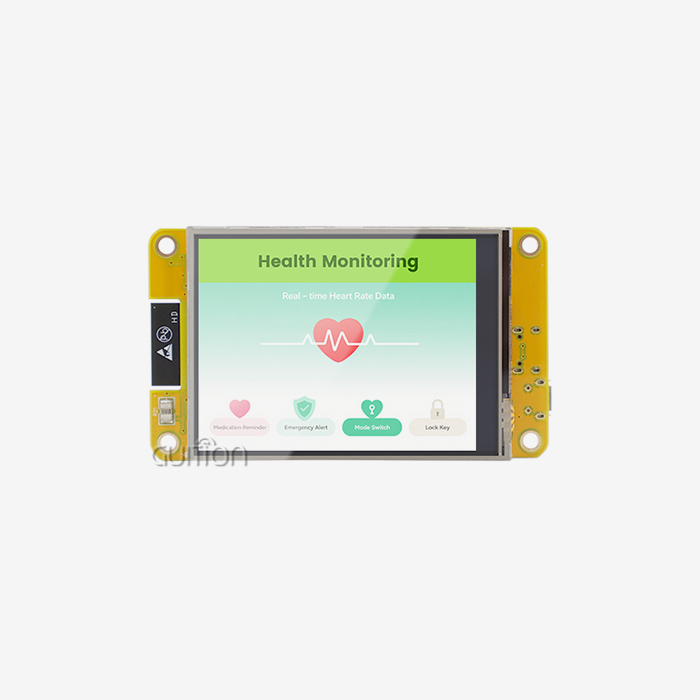
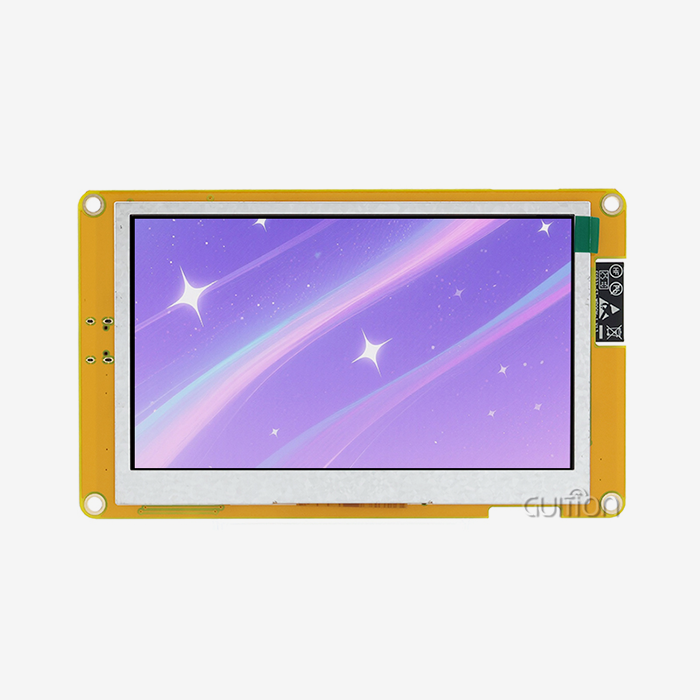
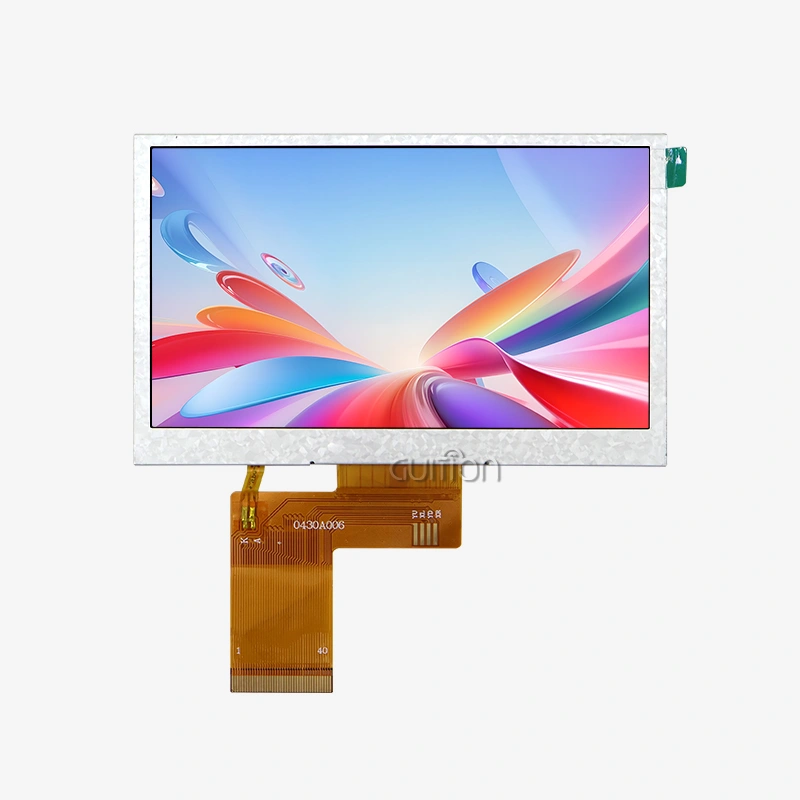
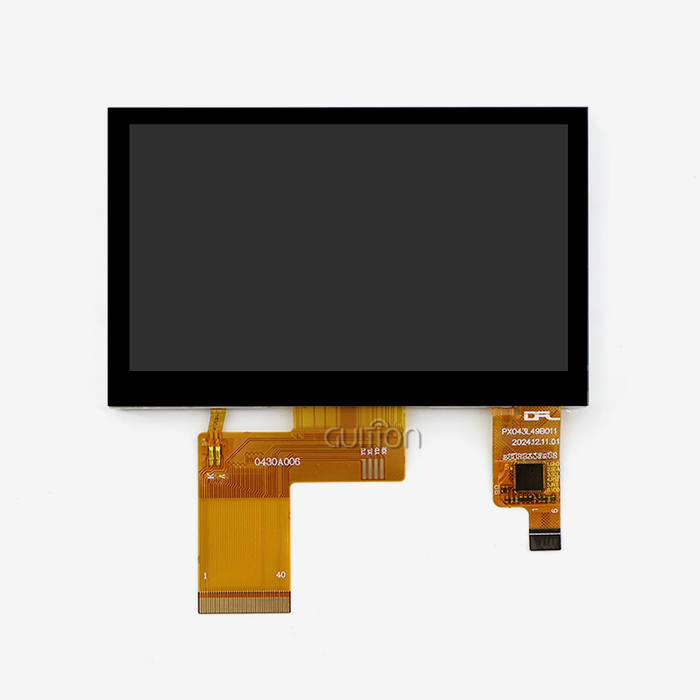
- Display size and resolution: With a 4.3-inch screen and a resolution of 480x272, the Guition JC4827W543C_I is perfect for small industrial panels and medical devices that need to save room. Guition's catalog has sizes from 1.28" to 21.5" to meet all of your application needs.
- Processing power: The ESP32-S3R8 has two cores running at 240 MHz, 8 MB of PSRAM, and 4 MB of Flash. It can handle both UI display and sensor data processing at the same time without any frame drops, even in energy management screens with a lot of data.
- Development environment compatibility: The JC4827W543C_I works with the Guition graphic programming tool, the Arduino IDE, ESP-IDF, and MicroPython. Engineers pick the setting that works best for their current workflow. This makes the training process much faster.
- Connectivity options: The ESP32-S3 module has built-in WiFi and Bluetooth, which lets you log data to the cloud, communicate with mobile apps, and get Over-the-Air (OTA) updates without any extra hardware. For IoT-connected devices and tracking sites far away, this is important.
- Expandable storage: The built-in TF card slot lets you keep more than just 4 MB of data. This includes large font libraries, background images, and data logs, making it possible to launch in multiple languages across global markets.
These factors together tell you if a display module will work with your product through different hardware versions. Once the technical fit is confirmed, check the supplier's dependability by looking at the quality of the documentation, the time it takes to get samples, and how quickly they answer technical questions. Guition offers dedicated engineering support in all of these areas.
Future Prospects and Optimization of Serial HMI Displays in Industry
The Serial HMI display category is changing along with automation trends in general, and the trend is toward better integration rather than replacement by a single rival technology, with esp32 display module solutions becoming part of this broader development.
Integration with IoT and Industry 4.0
There are already display units with WiFi built in, such as the JC4827W543C_I, that connect local user interfaces to cloud SCADA systems. As MQTT and HTTP become common in industrial data infrastructure, having a display that can directly connect to TCP/IP networks gets rid of a whole layer of translation.
Multi-Language Support for Global Deployment
With UTF-8 support, Guition's firmware image can change between English, Spanish, Mandarin, and other languages while it's running. For OEMs that ship to more than one area, this gets rid of the need to keep up with different firmware branches for each market, which saves a lot of money when thousands of units are used.
OTA Upgrades Reducing Lifecycle Costs
When you upgrade a project remotely over WiFi, changes to the protocol, UI, or new language packs can reach deployed units without having to go there in person. This feature usually saves more in upkeep costs over the five to ten years that a product is used than the difference in module price between a connected and a non-connected display at the start.
Conclusion
At every stage, from wiring and firmware development to long-term maintenance, a Serial HMI display makes the machine interface simpler. It is a 4.3-inch ESP32 Display Module that works with Arduino, ESP-IDF, and MicroPython right out of the box and has a 240 MHz dual-core processor, built-in WiFi/Bluetooth, sensitive touch, and a powerful visual development tool. This design saves time and money by letting you make prototypes faster, fix bugs more quickly, and lower the cost of field service. It works for industrial control screens, medical monitors, and smart home devices...
FAQ
What communication protocols does a serial HMI display support?
Most UART HMI modules, like Guition devices, can handle TTL, RS232, and RS485 output levels at baud rates that can be set between 9600 and 921600 bps. This means that they can work with almost all PLCs and MCUs on the market.
Can a serial HMI display work alongside Ethernet systems?
Yes. Models with WiFi, like the JC4827W543C_I, connect to Ethernet networks through a wireless access point. This lets them work with SCADA or cloud platforms even though they don't have an Ethernet port on the module itself.
How do I update the UI project on the display?
You don't have to physically access deployed hardware to load updated projects. Instead, you can use Guition's OTA upgrade feature to push them over WiFi or load them via TF card when the machine is turned on.
Is resistive touch reliable in industrial environments?
Because resistive touch only reacts to pressure from gloves, styluses, or any pointed object, it can't be affected by electrical noise. It is the best choice for plant areas and medical equipment where PPE is required for operators.
What development environments are compatible?
The JC4827W543C_I works with Arduino IDE, ESP-IDF, MicroPython, and the Guition drag-and-drop UI tool, so engineers can choose the one that works best for them.
Partner with Guition for Your Next Serial HMI Display Project
When it comes to Serial HMI displays, Guition makes them in sizes ranging from 1.28" to 21.5" and offers engineering help and reliable production that B2B teams rely on. The JC4827W543C_I comes with test apps already installed, so your team can start testing it as soon as it gets there. Email our team at david@guition.com to get samples, pricing information, or a technical consultation that is specifically made for your needs. Let's get your project going.
References
1. Harrington, R. Industrial Automation Handbook: HMI and SCADA Systems. ISA Press, 2019.
2. Bolton, W. Programmable Logic Controllers, 6th ed. Newnes/Elsevier, 2015.
3. Parr, E. A. Industrial Control Handbook, 3rd ed. Butterworth-Heinemann, 1999.
4. National Instruments. Fundamentals of Industrial Communications: Serial, USB, and Ethernet Protocols. NI Technical Publications, 2020.
5. Berges, M. et al. "Enhancing Electricity Audits in Residential Buildings with Bidirectional Metering Infrastructure." Journal of Industrial Engineering and Management, 2014.
6. IEC 61131-3 Standard. Programmable Controllers — Part 3: Programming Languages. International Electrotechnical Commission, 2013.
Learn about our latest products and discounts through SMS or email