- English
- French
- German
- Portuguese
- Spanish
- Russian
- Japanese
- Korean
- Arabic
- Greek
- German
- Turkish
- Italian
- Danish
- Romanian
- Indonesian
- Czech
- Afrikaans
- Swedish
- Polish
- Basque
- Catalan
- Esperanto
- Hindi
- Lao
- Albanian
- Amharic
- Armenian
- Azerbaijani
- Belarusian
- Bengali
- Bosnian
- Bulgarian
- Cebuano
- Chichewa
- Corsican
- Croatian
- Dutch
- Estonian
- Filipino
- Finnish
- Frisian
- Galician
- Georgian
- Gujarati
- Haitian
- Hausa
- Hawaiian
- Hebrew
- Hmong
- Hungarian
- Icelandic
- Igbo
- Javanese
- Kannada
- Kazakh
- Khmer
- Kurdish
- Kyrgyz
- Latin
- Latvian
- Lithuanian
- Luxembou..
- Macedonian
- Malagasy
- Malay
- Malayalam
- Maltese
- Maori
- Marathi
- Mongolian
- Burmese
- Nepali
- Norwegian
- Pashto
- Persian
- Punjabi
- Serbian
- Sesotho
- Sinhala
- Slovak
- Slovenian
- Somali
- Samoan
- Scots Gaelic
- Shona
- Sindhi
- Sundanese
- Swahili
- Tajik
- Tamil
- Telugu
- Thai
- Ukrainian
- Urdu
- Uzbek
- Vietnamese
- Welsh
- Xhosa
- Yiddish
- Yoruba
- Zulu
Custom LCD Display Module Cost: What Affects Pricing?
Pricing a custom LCD display module is rarely straightforward. The final cost reflects a layered combination of panel technology, resolution, size, interface complexity, order volume, and supplier capabilities. Whether you are an embedded engineer sourcing components for an industrial HMI panel or a product manager planning a smart appliance line, understanding what drives display module pricing gives you a real edge during procurement. This guide breaks down each pricing variable clearly so you can make confident, budget-aligned decisions — and avoid costly surprises down the line.

Material and Technical Factors Driving Cost Variability
Technology selection is one of the most consequential cost levers in any Custom LCD display module project.
LCD Technology Type: TN vs. IPS vs. VA vs. OLED
TN panels are the most affordable, but they deliver narrow viewing angles and lower color accuracy. IPS panels offer wide viewing angles and precise color reproduction, making them popular in medical monitoring and smart home devices — but they cost noticeably more. VA panels occupy a middle ground, offering strong contrast ratios suited for energy management displays. OLED modules provide superior contrast and thinness but carry the highest unit cost and shorter operational lifespan under continuous industrial use. Choosing the right technology means balancing application demands against budget realities.
Resolution, Size, and Touch Integration
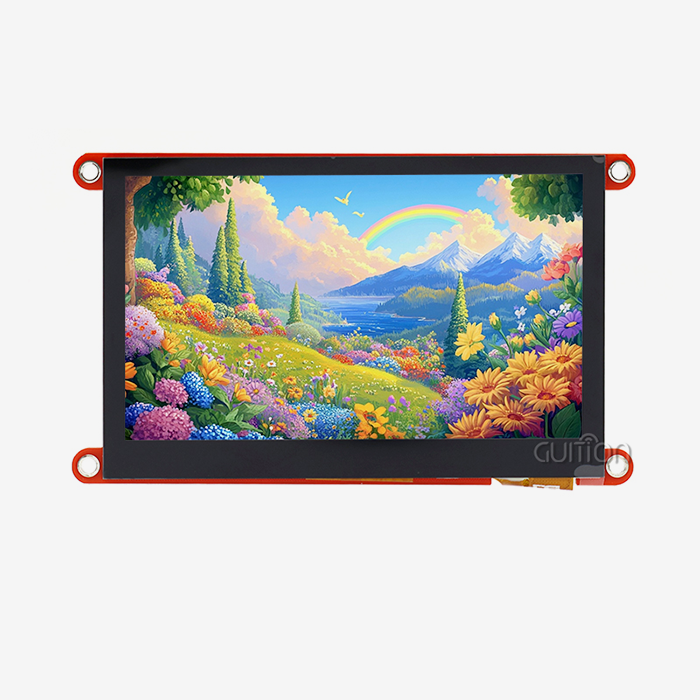
Screen size and resolution share a direct relationship with manufacturing complexity. A 7-inch panel at 800×480 resolution, such as the GUITION ESP32-8048S070N, represents a well-tested price-performance point widely used in industrial control panels and smart appliance interfaces. Larger panels — approaching 15" or 21.5" — introduce significantly higher glass, backlight, and driver IC costs. Capacitive touch panels (CTP) add more to the bill than resistive touch (RTP), but they deliver better responsiveness and glove-touch compatibility essential in medical environments. Non-touch configurations, like the ESP32-8048S070N, reduce unit cost while still meeting the needs of applications where touch input is unnecessary.
Environmental durability requirements also affect pricing. Modules rated for wide operating temperatures (-30°C to +85°C), anti-glare (AG) coatings, IP67/IP68 sealing, or high-brightness backlights (1500+ nits for sunlight readability) each add measurable cost. These specifications are non-negotiable in automotive, marine, and outdoor kiosk deployments.
Manufacturing and Supply Chain Influences on Pricing
Production dynamics and sourcing strategy have an equally significant impact on what you ultimately pay per unit for a Custom LCD display module.
Order Volume: Samples to Bulk Procurement
Unit pricing drops substantially as order volumes increase. Sample orders typically carry the highest per-unit cost due to engineering setup, firmware pre-loading, and manual inspection. Moving from prototype quantities to production volumes of 500+ units can reduce per-unit costs by 20–40%, depending on the supplier's manufacturing capacity and tooling amortization. Lead times also compress with established volume commitments, which is critical for teams managing tight product launch windows.
OEM vs. ODM: Sourcing Risk and Cost Trade-offs
OEM partnerships allow you to specify every module detail — interface pinouts, bezel dimensions, firmware configuration — but require higher minimum order quantities and longer development cycles. ODM solutions use pre-engineered platforms that you can brand and lightly customize, reducing NRE (non-recurring engineering) costs and shortening time-to-market. Guition's approach as a manufacturer and ODM supplier offers a flexible middle path: pre-validated hardware platforms with deep secondary development support, so teams can customize without rebuilding from scratch.
Supplier reputation, warranty terms, and after-sales technical support are costs that rarely appear in the initial quote but materially affect total project expenditure. A supplier offering cross-platform documentation, remote debugging support, and OTA upgrade capability — as Guition does through its proprietary development software — reduces downstream engineering hours significantly.
Market and Procurement-Related Cost Drivers
The global LCD module market was valued at approximately $65 billion in 2023 and continues to grow, driven by industrial automation and IoT adoption. Within this market, Custom LCD display modules command a premium over standard modules — typically 15–40% higher — due to tooling, engineering customization, and quality validation overhead.
Pricing benchmarks in 2024 show that a well-specified 7-inch Custom LCD display module with integrated MCU, Wi-Fi, Bluetooth, and 800×480 resolution — comparable to the GUITION ESP32-8048S070N — sits at a competitive price point for development and mid-volume production. The ESP32-8048S070N integrates the ESP32-S3-WROOM-1 dual-core MCU running at 240MHz, 8MB PSRAM, 16MB Flash, and supports Arduino IDE, ESP-IDF, MicroPython, and Mixly. This level of integration at a single module price point consolidates what would otherwise require separate MCU, display, wireless, and storage components.
When evaluating total procurement cost, factor in shipping terms (DDP vs. FOB), import duties, sample flexibility, and the availability of free technical consultation. Suppliers who provide working sample programs, one-click firmware download tools, and documented API libraries reduce your engineering labor cost — which often exceeds the hardware cost itself on complex projects.
Practical Tips for Optimizing Custom LCD Display Module Costs
Procurement teams can take concrete steps to reduce Custom LCD display module costs without sacrificing performance requirements. Here are several strategies worth embedding into your sourcing process:
- Match specifications to application needs. Selecting a non-touch 7-inch module like the ESP32-8048S070N for control panels that use physical buttons instead of touch input eliminates CTP cost entirely, while the integrated TF card slot and reserved IO interfaces still provide full expandability.
- Leverage integrated platforms. Modules that bundle the MCU, wireless connectivity, display driver, and storage into a single validated design — as Guition's ESP32-8048S070N does — dramatically reduce BOM complexity and PCB real estate, cutting both unit cost and integration risk.
- Negotiate based on lifecycle volume, not just the initial order. Sharing your 12-month forecast with your supplier creates room for volume pricing agreements even when initial orders are modest.
- Request OEM/ODM customization proposals early. Custom LCD display module suppliers can often accommodate mechanical or firmware customization at low incremental cost when engaged during the design phase rather than after tooling is set.
These approaches help teams avoid the most common pitfall: underestimating hidden integration costs. Certification overhead (CE, FCC, RoHS), firmware porting, and display calibration can collectively exceed the module hardware cost if the chosen supplier lacks comprehensive documentation and cross-platform SDK support.
Conclusion
Custom LCD display module pricing reflects the sum of technology choices, manufacturing scale, supply chain structure, and supplier capability. Procurement professionals who understand these variables can negotiate more effectively, scope projects more accurately, and select display partners who deliver genuine long-term value. Modules like the GUITION ESP32-8048S070N demonstrate how thoughtful platform integration — combining a dual-core MCU, wireless connectivity, multi-platform development support, and expandable storage — can optimize cost-per-feature while maintaining industrial-grade reliability.
FAQ
How much does a Custom LCD display module typically cost?
Pricing varies widely based on size, technology, volume, and customization scope. A 7-inch module with integrated MCU and wireless capability at development quantities may range from $20 to $60 per unit. Production volumes above 500 units typically reduce this cost by 20–40%. Always request itemized quotes that separate panel, firmware, tooling, and support costs.
Does customization always increase lead time?
Not necessarily. Suppliers offering pre-validated ODM platforms with secondary development support — such as Guition — can deliver customized LCD display modules faster than full custom builds. Firmware customization on an established hardware platform like the ESP32-8048S070N adds days, not weeks, compared to ground-up hardware design.
Can budget-tier LCD modules handle industrial or outdoor environments?
Standard-grade modules are not rated for extreme temperatures, UV exposure, or impact resistance. Industrial applications require wide-temperature panels, tempered cover glass, and appropriate IP ratings. Choosing a lower-cost module without verifying these specifications can result in field failures and costly recalls. Always confirm environmental ratings against your deployment conditions before finalizing supplier selection.
Get a Custom LCD Display Module Quote from Guition Today
Guition's engineering team is ready to help you source the right Custom LCD display module supplier solution for your project. The ESP32-8048S070N is available for sample evaluation, with full development documentation, Arduino/ESP-IDF/MicroPython support, and direct technical consultation. Contact Us at david@guition.com to request your free quote and explore how Guition's display solutions can accelerate your next product launch.
References
1. IHS Markit (S&P Global). (2023). Touch Panel Technology Report: CTP vs. RTP Cost and Performance Analysis. S&P Global. https://www.spglobal.com/marketintelligence/en/
2. IEEE Spectrum. (2022). Engineering Display Systems for Harsh Environments: IP Ratings, Temperature Tolerance, and Optical Bonding. IEEE. https://spectrum.ieee.org/
3. Embedded Computing Design. (2024). OEM vs. ODM in Embedded Display Procurement: Cost, Risk, and Time-to-Market Trade-offs. Embedded Computing Design. https://www.embeddedcomputing.com/
4. Grand View Research. (2024). LCD Module Market Size, Share & Trends Analysis Report, 2024–2030. Grand View Research. https://www.grandviewresearch.com/industry-analysis/lcd-module-market
5. Electronic Design. (2023). Selecting the Right MCU-Integrated Display Module for IoT and HMI Applications. Electronic Design. https://www.electronicdesign.com/
Learn about our latest products and discounts through SMS or email