- English
- French
- German
- Portuguese
- Spanish
- Russian
- Japanese
- Korean
- Arabic
- Greek
- German
- Turkish
- Italian
- Danish
- Romanian
- Indonesian
- Czech
- Afrikaans
- Swedish
- Polish
- Basque
- Catalan
- Esperanto
- Hindi
- Lao
- Albanian
- Amharic
- Armenian
- Azerbaijani
- Belarusian
- Bengali
- Bosnian
- Bulgarian
- Cebuano
- Chichewa
- Corsican
- Croatian
- Dutch
- Estonian
- Filipino
- Finnish
- Frisian
- Galician
- Georgian
- Gujarati
- Haitian
- Hausa
- Hawaiian
- Hebrew
- Hmong
- Hungarian
- Icelandic
- Igbo
- Javanese
- Kannada
- Kazakh
- Khmer
- Kurdish
- Kyrgyz
- Latin
- Latvian
- Lithuanian
- Luxembou..
- Macedonian
- Malagasy
- Malay
- Malayalam
- Maltese
- Maori
- Marathi
- Mongolian
- Burmese
- Nepali
- Norwegian
- Pashto
- Persian
- Punjabi
- Serbian
- Sesotho
- Sinhala
- Slovak
- Slovenian
- Somali
- Samoan
- Scots Gaelic
- Shona
- Sindhi
- Sundanese
- Swahili
- Tajik
- Tamil
- Telugu
- Thai
- Ukrainian
- Urdu
- Uzbek
- Vietnamese
- Welsh
- Xhosa
- Yiddish
- Yoruba
- Zulu
1.28 inch ESP32 display module Buying Guide for OEM Projects
If you are sourcing a 1.28 inch esp32 display module for an OEM project, this guide is written for you. Whether you manage procurement for an industrial equipment manufacturer, run R&D at a medical device startup, or integrate automation systems, selecting the right compact display module directly affects your product's time-to-market, reliability, and total engineering cost. This guide walks you through technical specifications, selection criteria, procurement strategy, integration steps, and market options — so you can move from research to purchase with confidence.

Understanding 1.28 Inch ESP32 Display Modules: Specs & Features
Core Technical Specifications
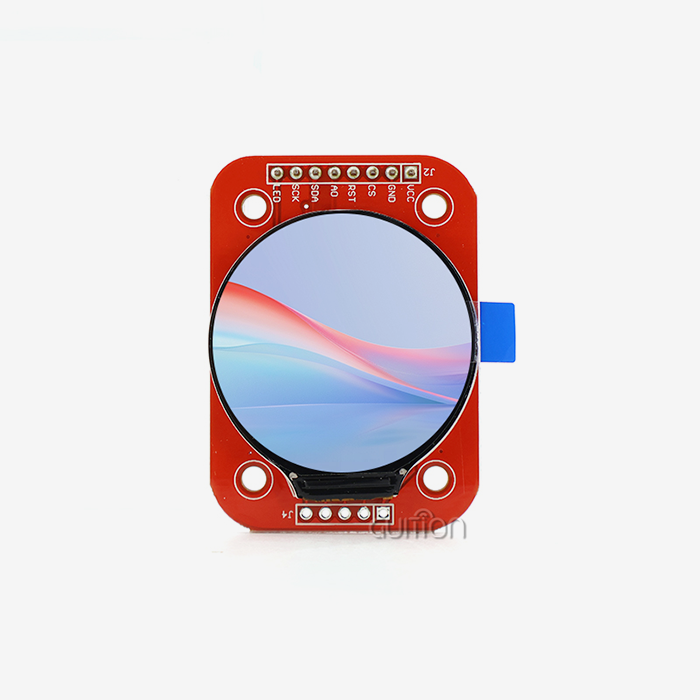
An Espressif ESP32 microprocessor and a circle IPS LCD panel are combined in a single integrated unit to form the 1.28 inch ESP32 display module. This guide, ESP32-2424S012C_I_Y(B), works on the ESP32-C3-MINI-1U, a 160MHz single-core MCU with 400KB SRAM, 384KB ROM, and 4MB Flash. The screen has a size of 240x240 pixels and a color depth of 16 bits (65K RGB), so images are clear and viewing angles are more than 160 degrees. The brightness is usually between 350 and 450 nits, which means that material can be read in most urban settings.
Communication Protocols and Connectivity
The module uses SPI to drive the LCD screen so that it can refresh quickly, and I2C to let the CST816S controller handle capacitive touch input. Wi-Fi and Bluetooth 5.0 BLE are built right into the ESP32-C3 chip, so you don't need any extra wireless units. With this dual-mode wireless feature, your product can connect to a home network, send over-the-air firmware updates, and talk to mobile apps, all without the need for extra hardware.
Supported Development Environments
This 1.28 inch ESP32 display module has a wide range of applications, which is one of its useful advantages. It works with MicroPython, Mixly, Arduino IDE, and ESP-IDF. Guition's own software for UI design has drag-and-drop controls that let engineers make interfaces without having to write low-level graphics code. With factory-preloaded test software, you can check the display as soon as you get the unit, which cuts down on the time needed for initial hardware proof.
How to Choose the Best 1.28 Inch ESP32 Display Module for Your Project
Match Display Technology to Your Use Case
IPS TFT panels, like the one in the GUITION ESP32-2424S012C_I_Y(B), show colors accurately from a lot of different angles. This makes them better than OLED panels in situations where people are viewing the screen from different angles. When the lighting is low, OLED screens use less power, but they break down faster over time and don't work well when there is a lot of light around. An IPS module with 400+ nits output is the more reliable choice for industrial control panels, medical monitors, and devices that will be used outside.
Evaluate Environmental and Power Requirements
Before deciding on a supplier, make sure that the operating temperature range of the module fits with the temperature range where it will be used. From -20°C to +70°C, industrial-grade modules should work reliably. It can be used for battery-powered wearables and portable diagnostic tools because it has a lithium battery charging circuit with overcharge and overcurrent protection. Check that the module's deep sleep current doesn't go over your power limit. Well-designed units use less than 10µA when they're in deep sleep mode.
Assess Supplier Documentation and Support Quality
There are a lot of engineering teams that lose weeks because of bad documentation. Complete pinout diagrams, working Arduino library examples, driver source code, and quick technical support are all things that a trustworthy 1.28 inch ESP32 display module supplier should offer. GUITION gives you a full secondary development package with sample programs and library functions. This way, your team can change how things work without having to start from scratch and write the software stack.
Procurement Considerations: Securing Your 1.28 Inch ESP32 Display Modules
Wholesale Pricing and Bulk Order Strategy
When buying in bulk for OEMs, the unit price drops significantly. Request tiered prices for quantities of 100, 500, and 1,000 units when considering a 1.28 inch ESP32 display module provider. Instead of just looking at the unit price, you should also look at the total landed cost, which includes shipping, import taxes, and packing. GUITION is both a maker and a direct seller, which means that the markup is usually lower than with multi-tier distribution.
Supply Chain Reliability and Lead Times
When you have a set production schedule, knowing how much stock you have and how long the lead time will be is more important than price alone. Ask potential providers what the smallest order size is, how long the wait time is on repeat orders, and if they keep key parts in stock as a safety measure. Professional-grade modules usually go through a 48–72 hour burn-in test at 50°C as part of their quality control process. This tests for early failures before they are shipped.
Quality Assurance and Warranty Terms
In the industrial OEM buying process, buyers should ask for proof of quality control methods. Dead pixel analysis on the 240x240 matrix, touch coordinate accuracy across the circular panel edge, and RF antenna impedance verification at 50 ohms are some of the most important checks for a 1.28 inch ESP32 display module. Before you place a large order, make sure the supplier has a clear warranty policy that covers manufacturing defects and that you understand how to return or replace items.
Step-by-Step Guide: Integrating 1.28 Inch ESP32 Display Modules into Your OEM Projects
Hardware Setup and Pinout Configuration
First, carefully read through the module's pinout documentation. The ESP32-2424S012C_I_Y(B) GUIDE shows the SPI (display), I2C (touch), power, and GPIO port connections. Before turning it on, make sure the logic level is compatible with your host system and connect power through the voltage rails that were given. Most hardware damage during initial integration is caused by voltage levels that don't match up.
Recommended Libraries and Sample Code
The TFT_eSPI tool is a good place to start for static UI layouts because it is fast and works with a lot of drivers. LVGL is the usual graphics library for animated or data-heavy interfaces, and it works well with the ESP32-C3's DMA features to make frame changes smooth. The GUITION development software adds a visual layer on top, letting designers make screens by dragging and dropping elements before sending them to firmware. This is especially helpful for teams where the UI designer and embedded engineer are not the same person.
Testing and Validation Before Production Scale
Run practical tests that check the refresh rate, the accuracy of touches across the whole circle panel, and the wifi connection when it's busy. Touch coordinate drift near the circle border is a common place where things go wrong. Make sure that the CST816S firmware hides the coordinate map to the circle radius to stop false inputs. Before locking down your production software version, test over-the-air (OTA) update delivery over Wi-Fi. Being able to change devices remotely is a big plus for long-term support for devices that are already in use.
Top 5 1.28 Inch ESP32 Display Modules on the Market
The market for small ESP32 display units has grown, and OEM projects should look at a number of choices. Here is an unbiased look at five models based on their specs, ecosystem support, and ability to work with OEMs.
- GUITION ESP32-2424S012C_I_Y(B): This 1.28 inch ESP32 display module runs on the ESP32-C3-MINI-1U at 160MHz with a 240×240 IPS panel, capacitive touch, Wi-Fi, and Bluetooth. It stands out for its multi-IDE support (Arduino, ESP-IDF, MicroPython, Mixly), Guition UI software, OTA upgrade capability, and integrated battery management. It is the most complete option for OEM teams that need fast iteration and long-term remote maintainability.
- Waveshare ESP32-S3 1.28" Round LCD: Based on the ESP32-S3 with PSRAM, this module targets developers who need more memory headroom for LVGL-intensive UIs. Documentation is good, but the development software ecosystem is thinner than GUITION's.
- M5Stack M5Dial: A polished circular display module with a rotary encoder, suited for consumer product prototyping. It is less optimized for high-volume OEM manufacturing due to its premium retail pricing.
- LilyGO T-Watch S3: Designed as a smartwatch platform, this unit bundles a 1.28" round display with wearable-focused peripherals. It is strong for wearable OEM but less flexible for industrial panel applications.
- Seeed Studio XIAO ESP32C3 + GC9A01 Display Combo: A modular approach popular among makers and small-batch OEM builds. Integration requires more engineering effort since the MCU and display are separate components without a unified software layer.
Each choice is good for a different group of people. The GUITION model covers more ground than any other option for teams looking for a 1.28 inch ESP32 display module with built-in OTA support, multilingual support, and a dedicated UI design tool for accelerated product cycles.
Conclusion
Processor power, screen quality, wifi support, and provider support must all be considered when selecting the best 1.28 inch ESP32 display module for an OEM project. With its 160MHz ESP32-C3-MINI-1U core, 240x240 IPS screen, dual-mode wifi, and flexible multi-IDE development support, the GUITION ESP32-2424S012C_I_Y(B) takes care of all of these issues. If reliability and quick iteration cycles are important to procurement teams, this module is a technically sound and commercially sensible choice. Get in touch with GUITION right away to start your review.
FAQ
What graphics library works best with a 1.28 inch ESP32 display module?
A lot of people use TFT_eSPI for static interfaces because it works quickly with SPI-driven screens. LVGL uses DMA on the ESP32-C3 to handle frame buffering well for dynamic or data-heavy UIs. The Guition program from GUITION adds a no-code UI layer on top for teams that don't want to do any graphics writing by hand.
How do I prevent touch inaccuracy near the edges of a round display?
The firmware needs to be calibrated. To make the CST816S capacitive controller work in a circle, its coordinate map needs to be hidden. If you don't mask this area, the controller reports ghost touches from the corners of the bezel that aren't on the visible round panel.
Can this module run on a LiPo battery?
Yes. The GUITION ESP32-2424S012C_I_Y(B) has a lithium battery charging circuit built in that protects against overheating and overcurrent. This means that it can be used straight with 3.7V LiPo cells.
Does the display work for outdoor applications?
The 240x240 IPS panel has good readability indoors and wide viewing angles. If you want to use the module outside in bright conditions, make sure the module's luminance rating is higher than 400 nits and set the backlight PWM to maximum duty cycle.
Partner With Guition for Your OEM Display Needs
The ESP32-2424S012C_I_Y(B) from GUITION is a tried-and-true 1.28 inch ESP32 display module that is used by OEM teams in medical devices, smart home products, and industrial automation. As a straight 1.28 inch ESP32 display module maker, GUITION offers low bulk prices, reliable supply, OTA upgrade support, and full secondary development resources. To get a price or a list of products, email the team at david@guition.com or go to https://jingcaizhineng.aixdb.cn/.
References
1. Espressif Systems. ESP32-C3 Series Datasheet. Espressif Systems, 2023.
2. Kolban, N. Kolban's Book on ESP32. Leanpub, 2022.
3. LVGL Development Team. LVGL: Light and Versatile Embedded Graphics Library — Developer Documentation. LVGL, 2024.
4. Patel, R. & Mehta, S. "Embedded HMI Design Patterns for IoT Devices." IEEE Embedded Systems Letters, 2023.
5. Grand View Research. Global Human-Machine Interface (HMI) Market Report. Grand View Research, 2024.
6. Monk, S. Programming the ESP32 with Arduino. McGraw-Hill, 2022.
Learn about our latest products and discounts through SMS or email